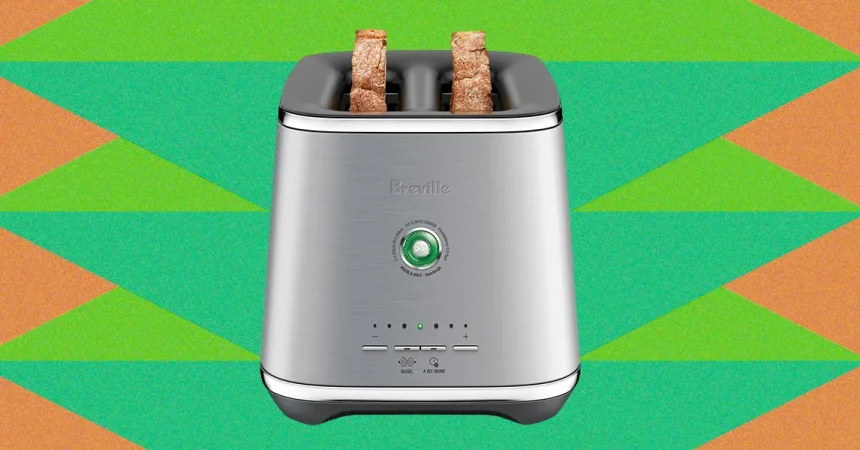
The first thing you notice about the Breville Eye Q toaster is that it doesn’t look like a toaster you’d hide under the counter when guests come over. It looks like something you’d want to show off, a small piece of culinary equipment that belongs on display. As countertop appliances go, it’s genuinely good-looking, and that’s not a small compliment. Breville has a reputation for designing products that clear the bar between function and aesthetics with ease, and the Eye Q lives up to that legacy. The “dark noir” brushed steel finish is handsome in a way that feels both modern and classic, not flashy but confident. The controls are intuitive, which matters more than you might think; there’s no fumbling with tiny knobs or cryptic symbols. You know exactly what you’re doing the moment you look at it. The ceramic-coated top is another thoughtful touch, clean and likely to stay that way over time. Traditional stainless steel tops show every fingerprint, every smudge, every splash of butter or stray crumb, but the ceramic finish feels more forgiving, more durable, and easier to wipe down after a chaotic breakfast. It’s the kind of surface that reassures you that this isn’t just a pretty face; it’s designed for real life. And that first impression matters, because a toaster sits on your counter every single day, and if it annoys you every time you look at it, that annoyance builds. The Eye Q doesn’t annoy. It invites. It makes you want to make toast, even when you’re not particularly hungry, just to watch it work. That’s the mark of a well-designed appliance: it turns a mundane chore into a small pleasure. But as with anything that looks this good, you start to wonder whether the performance can possibly match the promise. So I decided to put it through its paces, not in a lab, but in the messiest, most unpredictable environment I know: a full house of family members with different tastes, different schedules, and very strong opinions about toast.
Over the summer, I brought the Eye Q along for a couple of weeks of family time in New Hampshire. It wasn’t a controlled test or a formal review session; it was just real life, the kind of summer gathering where the kitchen becomes the center of the universe. There were often eight or more of us around the table, ranging from tweens to octogenarians, which is exactly the kind of crowd that can expose an appliance’s weaknesses. The tweens wanted their toast barely kissed by heat, the older generation wanted it sturdy and crisp enough to hold a poached egg, and everyone in between had their own particular vision of what “perfect toast” meant. What surprised me most was how intrigued everyone was by the toaster. It wasn’t just another appliance sitting on the counter; it was a conversation piece. People noticed the dark noir finish, the sleek silhouette, the thoughtful layout of the controls. Encouragingly, nobody needed coaching on how to use it. My aunt, who generally avoids anything with more than two buttons, figured it out immediately. My teenage nephew, who usually operates by instinct, never once asked for help. The toaster was accessible in a way that many high-design products aren’t; it didn’t require a manual, a YouTube tutorial, or a tech-savvy teenager to translate its functions. That ease of use is a huge part of its appeal. In a busy kitchen full of competing personalities and varying levels of patience, the last thing anyone wants is a toaster that demands a learning curve. The Eye Q simply got out of the way and did its job. Breakfast moved smoothly, toast appeared in rounds, and the conversation never had to pause for appliance troubleshooting. For that alone, I was grateful. But I also knew that a week or two of summer mornings isn’t enough to judge a toaster. The real test would come with time, with daily use, with the kind of repetition that reveals every quirk and flaw.
During the months I had it, the Eye Q almost always did an acceptable job. It wasn’t hard to get the toast right, which is more than you can say for some toasters that turn every slice into a gamble. But here’s the big but: compared to a regular toaster, the quality of the toast it made was comparable, not superior. That’s not necessarily a damning criticism, but it is a reality check. When you pay a premium for a toaster that looks like this, you hope for something magical, toast that’s somehow crispier on the inside, more golden on the outside, more evenly browned, more everything. The Eye Q didn’t deliver that magic. It made good toast, but it didn’t make transcendent toast. The more I used it, the more I noticed a pattern of unevenness. If you looked at a slice from front to back, the browning was inconsistent, and the top of the toast tended to come out darker than the bottom. It wasn’t a dramatic flaw; it was the kind of thing you’d only notice if you were paying close attention, or if you were the kind of person who likes to examine your toast before you butter it. And if you compared piece to piece, especially if you were toasting for a crowd, there were noticeable differences. One slice might be perfectly golden while its partner was a shade or two lighter, or a little too dark around the edges. These inconsistencies were the kind of thing a polite person wouldn’t complain about if you set a couple of buttery slices in front of them. Nobody would send it back. But for someone who appreciates the subtle art of toast, the unevenness was always there, lurking beneath the surface. It wasn’t a deal-breaker, but it was a disappointment, a small reminder that this handsome machine was not the perfectionist it appeared to be. I kept hoping that I was just imagining it, that the next batch would come out flawlessly, but the pattern held. The top of the toast, darker. The bottom, lighter. The edges, sometimes too crisp. The center, sometimes pale. Nothing catastrophic, just a persistent inconsistency that made me wonder if the Eye Q was more about style than substance.
The most revealing experiment came on BLT day, when I decided to take a more methodical approach. My nephew Eli, who had been eyeing the toaster with curiosity all summer, volunteered to be my intern for the afternoon. He’s the kind of kid who loves a project, especially if it involves food and the chance to press buttons. Together, we set out to test all seven settings, one after another, to see how the toaster actually behaved across its range. Eli’s job was to feed in slices of bread, press the lever down, wait for the pop, and then carefully place each finished slice on a sheet pan in the order it was toasted. Seven batches, seven settings, lined up like a toast rainbow. The results were fascinating. The lowest setting produced very light toast, the kind of bread that’s barely warmed and slightly colored, perfect for someone who wants the texture but not the crunch. Settings two and three, however, were pretty identical, which was surprising. You’d expect each click to produce a noticeable step up in darkness, but there was almost no difference between them. Settings four and five were excellent, the sweet spot for most people, with a golden brown color and a satisfying crispness. But then came setting six, which was mysteriously lighter than setting four. That made no sense. It was as if the toaster had its own opinions, its own internal logic that didn’t correspond to the numbers on the dial. And setting seven was very dark, a little burnt, the kind of toast that scrapes the roof of your mouth and leaves a lingering bitterness. Eli and I stared at the lineup, trying to make sense of it. The progression wasn’t linear; it was almost musical, with highs and lows and unexpected pauses. To be fair, two-slot toasters aren’t designed for seven back-to-back cycles of toasting. The internal thermostat gets confused, the heating elements get hotter or cooler, and the results can be erratic. But even accounting for that, the Eye Q’s performance was odd. It wasn’t unreliable exactly, just inconsistent, as if each setting was less a promise and more a suggestion. The experiment made for a fun afternoon, and Eli was proud of his toast lineup, but it also confirmed my growing suspicion that the Eye Q was a beautiful machine with a quirky personality, not a precision instrument.
When it came to bagels, the Eye Q didn’t fare particularly well. Store-bought bagels, the kind you pick up at the grocery store, are a common breakfast staple, and a toaster should handle them with grace. The Eye Q struggled. The bagels came out unevenly toasted, with some parts too dark and other parts disappointingly soft. The bagel setting, which is supposed to focus heat on the cut surface while barely toasting the outer crust, didn’t seem to make much of a difference. It was as if the toaster didn’t quite know how to handle the dense, chewy texture of a bagel, and the results were consistently underwhelming. Back in Seattle, after the family trip ended, I unpacked a new Eye Q to continue testing. That second unit had a bad habit of making lighter shades darker than most people would appreciate. The settings that should have produced gentle, pale toast instead came out brown and crispy, which would have been a problem for anyone who likes their toast barely colored. It was a noticeable flaw, not something you could shrug off. Breville, to their credit, sent another one along to close out the testing. That third unit worked fine, but it had its own quirk: it tended to get the edges a little toastier than the center. At first, this was subtle, easy to ignore, but as testing wound down, it seemed to be getting worse. The edges became increasingly dark, even burnt, while the centers remained pale and soft. It was as if the toaster was slowly losing its ability to distribute heat evenly. By the end, I found myself rotating the bread halfway through the cycle, a hack that worked but felt like too much effort for a toaster in this price range. If you’re thinking about buying one of these, perhaps watch the comments for a couple of months before pulling the trigger. Quality control seems to be an issue, and the experience can vary significantly from unit to unit. The first one was acceptable, the second was disappointing, and the third was fine but fading. That inconsistency is a red flag, especially for a product that’s supposed to be a step above the average toaster.
So where does that leave the Breville Eye Q? It’s a toaster that looks wonderful and is a joy to have on the counter, the kind of appliance that elevates the whole kitchen aesthetic. It’s easy to use, intuitive, and welcoming to everyone from kids to grandparents. It makes decent toast, and for most people, most of the time, it will be perfectly fine. But it doesn’t deliver the superior performance its appearance promises, and its consistency leaves something to be desired. The uneven browning, the strange behavior across settings, the issues with bagels, and the variation between units all suggest that this is a product still finding its footing. If you value design above all else, the Eye Q might be worth the risk; it really is that beautiful. But if you want a toaster that you can set and forget, one that delivers reliably even toast every single morning, you might be better served by something more basic, less glamorous, and more dependable. The Eye Q is a reminder that good looks aren’t everything. It’s a charming companion, a conversation starter, a beautiful object that happens to make toast. But in the end, it’s still a toaster, and the most important thing a toaster can do is toast evenly and consistently. The Eye Q, for all its style, doesn’t quite master that. It’s a product with potential, but it’s also a product that asks you to compromise, to accept its quirks, to work around its flaws. For some, that’s a reasonable trade-off. For others, it will be a frustration. My advice? Wait, watch the reviews, see if Breville smooths out the kinks. There’s a great toaster hiding inside this handsome shell, but it hasn’t fully emerged yet. Until then, I’ll keep using mine, but I’ll also keep a close eye on it, ready to intervene when the edges start to burn or the settings go their own way. That’s not the kind of relationship you want with a toaster, but with the Eye Q, it’s the one you get.