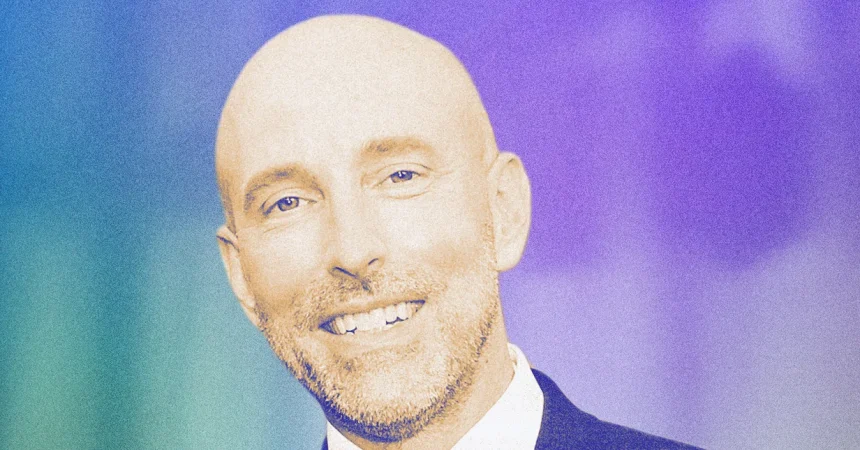
Brian K. Vaughan has spent more than three decades moving between the worlds of comics, television, and film, but if you ask him where his heart truly lives, there is no hesitation: it is still in comics. There is something almost paradoxical about that, because on paper he looks like exactly the kind of writer who might have left the four-color page behind for the seductive glow of Hollywood. He has written for shows that people love, worked with some of the most imaginative directors in the business, and seen his own comics turned into cultural events. And yet, when he talks about his work, you get the sense that comics are not a launching pad for him. They are the ground he stands on. He laughs at the idea that anyone would see his career as a kind of slow-motion departure. “I think sometimes people are like, ‘Oh, are you just going to sell out, Vaughan? Are you just going to go to Hollywood full-time?’” he says. The question doesn’t seem to bother him much, but he answers it with the quiet certainty of someone who knows exactly who he is. “But I’m only able to do work in Hollywood because I have comics.” That sentence says everything. Comics are not the thing he does when he is waiting for the phone to ring. Comics are the thing that made the phone ring. They are the source, the foundation, the place where his voice was shaped and where his imagination still returns. There is a kind of humility in that, too, a reminder that the flashy world of adaptation and development is built on the quiet, patient work of putting one page after another, trusting that a story will find its readers.
That deep attachment to the form is especially visible when he talks about Roam, his forthcoming comic with the brilliant artist Cliff Chiang. He is careful not to reveal too much, and that is completely intentional. Roam is, he says, “completely unlike Paper Girls, completely unlike anything I’ve ever done.” That alone would make it intriguing, but then he offers a logline that feels both enormous and strangely intimate: in the distant, distant future, everyone gets to be a superhero, but only while they are young. It’s one of those ideas that sounds simple until you start to think about what it actually means, about the way youth is a kind of superpower in itself, about the inevitability of growing into ordinary life, about the ache of leaving behind a time when the world felt infinite. Vaughan is deliberately keeping the details close to the chest, and that restraint isn’t coyness. It’s an artistic choice. He remembers seeing The Matrix for the first time without knowing a single thing about it, and the pure, electric joy of being caught completely off guard. “I have no idea what the fuck it was gonna be about,” he says. “That was such a delight. So we’re trying to do that here.” The comparison is telling, because The Matrix was not just a movie; it was a rupture, a moment where the rules of storytelling suddenly seemed to bend. Vaughan wants Roam to feel like that, to drop readers into a world that is strange enough to disorient them but human enough to make them care. He has been doing this for thirty-one years, longer than many of his readers have been alive. He started as a teenager, writing his first stories before he had any idea what the industry really demanded. Over the years, he has left his fingerprints on a wide range of characters and genres, from a Spider-Man story here and there to a little Batman, to Ex Machina, his sci-fi political comic that deconstructed the entire idea of superheroes. But Roam is different. It is, he says, “certainly my first true superhero book.” That is a strange thing to hear from someone who has written superheroes before, but it makes sense if superheroism, in his hands, has always been a metaphor, a way of exploring power and responsibility rather than a genre to be embraced on its own terms. Roam seems to be his attempt to strip away the irony and the deconstruction and to engage with superheroes as a genuinely visionary idea, one that can still produce wonder in a world that thinks it has seen everything.
But for all his excitement about the future, Vaughan is also looking at that future with real fear, and he isn’t afraid to say so. When the subject of AI comes up, his tone shifts. It is not the measured enthusiasm of a creator discussing a new collaboration. It is the honest worry of someone who has spent his whole life making things with his own hands and now sees those things being automated in real time. “It’s terrifying,” he says plainly. He thinks about his friends who work in previsualization and as storyboard artists, people who turn scripts into visual blueprints, who help directors see the movie before it exists. Those jobs are going away. He has heard about editors going away as well. The cruel irony is that this is happening at a time when the demand for visual storytelling has never been higher. But show business, as Vaughan points out, is a business, first and foremost. The point is not to make art or to preserve craft; the point is to deliver product at the lowest possible cost. He knows he is in a strange position, protected by years of reputation and relationships, by having been “grandfathered in” to an industry that still depends on his name and his particular voice. But there is no comfort in that, because he can see what is coming for the people behind him, the younger writers and artists who are trying to get their first big break, who are trying to build the kind of career that he was able to build. He holds onto the belief that there will always be people who are interested in bespoke, human-made stories, stories that come from a single person’s messy, contradictory, miraculous brain. But he also understands that the future is “terrifying and unknowable, and coming at us very, very quickly.” There is no nostalgia in the way he says it, no moral panic. It is just the clear-eyed assessment of someone who has learned to watch trends come and go, who knows that the old guarantees no longer hold.
There is something almost reassuring, though, in hearing how personal his disgust with AI is. It’s not just an abstract anxiety about the economy or the future of art; it’s a visceral, bodily revulsion that he shares with his family. He has two teenagers, and they are, in his words, “so disgusted by AI and grossed out if they ever hear I used it.” He is quick to add that he certainly has never used it for anything creative. That matters. It would be easy for a writer with his status to dabble, to use AI as a kind of elaborate toy, a way of generating ideas or overcoming writer’s block. But Vaughan understands that once you cross that line, you are saying something about your own craft, about whether the work actually needs you, about whether the hours of sitting alone with your own thoughts are worth anything at all. His teenagers’ reaction is a reminder that the younger generation, the people who are supposedly digital natives, are not uniformly embracing this technology. Many of them see it for what it is: a shortcut that degrades the very thing it claims to create. Vaughan’s anxiety is even sharper when he imagines what happens next. He talks about the day when someone might say, “I’m tired of waiting for the next issue. Give me the next issue of Saga.” On the surface, that sounds like a fans’ dream, a world where beloved comics are never late, where the story you love is always just a prompt away. But Vaughan knows that what that person is really asking for is not a story. It’s a distraction. It’s content. It’s the appearance of Saga without the soul of Saga. The next issue of Saga is the result of years of lived experience, of thinking, of struggling with what characters mean, of working closely with an artist like Fiona Staples to make every page feel alive. An AI-generated version might look like Saga, even read like Saga superficially, but it would not be Saga. It would be a hollow reproduction, a simulation of creativity that offers the comfort of familiarity without the risk of genuine expression. Vaughan is not saying that readers are stupid for wanting more of what they love. He is saying that the desire for easy, endless output is exactly the opposite of what art is supposed to do. Art asks you to wait, to sit with uncertainty, to trust that the creator is taking you somewhere you didn’t expect. AI promises to take you nowhere new at all; it only gives you more of what already exists.
The deeper question underneath all of this is why comics still matter to Vaughan, why he hasn’t simply walked away. Part of the answer is that comics are a medium defined by collaboration, and collaboration is impossible to automate in any meaningful way. A writer and an artist sitting together, looking at a page, arguing about a gesture or a piece of dialogue, trying to make something that neither of them could have made alone—that is the opposite of AI. That is the human thing. Cliff Chiang, the artist on Roam, is not a technician who illustrates Vaughan’s scripts. He is a partner, a co-creator, someone whose sensibility and visual language shape the story as much as the words do. There is no way to separate their voices, and that is exactly why the book will feel alive in a way that generated content never can. Vaughan has been working in this collaborative mode for over three decades, and he has seen the way it can produce miracles. He knows that the best comics are not written and then drawn. They are built, layer by layer, in the strange space between two minds. That kind of intimacy is almost impossible to explain to someone who has only ever known the polished final product. But it is the reason he stays. It is the reason he started publishing stories when he was a teenager, and why he is still doing it now, long after he has achieved everything this industry could possibly offer. The money is in Hollywood. The fame is in film and television. But the love is in comics, in the tactile pleasure of a page turning, in the strange alchemy of words and pictures, in the community of readers and creators who understand that a comic book can be as profound as any novel and as thrilling as any blockbuster.
In the end, Vaughan’s thoughts about Roam and AI are really thoughts about what it means to make something with your life. He has no illusion that the future will be kind to the old ways of doing things, no false confidence that his own career will spare him from the changes that are coming. But he also seems to believe that human beings will always recognize the difference between a story that was made and a story that was generated. The first is an act of empathy, a hand reaching across time and space to say, “I felt this too.” The second is just a mirror, reflecting back what you already know. His teenagers’ disgust gives him hope, because it means the next generation is paying attention, that they can see the con, that they still value the strange imperfection of human art. And his own excitement about Roam, about the possibility of surprising readers again, of making them feel that old Matrix thrill, is proof that he has not become cynical. He still wants to tell stories that make people feel something. He still wants to wait, to wonder, to be astonished. The future may be terrifying and unknowable, coming at us very, very quickly. But as long as there are people like Vaughan who believe in the power of a singular human vision, who refuse to hand over their imagination to a machine, there will be comics. There will be stories that require patience and reward attention, stories that could only have been made by a specific person at a specific time, stories that are not content but conviction. That is what his heart remains in. That is what he is fighting for, still, after all these years.