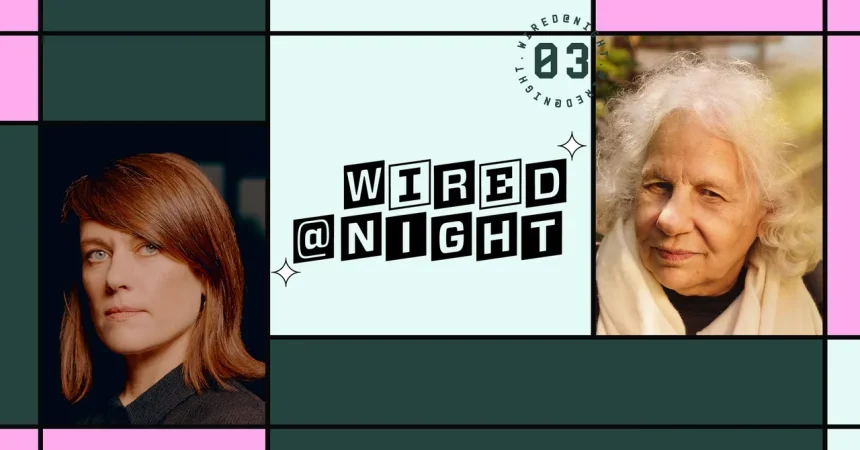
On a cool October evening in San Francisco, when the fog has settled over the Mission and the lights of the city are beginning to flicker on, a group of people will gather at KQED’s The Commons for a live recording of WIRED’s podcast, Uncanny Valley. The question on the table is not a small one: What is the state of women in Silicon Valley? The answer, offered by WIRED as a starting point, is a single word: shaky. It is a word that carries a great deal of weight—instability, unease, a foundation that is not quite steady. It suggests progress mixed with hesitation, visibility mixed with erasure, and a persistent feeling that whatever has been gained could still be lost. This is the terrain WIRED is exploring this fall with a special issue devoted to gender and power, and this live event is part of that deeper reckoning. The evening is being framed as a conversation, not a lecture, and its structure reflects the complexity of the topic. There will be two distinct segments: an intimate dialogue between two people who have spent their careers thinking about technology and culture, and then a panel discussion featuring WIRED’s own editors and reporters, all of whom have circled around the same frustrating question from different angles. It is a format that allows for both the long arc of history and the sharp edges of contemporary reporting. For the audience, it is a rare opportunity to be in the room for a recording that will feel alive, spontaneous, and unpolished in the best sense. Doors open at 6:30, with the show starting at 7:00, and the intimacy of The Commons at KQED means that no one will be a passive observer. The evening is designed to hold space for all the contradictions of the tech industry—its idealism and its excesses, its meritocratic stories and its very real hierarchies. It is an opportunity to ask why the most powerful women in Silicon Valley are often not the ones on magazine covers, and why the ones on magazine covers are rarely the ones actually setting the direction of their companies. The wording “shaky” is deliberately uncomfortable. It refuses to let anyone off the hook with a simple narrative of progress. It acknowledges that the state of women in tech is not a story of steady, linear improvement, but something far more fragile. And that is precisely why this conversation needs to happen in public, with an audience, and with all the messy honesty that comes from a live microphone.
The first half of the evening places the spotlight on Paulina Borsook, a tech journalist and former WIRED writer whose prescient 2000 book Cyberselfish is being re-released this fall. Borsook has been a skeptic of the tech world for decades, and at times that skepticism came at a cost. During the growth-obsessed years of the late 1990s and early 2000s, when the industry was drunk on its own mythology, her critical voice was not always welcomed. She asked questions that people in power would rather not answer, poked holes in the ideology of cyberlibertarianism, and pointed out that the freewheeling culture of the internet was not as free or as open as it claimed to be. Her conversation with WIRED’s global editorial director Katie Drummond promises to be one of the most compelling exchanges of the night. The two will talk about WIRED, then and now, and what it has meant to watch a countercultural publication become part of the mainstream media establishment. But the conversation will also go broader, reaching into Borsook’s long-held skepticism of the tech industry’s promises and her thoughts on the current trillionaire class. In an era when the wealthiest figures in Silicon Valley have moved from building tools to shaping governments, from creating platforms to owning the public square, Borsook’s warnings feel less like paranoia and more like prophecy. She has never been seduced by the dazzling rhetoric of disruption, and her voice is needed now more than ever. The conversation will likely touch on the personal as well as the political: what it is like to be right too early, to be a woman in tech culture before it became a fashionable topic, and to have a career shaped by one’s willingness to speak inconvenient truths. Borsook’s return to the spotlight with the re-release of Cyberselfish is not just a nostalgic trip. It is an opportunity to revisit the foundational myths of the internet and to see how many of them have hardened into dogma. For the audience, hearing her in dialogue with Drummond is a chance to watch two women who have spent their lives negotiating power, language, and identity in a world not always willing to listen to them. It is a reminder that the history of the internet is not just a story of engineers and venture capitalists, but also of the outsiders who refused to celebrate the industry uncritically. The conversation will engage with the uncomfortable question of whether the tech world has learned anything at all from its critics—or whether it has simply learned how to better package its promises.
After the opening conversation, the energy shifts as the podcast panel takes over. The panel features WIRED’s executive editor Brian Barrett and contributing editor Zoë Schiffer, and they will be joined by senior correspondent Lauren Goode. The focus of their discussion is Goode’s quest to find the most powerful woman in Silicon Valley. At first glance, the premise might seem like a straightforward journalistic assignment: identify the women who run major companies, hold influential board seats, or command the biggest pay packages. But the quest, as Goode has discovered, is far more complicated than a simple ranking. Power in Silicon Valley is rarely direct. It is often exercised behind closed doors, through relationships, through access to capital, through the ability to decide which startups get funded and which are ignored. Women who hold meaningful power in the industry are sometimes the ones whose names appear in the headlines, but just as often they are the quieter forces, the partners at venture capital firms, the advisors, the talent agents, the executives who shape strategy without seeking publicity. The panel will explore the difficulty of defining and locating power in a culture that conflates visibility with influence. There is also a deeper problem: many women in the industry are reluctant to describe themselves as powerful, aware that the label can invite scrutiny, resentment, and even retaliation. The conversation will likely address what the quest itself reveals about structural barriers, about who is seen as a leader, and about the compromises women have to make to reach the upper echelons of an industry that was not designed for them. Goode’s reporting has always been grounded in a curiosity about the human condition, and this panel will be no exception. Brian Barrett and Zoë Schiffer, both of whom have covered the blurring boundaries between tech and culture, will bring their own perspectives to the discussion. They will ask what power actually means in a place where wealth is often absurd, where young founders can become billionaires overnight, and where the women who are invited to the table are sometimes there only to add diversity to a room that has not changed its fundamental structure. The quest, in other words, is not just about finding an answer. It is about holding a mirror up to the industry and asking why the question is so difficult to answer in the first place.
For those who want to be part of this conversation in person, the details are worth marking on the calendar. The event is WIRED’s Uncanny Valley, featuring Cyberselfish author Paulina Borsook, and it is co-presented with KQED. It takes place on Thursday, October 8, at 7:00 PM, with doors opening at 6:30 PM, at The Commons at KQED in San Francisco. General admission is $25, but WIRED readers can purchase tickets for $15. Subscribers get an even better deal, saving $10 per ticket—and, of course, enjoying all the other benefits that come with a WIRED subscription. To take advantage of that subscriber discount, you simply use the code “WIRED” at checkout. The event is designed to be accessible, and the pricing is intentionally modest compared to the usual cost of tech conferences or exclusive industry gatherings. This is a conversation for the public, not a private salon for the elite. If you are unable to attend, there is still a way to stay connected: you can sign up to receive updates on WIRED’s next events. The live recording is more than just an evening of entertainment. It is a chance to witness journalism happening in real time, to hear reporters and writers think out loud, and to be part of an audience that can respond, laugh, sigh, and perhaps gasp at the insights being shared on stage. The Commons at KQED is a space designed for public conversation, and this event fits that mission perfectly. Arrive a little early, settle into your seat, and let the energy of the room carry you through the evening. With the special issue on gender and power as a backdrop, the night promises to offer the kind of depth that mainstream coverage often misses. Whether you are a longtime reader of WIRED, a newcomer, or someone who has simply felt the pressures of inequality in your own career, this event has something to offer. It will be a space to think together about the history, present, and future of women in an industry that shapes much of our world.
The stakes of this conversation go far beyond a single podcast episode or a special issue of a magazine. The question of women in Silicon Valley is not just about workplace diversity statistics, although those numbers remain dismal. It is about who gets to design the technologies that shape our lives, whose problems are addressed, and whose voices are encoded into the very architecture of the future. Silicon Valley is not merely a place; it is a worldview, a set of assumptions about progress, merit, and success. That worldview has often celebrated the lone genius, the founder who seems to have been born with a vision, the wizard behind the curtain of innovation. Yet the reality is that every successful company, every transformative product, every profitable platform is built by thousands of people, many of them women, whose names are never mentioned. They are the researchers, the designers, the operations leaders, the PR strategists, the lawyers, the recruiting managers—the invisible workforce that sustains an ecosystem dominated by a handful of visible men. Borsook’s critique of cyberlibertarian culture can now be seen as an early diagnosis of this problem. The ideology of the open internet, she argued, treated the online world as a space free from hierarchy and discrimination, a digital frontier where anyone could succeed based on merit alone. But that myth concealed a far messier reality: the internet was built by a counterculture that, for all its supposed radicalism, was overwhelmingly white, male, and obsessed with individual freedom at the expense of community and responsibility. The result was a tech culture that believed it had no prejudice because it believed it had no history. And in that vacuum of self-awareness, the old patterns of exclusion were simply recreated in a new medium. The special issue on gender and power, and the live event that accompanies it, is an attempt to correct that historical amnesia. It is a way of asking whether the values that built the internet—openness, collaboration, the free exchange of ideas—were ever actually true, and whether they can be made true in the future. The word “shaky” suggests a structure that could be collapsed, but it also suggests one that is still standing, still capable of being repaired. And perhaps that is the most honest way to describe the state of things: not hopeless, but not secure. The women of Silicon Valley have made undeniable progress, but they remain in a precarious position, forever at risk of being pushed aside by the next wave of hype or fear or regression. An event like this one does not pretend to solve all of that. It does, however, provide a place to begin the conversation, to hear from the people who have been raising these questions for decades, and to commit to asking better ones.
In the end, WIRED’s Uncanny Valley live event is an invitation—to think, to question, and to be present for a conversation that matters. The state of women in Silicon Valley is shaky, but that does not mean it is static. It means the ground is still moving, the future is still unsettled, and there is still room to make the industry look different from the way it does today. Paulina Borsook’s presence on stage is a reminder that the critics were there all along, chronicling the flaws of tech culture before it was fashionable to do so. Her conversation with Katie Drummond will offer a bridge between the early days of WIRED and the current moment, between the optimism of the digital revolution and the sobering reality of trillionaires, monopolies, and moral crises. The panel with Lauren Goode, Brian Barrett, and Zoë Schiffer will push that conversation further, asking what power means in an industry where the most influential women are not always the most famous. And for the audience, the night will be an experience, not just a stream. It will be a chance to sit in a room with other people who care about these issues, to feel the collective attention rise and fall, to laugh at the absurdities and wince at the truths. If you can be there, the invitation is open to you. If you cannot, signing up for WIRED’s event updates ensures you will not miss the next opportunity. Because this is not a one-off conversation. It is part of a larger, ongoing reckoning with gender and power, a reckoning that requires all of us to stay curious, stay uncomfortable, and stay engaged. The word for the moment may be shaky, but the conversation does not have to be. On October 8, under the lights of The Commons at KQED, the first words of a much longer conversation will be spoken. And if you are lucky enough to be in that room, or thoughtful enough to listen when the recording makes it out into the world, you will be part of a conversation that is trying, at last, to tell the truth about the powerful and the powerless in the valley that changed the world—and has not yet finished changing itself.