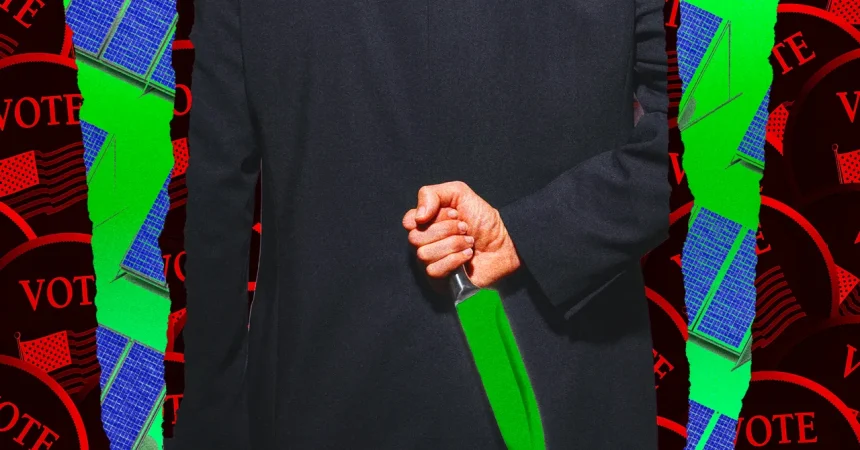
You’ve probably seen the ad by now, or at least heard the story: a grainy theater surveillance shot, Congresswoman Lauren Boebert of Colorado, and her date at a performance of Beetlejuice, getting a little too handsy while the audience watched. It was the kind of moment that would normally be fodder for late-night comedy, not a serious political hit piece. But in the final weeks before November’s election, that clip is being turned into an attack ad by a strange and deliberately vague political action committee called the Invest in Tomorrow Coalition. The same PAC is also running a spot against Anthony Constantino, a Trump-supporting congressional candidate in upstate New York, because someone at his sticker-printing company once made stickers that read “Kill the Police.” The ads feel like classic, cynical, dirt-digging politics—the kind you expect from super PACs with ties to the fossil fuel industry or the party machinery. But here’s the twist: this particular PAC is a pro-solar-energy outfit, funded in part by Chris Larsen, the crypto billionaire cofounder of Ripple, and run by a team of New York City political operatives who clearly believe that the only way to win the clean energy fight is to fight dirty.
Larsen doesn’t apologize for it. “Playing hardball politics, that’s what our opponents do, right, in oil and gas? And I just think the solar industry has been—I don’t know how to describe it—a little too nice,” he says. That one sentence captures a revolution in how green groups are approaching politics. For decades, environmental advocacy was built on a certain kind of respectability. Climate activists made PowerPoints about scientific consensus, pleaded with lawmakers to listen to the experts, and warned about the existential dangers of a warming planet. They believed that if they just made the case clearly enough, reason would win. They also leaned heavily Democratic, assuming that the moral high ground was enough. But Larsen and his team have concluded that the moral high ground is a nice place to visit, not a place to win elections. They want to fight like the oil and gas lobbyists who have dominated American energy policy for a generation. That means funding attack ads that have nothing to do with solar panels or carbon emissions, and everything to do with embarrassing, disqualifying, and taking down the most vocal opponents of renewable energy—by any means necessary.
The Invest in Tomorrow Coalition is currently pouring $15 million into seven congressional races this fall, targeting some of the most prominent renewable-energy skeptics in Washington. That’s on top of roughly $5 million they already spent in the primaries, and they’re not afraid to get personal. Republican Representative Ralph Norman of South Carolina was branded a “MAGA traitor” in their ads. Representative Andy Ogles of Tennessee was mocked with the line “He doesn’t even bother going to work.” And Representative Chip Roy of Texas, who was running for attorney general, faced the truly brutal charge that he had “chosen the side of powerful pedophiles.” The PAC also went after a Democrat, Rhode Island Governor Dan McKee, through a connected group. All four of those candidates lost their primary races. In Roy’s case, the Invest in Tomorrow Coalition spent nearly $1.5 million to stop his bid, and almost all of it went into ads on right-wing platforms like Truth Social and Rumble—places where conservative primary voters actually live. Notably, the word “solar” never appeared in any of those ads. This wasn’t about explaining the benefits of photovoltaic panels or tax credits. It was about painting these candidates as traitors, liars, and corrupt insiders to their own base.
You’d think that would make Larsen a hero among clean energy advocates, but the reaction inside the renewable energy world is more complicated. Some of his natural allies are openly uncomfortable with the strategy. They worry that by attacking Republicans in their own primaries with such venom, the PAC is alienating the very lawmakers and voters they’ll need to build a durable pro-solar coalition. They argue that energy policy is a marathon, not a sprint, and that burning every bridge in red districts will come back to haunt the industry. The politics of energy, after all, are changing quickly. Texas, the ancestral home of the fossil fuel industry, has become a solar powerhouse, and even some high-profile figures in the MAGA movement have started to speak up for solar energy. There are signs that the Trump administration’s reflexive opposition to clean power may be cracking, at least around the edges, after years of cutting green-tech subsidies and throwing regulatory roadblocks into the path of every solar and wind project. If solar is becoming an issue that can win across the political spectrum, why would you want to make it a weapon in a brutal partisan culture war?
Larsen’s answer is that the other side has been waging that war for years, and solar supporters can’t afford to keep taking punches. The fossil fuel industry has spent billions of dollars on political influence, lobbying against clean energy at every level, and funding candidates who promise to gut the EPA and protect coal and gas no matter what. Meanwhile, solar advocates have clung to the idea that their technology is simply better and cheaper, and that market forces will eventually win out. But markets don’t vote, and clean energy policy doesn’t advance by itself. It requires elected officials who are willing to stand up to the oil and gas industry. And the only way to get those elected officials, Larsen believes, is to beat the ones who are standing in the way. That means going after them in primaries, where they are most vulnerable, using the same unsavory tactics that have worked for conservative and corporate interests. It means hitting Boebert for an embarrassing moment in a Broadway theater, because it forces Republican voters to see her as a liability. It means dragging Constantino for a hateful sticker produced by his own company, because it makes him toxic to the suburban swing voters he’ll need. It’s ugly, it’s cynical, and it’s a deliberate rejection of the old-school environmentalist playbook.
But maybe that’s exactly what a movement needs when the stakes are this high. The planet is warming, the window for action is shrinking, and the political system is stacked against transformative change. For decades, the solar industry has been the nice kid at the lunch table, asking politely for a place to sit while the bullies grab all the food. Larsen’s bet is that the nice kid has to finally shove back—not just with cleaner arguments, but with sharper elbows. That means investing in attack ads that never mention solar, in the hope that by clearing the field of obstructionists, the clean energy future can advance even in red America. It’s a dangerous gamble, because the same tactics can easily be turned against green causes, and because it might alienate the very Republican moderates who are beginning to warm to solar on their own. But Larsen and the Invest in Tomorrow Coalition are willing to take that risk. They have the money, the motivation, and apparently the stomach for political combat. Whether you love it or hate it, the face of solar advocacy is changing—from earnest believers to street fighters. And in the final stretch before November, the message is clear: the sun may be bright, but the race is not going to be polite.