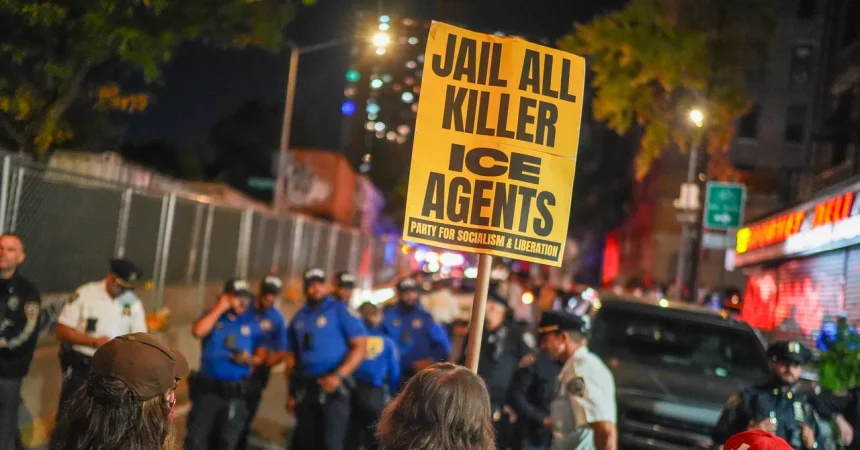
On a residential block in Marble Hill, a narrow pocket of upper Manhattan just north of the Bronx, Thursday afternoon turned from ordinary to terrifying in a matter of seconds. A car sat parked with a five-year-old child inside. According to witnesses and city officials, Immigration and Customs Enforcement agents surrounded the vehicle before gunfire erupted. Local media reported that as many as seven rounds were fired. When the chaos settled, a man identified by the NYPD as Oscar Belgal was bleeding from a gunshot wound to the neck, while the child inside the car appeared to be unharmed. The official account from the Department of Homeland Security was clinical: agents had been attempting to apprehend an undocumented immigrant from the Dominican Republic who had a prior grand larceny conviction. But the image that emerged from the scene was far more disturbing. Video footage captured a man wearing a bright yellow construction vest, the kind worn by road crews and utility workers, carrying a modified AR-15-style rifle fitted with a pistol grip, sling, and holographic sights. That man, according to court records, social media posts, and public records reviewed by WIRED, is Brenden Cuni, an ICE supervisor assigned to the agency’s National Fugitive Operations team. He identified himself to responding NYPD officers as an ICE agent, and he was the only federal officer on camera brandishing a weapon. What happened on that quiet street was not a piece of abstract policy debate; it was a scene from a lived nightmare, with a child as a witness.
The man at the center of that nightmare has had a federal career that, on paper, may look like a standard law enforcement trajectory. Cuni joined Customs and Border Protection as a Border Patrol agent in San Diego in 2018, then shifted roles in 2020 to become a deportation officer. In December 2024, he was promoted to supervisory detention and deportation officer, and in May 2025 he joined the National Fugitive Operations team, the unit responsible for tracking down people who have violated immigration orders or disappeared from ICE radar. Before his federal career, Cuni appeared on the 2018 baseball roster at Felician University, a private Catholic school in New Jersey, and listed his hometown as New Rochelle, a suburb just north of the Bronx. That detail matters because it suggests he is not an anonymous government figure imported from a distant region; he is from the area, someone who would presumably understand the streets he now patrols. Yet his enforcement record tells a more complicated and troubling story. According to court filings and federal litigation reviewed by WIRED, Cuni has been repeatedly accused of unlawful street arrests and excessive force during operations in New York City and Minneapolis. This was not a single isolated adrenaline-fueled moment. The pattern of allegations against him stretches back through multiple operations, including one referred to as Operation Metro Surge, a winter enforcement push that brought a wave of ICE street actions to the Northeast and Midwest. That history makes Thursday’s shooting less of a surprise and more of a symptom.
In federal court, the allegations against Cuni are specific and serious. Court filings accuse him of deploying a Taser on a handcuffed man during an arrest, conduct that, if true, goes far beyond the use of force allowed once a person is subdued and no longer resisting. That accusation is not buried in anonymous complaints; it appears in legal documents filed by people who encountered him during immigration enforcement operations around New York City. The pattern is broader than a single incident. In recent months, federal judges have repeatedly found that arrests connected to Cuni were unlawful. In one case, a judge described an arrest warrant that Cuni signed as “fraudulent,” a word that courts do not use casually. In another, a judge said that video evidence directly contradicted Cuni’s sworn account of how an arrest unfolded. In a third case, the government itself withdrew Cuni’s sworn statements, declining to stand by them as accurate. For a federal agent, having one’s credibility questioned in a single proceeding can be career-ending. Having multiple judicial findings and government withdrawals linked to the same officer is extraordinary. Yet Cuni remained in the field, promoted into a fugitive operations team that carries out high-stakes arrests. The gap between what the courts have found and what the agency has done is not just a bureaucratic concern; it is a measure of institutional accountability. When a supervisor accused of unlawful arrests continues to work in enforcement, the message to the public is that the system will tolerate dangerous conduct as long as it happens to people without power.
The allegations against Cuni extend beyond New York. During Operation Metro Surge last winter, he was involved in enforcement actions in Minneapolis, where activists have alleged he was one of the agents seen forcing a pregnant woman to the ground. That account, if true, would be a visceral example of the human cost of aggressive immigration tactics. A pregnant woman, already in a vulnerable state, being pushed down in the street by federal officers does not look like lawful enforcement; it looks like brutality. The broader record of judicial scrutiny in these cases underscores the seriousness of the allegations. When a federal judge looks at video footage and determines that an agent’s sworn statement does not match what actually happened, it chips away at the foundational idea that law enforcement officers are honest, reliable witnesses. When another judge sees a warrant signed by that same agent and calls it fraudulent, it undermines the legitimacy of the arrest process itself. And when the government quietly withdraws that agent’s statements because they cannot be supported, it raises questions about how many other encounters with the same officer were based on flimsy justifications. The legal system is supposed to be a check against exactly this kind of misconduct. But these findings did not keep Cuni from being promoted or placed in a role that gives him power over the lives of people who are often marginalized, frightened, and unfamiliar with their rights. The courts may have seen the pattern, but the agency kept moving him deeper into the field.
Thursday’s shooting in Marble Hill cannot be understood as a simple police action that spiraled. It happened in a context where ordinary New Yorkers are increasingly being confronted with the visible presence of heavily armed federal agents on residential streets. The choice to wear a construction-style vest, the decision to bring a modified rifle to an arrest involving a child in a car, and the willingness to fire multiple rounds in a crowded neighborhood all point to a style of enforcement that treats every encounter as a military operation. The people in these neighborhoods are not abstract statistics. They are parents picking up children from school, workers coming home from late shifts, families who may be undocumented or may have undocumented relatives. When federal agents surround a car with a five-year-old inside and open fire, the message to those families is clear: they are not safe. DHS’s statement about a grand larceny conviction does not erase the image of a child in the back seat. Mayor Zohran Mamdani condemned the operation, and local officials demanded answers. But the deeper issue is not just whether this one shooting was justified. It is whether an enforcement system that keeps an officer with Cuni’s record on the streets is capable of protecting the public, including the immigrant communities it claims to be policing.
The story of Brenden Cuni is not only a story about one officer’s conduct. It is a story about what happens when immigration enforcement becomes inseparable from militarized street violence, when agencies prioritize aggressive arrests over dignity, and when legal findings of misconduct do not lead to meaningful consequences. Cuni has the right to due process, and the shooting in Marble Hill will no doubt be investigated. But the record that follows him from New York to Minneapolis and back again paints a portrait of an enforcement culture that too often treats immigrants as enemies rather than neighbors. The child in that car will likely carry the sounds of those shots for a long time. Oscar Belgal will have to live with the physical and emotional wounds of being shot in the neck. And the community around Marble Hill will have to process the fact that a federal officer was walking their streets in plain clothes, carrying a weapon that looked like it belonged on a battlefield. Real accountability would mean more than statements of regret. It would mean independent investigations, transparent body camera footage, and a clear rule that any officer who signs fraudulent warrants or is caught lying in sworn statements cannot remain in a position of power over other people’s lives. It would mean recognizing that immigration enforcement does not have to look like this. But until that recognition is matched by action, scenes of gunfire and fear on quiet city streets will keep repeating, and the people who suffer will be those with the least ability to fight back.