The difference between a planet and a dwarf planet has nothing to do with being “small” or “insignificant.” Both kinds of worlds orbit the Sun, and both have enough gravity to squash themselves into a roughly round shape. The key difference is their environment, their neighborhood, the company they keep. A planet is a world that has, over the long, brutal history of the solar system, cleared its orbit of other bodies of comparable size. It has grown up to be the dominant gravitational force in its lane. A dwarf planet, on the other hand, has not managed that. It may be just as round, just as ancient, and just as interesting, but it shares its region of space with other objects of similar size. It is less like a landlord and more like a neighbor. This is why Pluto lost its planetary title in 2006. Pluto did not change. It did not shrink, fade, or wander off. The universe is exactly as it was. Instead, our understanding changed. Astronomers realized that Pluto’s orbit is a crowded, messy part of the outer solar system, and that many other icy worlds out there could be just as substantial. The International Astronomical Union needed a vocabulary that reflected that reality. So it created a category that was honest about the way the solar system actually is. Think of a planet as a great city that has absorbed the villages around it, while a dwarf planet is a small town still surrounded by independent neighbors. The town may be lovely, bustling, and full of history, but it is not the whole county. And that is not a bad thing. It is just a truer picture of the cosmos.
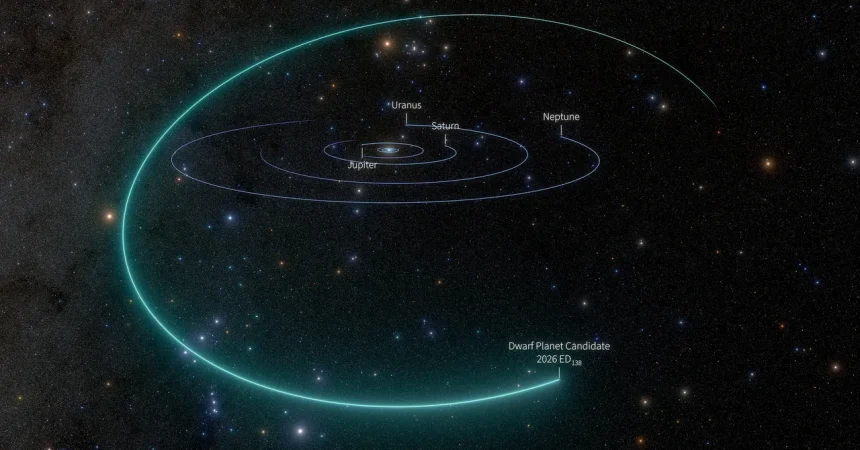
In the fall of 2026, astronomer Matthew Holman, a researcher at the Harvard-Smithsonian Center for Astrophysics and a member of the operations team at the Rubin Observatory, was sifting through an enormous pile of data when he spotted something curious. The object, temporarily identified as ED138, appeared in observations collected by Rubin during its survey of the southern sky. It was a faint point of light, moving slowly, deliberately, through a sea of stars. On October 13, Holman identified it, but a good astronomer never trusts a single image. So the team went digging. They searched through the archives and found older observations of the same object, some of them dating all the way back to 2016. With those scattered pieces of data, they were able to stitch together more than a decade of the object’s trajectory. They could see where it had been, where it was going, and how it was moving through the outer darkness of the solar system. For years, ED138 had been hiding in plain sight. It was not invisible because it was too small to be seen, but because it was sitting against one of the most distracting backgrounds imaginable: the glowing disk of the Milky Way. That thick band of millions of stars, which we see stretched across the night sky, is like a brilliant, glittering curtain. It makes it almost impossible to pick out a small, cold, distant object moving slowly among all those suns. But the Rubin Observatory is built for exactly this kind of challenge. Its camera, its relentless survey, and its staggering amount of data create a record of the sky so detailed and so repeated that even the faintest wanderer can be pulled out of the glare. ED138 had been there all along, waiting for someone, or some algorithm, to notice it.
It is tempting to call ED138 a new dwarf planet right away. The object seems to have all the right characteristics. It is a trans-Neptunian object, meaning it orbits the Sun beyond Neptune, in that dark, mysterious region of the outer solar system. But astronomers are careful. Before they can officially welcome a world into the dwarf-planet club, they need to know more about it. They need to determine its size more precisely. They need to understand whether its own gravity has pulled it into a nearly spherical shape. This is the crucial test. A round world is a world that has collapsed under its own weight, settling into a ball because its gravity is strong enough to overcome the rigid strength of rock and ice. A small, irregular asteroid is too weak in gravity to smooth out its bumps. A dwarf planet, by contrast, has enough self-gravity to be round. This is not simply a matter of diameter, because composition matters. A frozen, icy world may stay round at a smaller size than a rocky one. But the general principle is there: if you are round and you orbit the Sun, and you have not cleared your path, you are a dwarf planet. That is the standard. ED138 has not yet proven that it meets it. The data are promising, but more observations are needed. If it does meet the requirements, it would join the five officially recognized dwarf planets listed by the International Astronomical Union: Ceres, the largest body in the asteroid belt; Pluto, the beloved former planet; Haumea, a strange, fast-spinning world of the Kuiper Belt; Makemake, another distant icy giant; and Eris, a world whose discovery helped trigger the whole reclassification debate in the first place. It is a small, exclusive group. But it is about to get much larger.
ED138 is not alone in this awkward, waiting-room status. Astronomers have identified dozens of objects in the outer solar system that, based on their size and other characteristics, could qualify as dwarf planets. Some of the best-known candidates have names that sound like they come from myths and legends: Gonggong, a red, violent-looking world with a name from Chinese water mythology; Quaoar, named for a creation god of the Tongva people of California; Sedna, one of the most distant and mysterious objects known, named for the Inuit goddess of the sea; and Orcus, a shadowy world named after the Roman god of the underworld. These are not just faint smudges. They are entire worlds, complete with surfaces, histories, perhaps moons, and long, slow orbits around the Sun. They have been waiting for years, sometimes decades, for a definitive answer about what to call them. And experts acknowledge that the list could be even longer. Every new survey, every new telescope, every new archive search tends to reveal more objects out there. The outer solar system is not a barren void. It is a thick, swarming population of icy bodies left over from the birth of the planets. Some of them are enormous. Some are tiny. Many of them are probably round, and therefore dwarf planets. The official count of five is almost certainly a severe undercount. The real number, once telescopes like Rubin have had time to finish their work, could be in the hundreds. The only thing standing between us and that knowledge is the painstaking process of observing, measuring, and confirming.
Why is it so difficult to confirm these objects as dwarf planets? The short answer is distance. The long answer involves the limits of human vision, the stubbornness of physics, and the enormous scale of space. The outer solar system is not close. Even the nearest trans-Neptunian objects are billions of miles away. At that distance, a dwarf planet looks like nothing more than a faint point of light, even in the world’s most powerful telescopes. You cannot see its shape. You cannot tell whether it is a smooth sphere or a lumpy potato. To get a direct, high-resolution image of a dwarf planet’s surface, you have to send a spacecraft to its vicinity. We did this exactly once, for Pluto. The New Horizons probe launched in 2006, the very same year that Pluto was demoted, which felt like a strange cosmic joke. The mission flew across the solar system for nearly nine and a half years, a journey of over three billion miles, before finally reaching Pluto in July 2015. The images it sent back transformed our understanding of Pluto. We saw a heart-shaped nitrogen glacier, enormous water-ice mountains, and a surprisingly active, complex world. Then New Horizons continued even deeper into the Kuiper Belt. Three years later, in 2019, it reached Arrokoth, a small planetesimal even farther away. Arrokoth was not a dwarf planet. It was a cold, ancient building block, a frozen relic from the solar system’s earliest days. But its strange, two-lobed shape taught us more about how planets form. The point is that a spacecraft took over nine years to reach just one dwarf planet. We cannot do that for dozens of worlds. We cannot fly past them all. Instead, we have to be clever. Astronomers use methods like occultations, where a faint star blinks out as a distant object passes in front of it, to measure a world’s size. They study how a world’s brightness changes over time as it rotates. A smooth, round object will show only subtle variations. A lumpy, irregular object will flicker like a spinning potato flashing different sides. These techniques are powerful, but they are also slow, and they require exactly the right alignment of observations. For a newly discovered object like ED138, that evidence does not yet exist.
The solar system is often drawn in school textbooks as a neat diagram: a few planets in a row, maybe a ring of asteroids, and then nothing. The reality is far stranger and far more crowded. The Sun has at least eight planets, but it also has moons, dwarf planets, asteroids, comets, millions of small bodies, and structures that extend far beyond anything most people imagine. Just past Neptune lies the Kuiper Belt, a vast, donut-shaped collection of icy worlds and smaller debris that stretches to about 50 astronomical units from the Sun. One astronomical unit is the distance between Earth and the Sun, so 50 AU is a staggering distance. But even that is not the end. Beyond the Kuiper Belt lies the scattered disk, a region of wildly eccentric orbits and scattered icy fragments that reaches out to nearly 1,000 astronomical units. And beyond that, a vast, hypothetical shell called the Oort Cloud may extend up to about 100,000 astronomical units from the Sun. We have never directly observed the Oort Cloud. It is so distant and so dim that it remains theoretical, inferred from the long-period comets that occasionally fall inward from its depths. It could contain billions of icy bodies, a kind of frozen reservoir around the solar system. If the Kuiper Belt is the suburbs of the Sun’s domain, the Oort Cloud is the dark, unexplored wilderness far beyond it. Every new object like ED138 is a reminder that our cosmic address is not a tidy little system of eight planets. It is an enormous, intricate, overlapping web of worlds and fragments, some as large as planets, some as fine as dust. Reclassifying Pluto as a dwarf planet was not a demotion of Pluto. It was an elevation of our understanding. It was a recognition that the solar system is rich enough to contain many kinds of worlds, and that our labels must be flexible enough to describe them honestly. ED138, whatever it ultimately becomes, is part of that unfolding story. It is a small, distant reflection in a sea of stars, waiting to be understood. This story originally appeared on WIRED en Español and has been translated from Spanish.