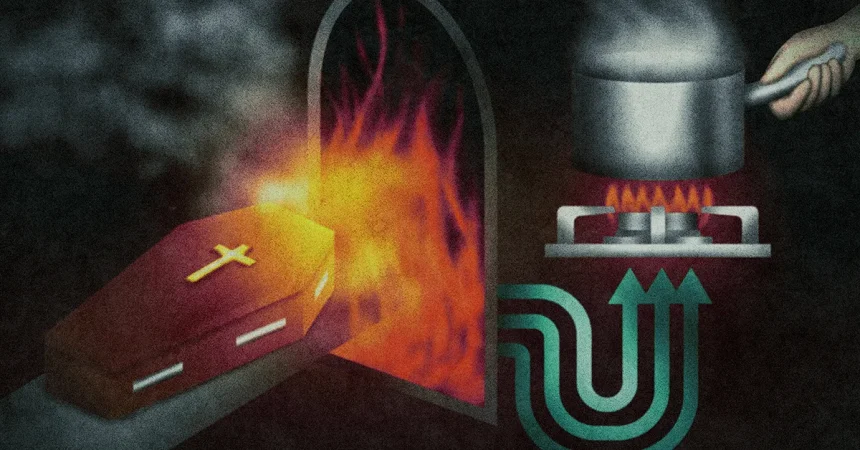
In 2011, the residents of Redditch, a modest town in the English Midlands, woke up to a story that seemed less like local news and more like a strange invention. Their borough council, the body responsible for things like trash collection, road repairs, and public amenities, had quietly decided to do something rather extraordinary: they were going to use the heat from the local crematorium’s cremation ovens to warm the water in the town’s swimming pool. The announcement triggered a public firestorm that the council never saw coming. Angry residents called it grotesque; international news outlets ran with headlines that made Redditch sound like something out of a dark comedy. A union official gave a quote that was reprinted all over the world, denouncing the plan as “sick and an insult to residents,” although the union, Unison, would later clarify that this was never its official position, nor had it been at the time. For a few weeks, the whole town seemed to be knee-deep in a morbid, uncomfortable conversation about whether it was appropriate to share warmth with the dead. Death, as Guy Revans, an official with the Redditch and Bromsgrove Councils, would later reflect, is always an emotive subject, and here it had been yanked out of the private realm of grief and thrown into the highly public, deeply practical world of municipal energy bills. It was, to put it simply, a scandal of misplaced decency—at least until people stopped to think.
But beneath all the shock and the headlines, the actual mechanism was surprisingly ordinary, even boring, in its engineering. Every year, around 1,200 cremations take place in Redditch. The crematorium’s gas-fired ovens burn at extreme temperatures, and the flue gases they produce are full of particulate matter and, notably, mercury vapor. Mercury vapor is a legacy of dental fillings, and for environmental and health reasons, it has to be filtered out of the emissions before anything is released into the air. To do this, the facility uses a filtration process that cools the flue gases down, pulling the mercury out and capturing it for safe disposal. And here is where the magic happens: all that heat. Heat that was once simply vented into the sky and written off as waste is instead captured by a heat exchanger. The exchanger sits right in the flow of those gases, absorbing their warmth and transferring it to a closed water loop. That water then travels 200 meters through pipes buried underground, snaking under roads and a grassy verge, until it arrives at the town’s recreation center. There, another heat exchanger transfers that warmth into the waters of the swimming pool. There are no bodies involved, no macabre connections, simply a clever bit of thermodynamics that prevents usable energy from disappearing into the atmosphere. And as Revans, a man clearly accustomed to explaining this to skeptical outsiders, points out, a swimming pool is an ideal destination for such heat. A body of water that large acts like a giant battery, a heat sink. You pump heat into it during the day, and it holds onto that warmth for hours, so even after the crematorium’s ovens have gone quiet for the night, the pool remains comfortably temperate. When extra punch is needed, the recreation center has its own gas-fired boilers that can kick in and bring the water up to temperature, but only as a supplement. The sum of this all is a system that has been quietly, and successfully, warming Redditch’s pool since 2013. It won a green award, the press eventually moved on, and the hospital-clean, faintly industrial smell of the pool stayed just as chlorinated as before. The council, meanwhile, has saved tens of thousands of pounds a year in fuel costs—money that could go to other services rather than simply vanishing as heat vapor.
What makes this story so fascinating is not the engineering, but the emotional journey it represents. In the beginning, the very idea was so ripe with taboo that it sounded less like an eco-initiative and more like a gothic horror’s plot point: the dead, burning to keep the living warm. But once the initial gag reflex wore off, the logic became impossible to dismiss. The heat from a cremation oven is simply heat. It doesn’t contain anything of the deceased; it’s just the thermal byproduct of an inevitable process, energy released by burning fuel and organic matter. And yet, human beings do not separate the physical from the emotional easily. The idea of “grandma’s heat” swirling around a swimming pool felt, to many, like a violation of the sacred boundary between the living and the dead. This is why the project was so controversial. Revans’s observation—that death is always an emotive subject—is precisely the key to understanding the whole episode. The clean, technical reality of heat exchangers and mercury filtration was never the real story. The real story was about how we, as a society, feel about the bodies of the dead, and how we judge what is dignified and what is an insult. The public outrage was fueled by a perception that the council had treated the dead as fuel, as a resource, as lumber lying in a timberyard. But as the project matured and the silence of routine settled in, the residents of Redditch adapted. The pool got heated. Children learned to swim in it. Old ladies did their aqua aerobics. Nobody thought twice about it. The taboo, it turned out, evaporated in the warmth, just like the heat it carried.
In the broader context, Redditch was not a pioneer, though in the United Kingdom it definitely felt like one. European countries, particularly the Dutch, the Germans, and the Swiss, have been harvesting warmth from crematoria for years, and they do so without a second glance from their neighbors. In many places, the capture of flue gas heat is standard practice regardless of what you do with it; the energy is sucked out of the fumes as a necessary byproduct of cleaning them. The only real question is whether you waste it or use it. In Redditch, they decided to spend it. In North America, such projects remain extraordinarily rare, due partly to the immense variety of municipal structures, a higher stigma around funeral rites, and what one might politely call a more commercially fragmented energy landscape. But the logic is universal: cremation is an energy-intensive process, and all that energy has to go somewhere. When it’s simply vented skyward, it contributes to the waste heat that warms our urban environments without any benefit to anyone. When it’s captured and redirected, it becomes a modest, constant, and carbon-reducing source of warmth. The total volume of heat available from a single crematorium is never going to solve a city’s energy crisis, but it doesn’t need to. In the search for ways to reduce the environmental impact of funeral rites—and the carbon footprint of their facilities—this simple act of recycling heat provides a tangible, measurable way for a town to lower the carbon intensity of its public services, all without altering the actual ritual of cremation in any way that any mourner would notice or care about.
The proof that this idea has legs, and that the shock value eventually wears off, can be seen in the slow, quiet expansion of similar projects. In Aberdeen, Scotland, a brand-new school currently under construction will receive its excess heat from the city’s crematorium, a development that has caused barely a ripple of controversy. Indeed, the Aberdeen crematorium already uses waste heat to warm its own premises, a closed loop of efficiency that is standard practice in many modern facilities. The school project, then, is less a radical departure and more a sensible extension. When you heat a building, you are not always aware of where that heat came from; the radiators in a classroom don’t whisper their fuel source. And so, the children in that future Aberdeen school will study, draw, and daydream in rooms kept comfortable not by oil or gas directly, but by the captured warmth of a farewell ritual. It is strangely poetic. In Redditch, too, the project has become simply what the town does. The council no longer fields media calls. The swimming pool is just a swimming pool. Children splash. Old men do lengths. And the crematorium, doing its solemn work on a nearby hill, continues to perform its ancient, incorrigible function of transforming bodies into memory, and, as it turns out, a few hundred extra degrees of average comfort for a municipal pool.
Perhaps the truest way to humanize this story is to step back and consider what we, as a society, actually want from our funeral customs. For most people, the ceremony is about memory, closure, respect for the dead, and solace for the living. It is not really about the physics of combustion, yet that is the reality of the modern world. As sustainability movements grow, families increasingly ask for greener burials, natural decomposition, and lower-carbon rites. But cremation, while land-efficient, requires tremendous energy, and that energy creates extreme heat which, unused, is simply wasted. By recovering that heat and putting it to work, a community isn’t disrespecting the dead; on the contrary, it is acknowledging that the energy released in the final act of caring for a body can continue to serve the community of the living. The initial “sick” accusation, leveled all those years ago, now feels like a relic of an older, more disconnected way of thinking. What is actually sick, one might argue, is letting thousands of gallons of hot water pour into the sky, while simultaneously burning fresh gas to heat the same community’s water elsewhere. The dead are not fuel; they are not seen as a resource to be mined. But their physical remains, in the very moment of transformation, release something that cannot be held back. In deciding to capture it rather than discard it, Redditch chose compassion for the community, prudence for the environment, and a kind of quiet, practical wisdom that turns a final goodbye into a gentle, unnoticed gift to a young child doing a cannonball into the deep end. And that, in the end, is the very human story: that even in our most taboo-laden institutions, we can find meaning and kindness in the most unexpected places—so long as we are brave enough to look past the horror, take a breath, and dive into the water.