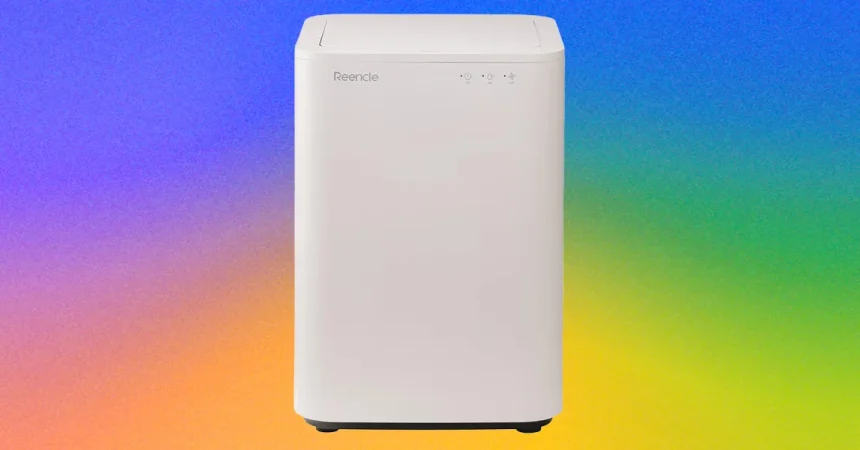
There’s a new Reencle composter in town, and of all the features I thought I might miss from the trailblazing original Reencle Prime, I never expected it to be the lid. But here we are. The Prime’s auto-close lid was something I actually found a little irritating at first. The opening sensor was overly sensitive, and in those early days, it felt like the machine was almost too eager to greet me every time I walked past it. But after a few weeks, I stopped noticing it entirely, and I used the Prime for nearly a year and a half without giving the lid a second thought. In hindsight, that’s the greatest compliment I can give any piece of kitchen technology. It became invisible. It just worked, quietly and reliably, fitting into the rhythm of our daily life. The Prime even has a setting for the lid to auto-open when you approach, so you can walk over with a bowl of vegetable peels and coffee grounds, dump them in, and walk away while it closes itself. Your hands never have to touch anything. The lid, the buttons, the handle—everything stays clean. No sticky residue, no smudges, no grime under your fingernails. That kind of convenience is easy to take for granted until it’s gone. And now it’s gone, because Reencle has released the Essential, a brand-new, lower-cost unit that is pretty much the same as the Prime, but with a few small tweaks. It has updated looks, a larger shovel, and a lid that you have to close manually. It also has a button you have to press to open. After only three weeks, that button and the lid are already dirty, which sounds like a small thing, but it’s the kind of small thing that starts to wear on you. My family, used to the auto-close lids of both our trash can and our old Prime, consistently forgets to push the Essential’s lid closed. At least a few days a week, I’m caught off guard by a constant beeping—the Essential letting us know that its lid is still open. It’s a minor annoyance, but it’s a daily reminder that “almost the same” isn’t quite the same.
What made the Prime’s auto-close lid so special wasn’t just the convenience, though that was certainly nice. It was the way it protected the machine from becoming gross. Kitchen composters live in a weird in-between world. They’re not quite appliances, not quite trash cans, and they’re constantly exposed to the messiest parts of cooking. With the Prime, I never had to worry about what my hands touched after handling raw chicken or peeling beets. I could approach the bin with messy fingers, let the sensor do its thing, and the lid would open like a little mouth waiting to be fed. After I dropped in the scraps, it would close itself, sealing in the odor and keeping the outside pristine. It felt almost magical, and I didn’t appreciate how much mental energy it saved until I had to start pressing a button and pushing a lid closed again. The Essential, by contrast, asks you to do a little more work. You press the button, the lid pops open, you dump in your scraps, and then you have to remember to close it. That sounds like nothing, but when you’re cooking dinner and juggling a cutting board, a skillet, and a toddler who wants attention, it’s exactly the kind of extra step that gets skipped. And when it gets skipped, you hear about it. The beeping starts, usually when you’re on a phone call or trying to watch a movie, and you have to get up, walk over to the machine, and close the lid. It’s not a big deal, but it’s an interruption, and interruptions compound. I’ve found myself standing in front of the Essential with my hands covered in food scraps, pressing the button with my wrist, then trying to close the lid with my elbow because I didn’t want to smear tomato sauce all over the clean surface. It’s a small dance, but it’s a dance I didn’t have to do before.
But let’s be fair: aside from that lid situation, the Essential delivers the same user-friendly, close-to-compost-producing experience as its older sibling, for $150 less. That’s a significant price difference, and for a lot of people, it’s going to make the Essential the more attractive option. The machine itself looks good—updated, modern, a little sleeker than the Prime—and the larger shovel is a genuinely nice improvement. It means you can scoop out the finished material more easily, which is one of those things you don’t think about until you’re hunched over the bin with a tiny scoop, trying to get every last bit of dark, crumbly soil out of the corners. The Essential also keeps the same simple, approachable design philosophy that made the Prime so easy to live with. There’s no app required for basic operation, no complicated settings, no Wi-Fi connectivity just for the sake of it. You plug it in, add the starter bacteria, and start feeding it scraps. It’s quiet enough that you’ll forget it’s running, and it processes food waste into something that looks and smells like good, dark soil. My family has been using it for three weeks now, and aside from the lid, the experience has been remarkably similar to the Prime. The same kind of earthy smell when you open it, the same satisfaction of watching a week’s worth of vegetable peels shrink into a small pile of compost-like material, the same sense that you’re doing something slightly better for the planet than throwing everything into the trash. If the Prime didn’t exist, I would be completely happy with the Essential. The only reason I miss the auto-close lid is because I know what I’m missing. That’s the tricky thing about convenience—once you’ve had it, you can’t un-know it.
Of course, it helps to remember what these machines are actually doing, because there’s a lot of marketing nonsense in the world of kitchen composters. You may have heard of the Lomi, the FoodCycler, or the original Reencle Prime, and you might have been drawn in by the same compelling fantasy: you put your food scraps in the bin, and out comes ready-to-use compost. It’s a beautiful image, and it’s also mostly a fantasy. For all of these machines, the reality is a bit more complicated. Many of them, like Lomi and FoodCycler, simply grind and dry your scraps to create a material that looks kind of like dirt. It’s odorless and shelf-stable, which is nice, but it’s not really compost. It’s dehydrated food waste, and if you want to use it in your garden, you need to mix it into potting soil at a very low ratio—like one part of the processed material to ten or even twenty parts of soil, especially if you’re processing a lot of meat and dairy. That’s not exactly the effortless, closed-loop system the advertisements promise. It’s more like a fancy food dehydrator with a marketing budget. You still have to think about ratios, you still have to be careful about what you feed it, and you still have to manage your expectations. The material that comes out of those machines is not going to enrich your garden the way real compost does. It’s a step up from sending your scraps to a landfill, but it’s not the magical transformation you might be hoping for.
Reencle, on the other hand, is doing something genuinely different. It actually uses thermophilic bacteria—including Bacillus and Actinomycetes—to break down the waste, and that means the end result is a biologically active material that is at least part of the way to being real compost. It’s not ready-to-use compost, and Reencle is honest about that. You still need to let it cure or mix it into your soil and give it time to finish breaking down. But it’s a far cry from the dehydrated powder that Lomi and FoodCycler produce. The bacteria are working, living organisms that are actively digesting your food scraps, and that makes a real difference in the quality of the final product. There are a couple of other machines on the market that also use this kind of biological process, and I’ve tried them, but they tend to be bulkier, pricier, and louder than the Reencle. That last point matters more than you might think. Don’t discount the noise-polluting effects of an audible fan running 24/7, especially if you live in a small space. A constant whirring in the background can drive you crazy, even if it’s not loud enough to be truly disruptive. It’s like living with a computer tower from 1999. The Reencle Essential, by contrast, is quiet enough to ignore. The only time you really hear it is when it beeps to remind you to close the lid. And if you’re wondering about the larger Gravity model, it was—and remains—the only food recycler or composter I’ve ever tested that was truly silent at all times. No fan noise, no hum, nothing. Just quiet, efficient decomposition.
So where does that leave the Essential? It’s a really good machine with one annoying flaw, and whether that flaw is a dealbreaker depends entirely on who you are and how you live. If you’re the kind of person who always closes lids, who doesn’t mind pressing a button, and who values saving $150 more than you value the luxury of never touching a handle, then the Essential is a fantastic choice. It does the same biological composting work as the Prime, it’s easy to use, it’s relatively compact, and it won’t keep you up at night with fan noise. It will, however, occasionally beep at you because someone in your household didn’t close the lid. If you live alone and you’re disciplined about closing things, that might never happen. But if you have a family, especially one that’s been spoiled by auto-close lids, it’s going to be a recurring theme. For us, it’s become a running joke. The beeping starts, someone sighs, and then someone gets up to close the lid. It’s not the end of the world, but it’s a reminder that the Essential is a budget option, even if it doesn’t feel like one in most other respects. The Prime, meanwhile, is still available, and if you’re willing to spend the extra money, you get the convenience of the auto-close lid, the auto-open setting, and the peace of mind that comes with knowing your family won’t leave the lid open and let odors escape. I can’t tell you which one is right for you, because it really comes down to how much you value that small, almost invisible convenience. But I can tell you this: after three weeks with the Essential, I’ve learned to appreciate the Prime’s lid in a way I never did when I had it. Sometimes you don’t know what you’ve got until it beeps at you to close it.