For months now, the tropical Pacific has been quietly but insistently storing heat, like a lung filling with air before a long, powerful exhale. That breath is El Niño, and this year it is shaping up to be something extraordinary. Scientists have been tracking a “super” El Niño taking shape, and the numbers are already startling: daily ocean temperature records have been falling with unsettling regularity, and forecasters now believe this event could reach unprecedented strength by the time winter arrives. El Niño is not a stranger to our planet. It is a natural climate rhythm that visits every few years, born when the trade winds that normally blow from east to west across the Pacific soften or reverse, allowing unusually warm water to pool in the eastern tropical Pacific. That may sound like a distant, watery technicality, but it is anything but. The Pacific is the largest ocean on Earth, and when a large patch of it runs hot, the atmosphere above it reacts. Those reactions ripple outward, shifting weather patterns across the globe in ways that can bring floods to one continent, drought to another, and misery or relief to millions of people. Because the ocean and atmosphere are so deeply entangled, El Niño is never just a local phenomenon. It is a global problem wearing a tropical disguise. And this year, it arrives with extra baggage: a planet already profoundly altered by climate change. It would be tempting to assume that a hotter planet automatically produces a hotter El Niño, and that the connection is obvious. But as Christopher Callahan, a climate researcher at Indiana University, put it, “I have more questions than I have reactions” to what is unfolding. The truth is more complicated, and this year’s event may be exactly what scientists need to finally understand how these two immense forces interact.
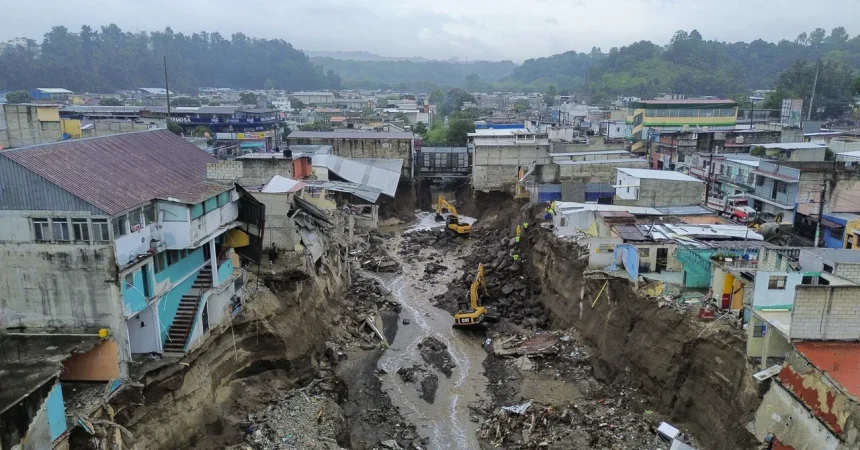
To understand why El Niño matters so much, it helps to picture the ocean and atmosphere as partners in a slow, gigantic dance. Normally, the Pacific Ocean has a kind of balance: warm water piles up in the west, near Asia and Australia, while cooler water rises along the coast of South America. During El Niño, that balance breaks down. The warm water that usually stays in the western Pacific surges eastward, spreading across a vast stretch of ocean near the equator. This added ocean heat does not just sit there quietly; it injects immense energy into the atmosphere, a shove rather than a gentle flick, and the resulting chain reaction can be felt thousands of miles away. Think of it like a line of dominoes: one tile falls, then another, and another, until the pattern of weather across the entire planet has changed. The jet streams shift, storm tracks move, rainfall patterns rearrange themselves. Some regions, like the southern United States and parts of South America, tend to see wetter conditions. Others, including Australia, Indonesia, and parts of Africa, often slide into dangerous drought. Meanwhile, the extra heat in the ocean can supercharge storms, making extreme weather events more intense than they might otherwise be. This year, forecasters are expecting the weather impacts to be generationally intense, meaning the kind of disruptions that leave lasting scars on communities and economies. It is not just about a warm winter or a strange storm here and there; it is about entire seasons being thrown off course, about farmers facing failed harvests, about cities bracing for floods they have not seen in decades, and about ecosystems struggling to cope with sudden, violent change. El Niño is often described as a weather pattern, but it is really a planetary event, a reminder that the natural world does not obey our tidy borders or our carefully planned seasons.
The forecasts for this El Niño are frankly hard to ignore. The United States National Oceanic and Atmospheric Administration, or NOAA, has been tracking it with growing concern, and its latest outlook calls for essentially a 100 percent chance of an extremely strong El Niño through December. Even more striking, there is better than an 80 percent chance that it will remain that strong through February, carrying its influence deep into the heart of winter. Those may sound like abstract statistics, but they are based on observations that have already broken records. This El Niño has set multiple all-time daily heat records in the Pacific, including a recent peak where ocean temperatures soared 3.4 degrees Celsius above normal. To put that in perspective, a shift of even a fraction of a degree in ocean temperature can have enormous consequences for weather; 3.4 degrees is not just unusual, it is almost shocking. NOAA issues its official El Niño forecast using a three-month rolling average, and the agency predicts that the heat could peak at 2.7 degrees Celsius above normal for the period from October to December. It is not out of the question that the peak could surpass 3 degrees Celsius. If the forecast holds, this event would smash the previous record of 2.4 degrees Celsius, which was set during the infamous 1982–1983 El Niño. That event was a disaster of enormous proportions, linked to droughts, floods, and thousands of deaths around the world. The fact that this year could exceed it is a sobering thought. It means we are not just watching another El Niño; we are watching a possible sign of what the future holds, and the future looks rougher than anything in the modern record.
So what role is climate change playing in all of this? It is a question on every scientist’s mind, but the answer is not as simple as it might seem. On the surface, a warmer planet should naturally produce a warmer El Niño, and there is a growing body of evidence suggesting that climate change is indeed influencing how El Niño behaves. But Christopher Callahan’s reaction, that he has more questions than reactions, captures the honest uncertainty that exists in the scientific community. The relationship between El Niño and global warming is one of the most active and difficult areas of climate research. Part of the challenge is that El Niño is a natural phenomenon that has existed for much longer than humans have been burning fossil fuels. It has always varied in strength and frequency, so distinguishing between natural variability and human-caused change requires careful analysis, sophisticated models, and a great deal of patience. Another challenge is that the eastern tropical Pacific, the very region where El Niño’s signature heat appears, is notoriously difficult for climate models to simulate accurately. Many models struggle to represent long-term temperature trends in that part of the ocean, which makes predictions about how El Niño will change in a warming world less certain than scientists would like. That uncertainty matters because it affects everything from seasonal forecasts to long-term planning. Yet the uncertainty does not mean there is no connection. It means the connection is complex, layered, and still being worked out. This year’s El Niño is happening in a world that has already warmed by about 1.2 degrees Celsius since the late 1800s, and that background warmth is bound to affect how this event unfolds, even if scientists are still figuring out exactly how.
There is, however, evidence that climate change is already leaving its fingerprints on El Niño. Francisco Estrada, who coordinates the Climate Change Research Program at the National Autonomous University of Mexico, points out that the magnitude and frequency of El Niño have increased over the past 60 years. That is not something scientists expect from natural cycles alone; it lines up with the rapid warming caused by greenhouse gas emissions. Estrada also notes that the variability of El Niño has increased, meaning the swings between warm and cold phases, and between moderate and extreme events, have become more pronounced. Just as important, the effects of El Niño are being distributed differently around the world, with some regions feeling impacts more strongly or at different times than they used to. Estrada argues that it is a mistake to frame the situation as a choice between a “natural El Niño” and an “El Niño caused by climate change.” In his words, “You can’t separate El Niño from global warming—they’re inextricably linked.” That is a profound statement. It suggests that every El Niño that occurs from now on will be a hybrid, a combination of natural variability and human influence, with the two forces feeding into each other in ways that are difficult to untangle. The heat from climate change makes the baseline warmer, so even a moderate El Niño may push temperatures to record levels. The extra heat also adds more energy to the atmosphere, potentially making storms wetter, droughts hotter, and weather extremes more intense. In that sense, climate change is not causing El Niño, but it is amplifying its effects, turning what might have been a disruptive event into something potentially catastrophic.
What does all of this mean for the future? It means we are in a period of intense scientific reckoning, and this year’s El Niño is a crucial piece of the puzzle. Every daily record set, every unusual weather pattern, every flooded city and parched field will be studied for clues about how these two forces interact. Scientists like Callahan and Estrada are eager to learn, but they also carry a sense of gravity because the stakes are so high. If climate change is making El Niño stronger, more frequent, or more destructive, then the worst is yet to come. A world where super El Niños become common is a world where extreme weather events become more common, where communities that have already been pushed to their limits are pushed further, and where the human cost of inaction grows ever larger. But there is also something hopeful in this knowledge. The more we understand about how climate change affects El Niño, the better we can prepare for what is coming. Better forecasts mean earlier warnings, more resilient infrastructure, and more effective humanitarian responses. They also mean we can no longer pretend that El Niño is simply an act of nature, something to be weathered and then forgotten. It is tied to the choices we make about energy, emissions, and the health of the planet. This year’s El Niño is not just a weather event; it is a signal, a preview of a future that is not yet written. Whether that future is defined by resilience or ruin depends, in large part, on how seriously we take the connections between a warm ocean, a hot atmosphere, and a world that is already feeling the heat in ways large and small. The Pacific is speaking in a language of heat and pressure, and the rest of the planet is listening. The question now is whether we will hear what it is telling us in time.