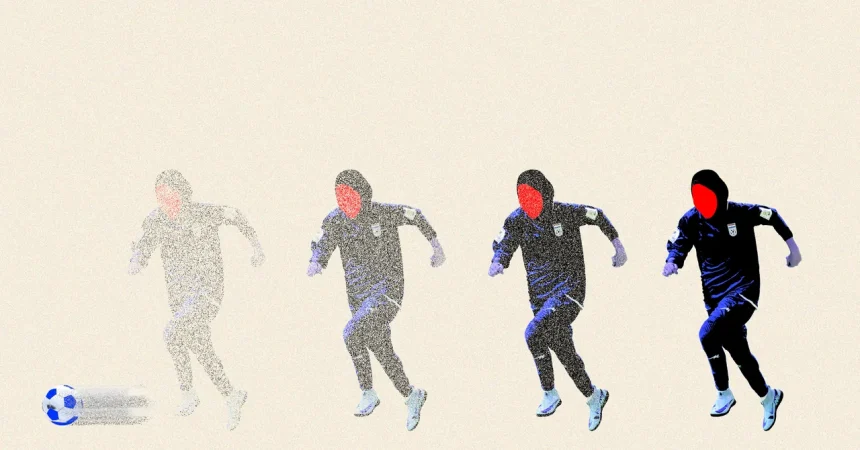
The 2026 World Cup has arrived for Iran’s national soccer team not as a simple sporting tournament, but as a complex performance played out against a backdrop of exhaustion and volatility. Following a tentative, fragile ceasefire that has barely begun to soothe months of regional conflict, the team finds itself in an logistical bind. Denied residency in the United States, they are forced to base themselves in Mexico, treated as transient visitors who must traverse the border for every match. This nomadic reality mirrors the internal state of the nation they represent—a country suspended between a turbulent past and an uncertain future, where the simple act of playing a game is inextricably linked to the heavy weight of international politics. For the players on the pitch, even a 2-2 draw against New Zealand carries a gravity that transcends athletics, serving as a reminder that their presence on the global stage is as much a political statement as it is a competitive effort.
To understand why this World Cup feels so fraught, one must recognize that sports in Iran have never been mere recreation. They serve as a vital, often painful intersection where personal identity, flag-waving patriotism, and state policy collide. For millions of Iranians, the national jersey is a mirror reflecting their own struggles, hopes, and disillusionment. The history of Iranian sports is littered with these dichotomies: the warmth of 1998, when Iranian footballers offered white roses to their American opponents in a gesture of shared humanity, stands in stark contrast to the modern era of high-profile defections and vocal dissent. In this environment, an athlete’s success is often celebrated, yet their silence can be viewed as complicity—a tension that makes the current tournament a microcosm of the Iranian experience itself.
The personal cost of this intersection is perhaps best embodied by athletes like Hadi Tiranvalipour, whose journey proves that the pursuit of excellence can carry an impossible price. Once the captain of Iran’s national taekwondo team, Tiranvalipour lived the dream that many young Iranians aspire to, winning countless accolades and serving as the face of the nation’s athletic prestige. Yet, his career was dismantled in an instant when he chose to speak out on television about the fundamental rights of women and girls in Iran. By choosing his conscience over his career, he found the walls of his homeland closing in on him; his opportunities were systematically erased, his education was blocked, and his future within Iran’s borders became a closed door. Faced with the choice between his integrity and his country, he chose the former, leaving behind his home, his family, and every hard-won medal he had ever earned to start over from scratch as a refugee.
Tiranvalipour’s narrative is a poignant reflection of a reality that many outside observers struggle to grasp: the immense difficulty of being a patriot who can no longer reside in the land they love. His departure in 2022 was not a betrayal, but an act of survival in an environment he describes as heart-wrenchingly complicated. His journey through Turkey to Italy was a testament to the sheer resilience required to keep a dream alive when the state machinery turns against you. He speaks of it now as a, “difficult” experience, one defined by profound uncertainty and the grief of abandoning the life he once knew. Yet, there is a quiet strength in his voice when he explains that he had no other way to reach his goals. For athletes like him, the “complex” nature of Iranian sports is not just a talking point; it is the fundamental reality that necessitates, and often punishes, the quest for personal and professional agency.
Despite the heavy toll of exile, Tiranvalipour’s story found a new chapter of defiance and grace. Two years after fleeing everything he had ever known, he regained his footing and found a stage that recognized his worth without demanding his silence. Representing the Refugee Olympic Team (with the support of Italy) at the 2024 Paris Olympics,