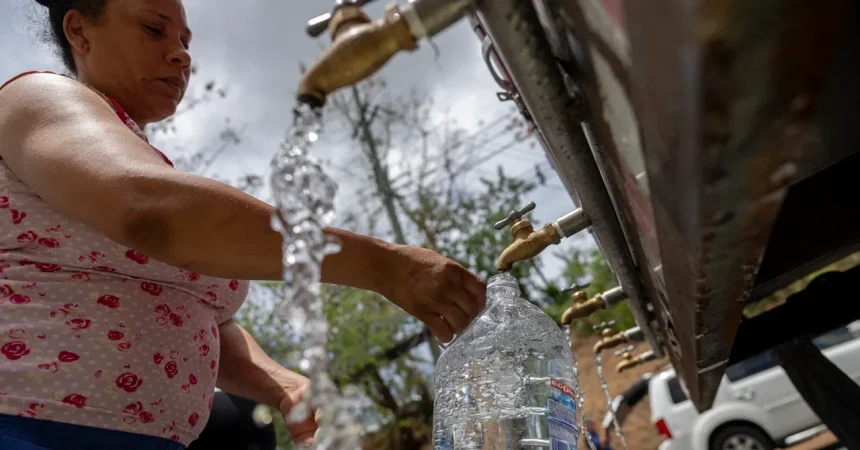
The sun beats down with an unforgiving intensity over Puerto Rico, casting long shadows across a landscape that is beginning to crack and thirst. What was once lush and green now carries the brittle, dusty scent of a land waiting for rain that refuses to come. The island is in the grip of a historic drought, the worst in a generation, following the driest month ever recorded in July. This isn’t just an inconvenience; it is a grinding, relentless crisis that has forced the government’s hand. In a desperate measure to conserve what little water remains in the reservoirs, municipal authorities have been ordered to shut off the taps for entire neighborhoods at a time. For the 180,000 households in the northeast, this means a life dictated by a two-day-on, two-day-off schedule, where daily routines—from cooking to bathing—are constantly interrupted. But for many families, the rationing is the final straw in a saga that has already dragged on for over 100 days of inconsistent or absent water service. The faucets sputter, the showers run dry, and a sense of deep frustration settles in as a place surrounded by an ocean and blessed with tropical rains finds its people parched.
The most glaring paradox of this crisis, however, is that the solution might be falling right from the sky. Even in its driest years, Puerto Rico receives a staggering amount of rainfall—anywhere from 30 to 169 inches annually. Yet, this abundant resource is being allowed to wash away, untapped and ignored. A quiet, decentralized revolution is waiting on the rooftops of millions of homes, where gutters could easily channel this free gift into cisterns and tanks. It’s a simple, time-tested technology, but one that remains remarkably absent from the Puerto Rican landscape. Unlike other island territories that have embraced rainwater harvesting as a fundamental pillar of their water strategy, Puerto Rico has largely passed it by, leaving its citizens vulnerable to the whims of a changing climate and a failing centralized system. It feels like a missed opportunity of epic proportions, especially as climate models predict that droughts will only become more frequent and more severe in the years to come. The infrastructure needed to weather these storms isn’t just massive dams and pipelines; it might be the humble rain barrel sitting in a family’s backyard.
To truly understand the water crisis, one has to look beyond the dry sky and into the decaying veins of the island’s infrastructure. The Puerto Rico Aqueduct and Sewer Authority, the entity responsible for delivering water to the public, is in a state of profound disrepair. It’s a staggering statistic: roughly 60 percent of the island’s drinking water is lost before it ever reaches a single tap, literally seeping into the ground through a labyrinth of ruptured and aging pipes. The current emergency was brought to a head by a series of dramatic breaks in the 72-inch Superaqueduct, a main artery that feeds the northern coast’s major cities. For environmental lawyer Ruth Santiago and many other community advocates, the core problem is one of mismanagement rather than a genuine lack of water. As she speaks, the irony is not lost on her that a sudden tropical storm erupts in the background of the conversation, dumping water on a landscape that is simultaneously facing rationing. It is a perfect, frustrating metaphor for the situation: there is water everywhere, but it is not being captured. It is being treated as a nuisance rather than a lifeline.
The contrast with neighboring territories is stark and instructive. In the US Virgin Islands, rainwater harvesting is not a niche hobby, but a way of life. Around 90 percent of homes there are equipped with cisterns, largely due to building codes that mandate their installation in new developments. They have recognized that in an island environment, dependence on a single, distant source is a vulnerability, and they have built resilience directly into their homes. Similarly, in Barbados, cisterns are a standard feature, and in Hawaii, some counties even subsidize or provide free rain barrels to residents. These are not desperate measures, but proactive, smart policies that treat the water that falls on the property as a valuable asset. It is, as University of Maryland professor Farah Nibbs notes, a way to treat the decentralized collection of water as “part of the national water supply.” The technology itself is beautifully simple: gravity does most of the work, pulling water from gutters into a storage canister that can then be connected to a home’s internal plumbing, feeding faucets and showerheads. On a larger scale, these systems can collect vast amounts of water to cool power plants or for industrial use. It’s flexible, scalable, and most importantly, it works.
The potential for Puerto Rico is enormous, a mathematical reality that is hard to ignore. Architect Fernando Abruña, who has long championed sustainable design on the island, estimates that if just one million households adopted rainwater catchment technology, the island could gather a staggering 30 billion gallons of water every year. To put that in perspective, the average resident uses about 62 gallons per day, which adds up to roughly 72 billion gallons of residential water use annually. While it wouldn’t single-handedly replace the entire municipal supply, it could alleviate a tremendous amount of pressure on the failing system, providing a buffer during dry spells and reducing the demand for centrally-piped water by nearly half. It would mean that during a drought, a family could still water their garden, flush their toilets, and wash their clothes. It is a buffer against the chaos and anxiety of a water shutoff, giving residents a degree of agency over their own most basic needs. This is the very definition of emergency preparedness, but it is also a pathway toward a more sustainable and autonomous daily existence.
Yet, despite its proven effectiveness and clear necessity, the government of Puerto Rico has offered no incentives, no subsidies, and no building codes to encourage this practice. The onus has been left on residents to fund and install these systems themselves, a significant upfront cost that puts them out of reach for many. This lack of institutional support is deeply frustrating for advocates who see the answer so clearly. While the most urgent fix is undoubtedly the repair and replacement of the island’s aged distribution network—a massive, long-term project—rainwater harvesting is the rapid, cost-effective solution that can be implemented right now. It puts power back into the hands of the people, literally, allowing them to weather the storm of a failing system. For experts like Nibbs, it’s not enough for governments to simply allow these systems; they must actively subsidize them so that the financial burden doesn’t fall unfairly on the poorest households. Without this crucial support, the burden of being unprepared is being passed directly onto citizens who are already struggling amidst a cascade of natural and infrastructural disasters.
The most heartbreaking part of this crisis is that solutions are often found in the quiet resilience of the community itself, not in the halls of government. Small, local non-profits are stepping in where the state has failed, working to install rainwater systems for households that could never afford them on their own. There is a growing movement of people who are not waiting for permission, but are taking action to secure their own water. In a world where the climate is becoming increasingly erratic, the ability to adapt is paramount. Across the island, people are beginning to look at their roofs with new eyes, seeing not just shingles and tin, but a patch of land that could hold a crucial reservoir of life. It is a story of adaptation, of common sense, and of the simple power of something as ancient as collecting the rain. The water cycle will continue to bring moisture to the Caribbean, and perhaps, with the right mix of community action, public pressure, and eventual policy changes, Puerto Rico can learn to catch it before it flows away, ensuring that its people are never left to thirst in the midst of a downpour.