The sun is dipping low over Golden Gate Park, casting long, amber shadows across the dusty fields as Charli XCX thunders through her hyperpop set. The bass is so visceral I can feel it pulsing in my teeth and rattling the loose change in my pockets, while the crowd—a writhing, ecstatic mass of glitter, latex, and bedazzled everything—vibrates with a frantic, communal joy. I’m trying to keep up, but my knees have a strict, bureaucratic policy against emergency cardio, offering a sharp, protestant twinge with every jump. Still, I bounce, because refusing Charli XCX is a cardinal sin, and also because the weight around my neck reminds me to stay grounded amidst the sonic whirlwind. It’s a chunky pendant—a constellation of brushed stainless steel swirls capped with a bulbous, almost edible orange orb that resembles a cross between a blown-glass jellyfish and a premium stress ball. The metal is cool against my heated skin, a tactile anchor in the swirling chaos of the evening. It feels deliberate, almost sculptural, a far cry from the disposable plastic beads and synthetic fishnets worn by the younger crowd surging around me. As the track reaches its frenetic crescendo, I grab the pendant for stability, feeling the precise ridges and polished facets of its design. It’s heavy—not annoyingly so, but enough to remind me it’s there with every turn of my head—a secret, physical weight in a world that is becoming terrifyingly intangible. The air smells of sunscreen, cheap beer, and the faint, nostalgic trace of weed. My ears are ringing, and I’m sweating through my shirt, but I keep bouncing, partly out of respect for the artist, but mostly because I’m fascinated by this object swinging against my clavicle. It’s not just a pretty bauble; it’s an invitation. I catch glimpses of strangers in the madness, their eyes momentarily fixated on the orange glow catching the strobes.
During a brief lull in the set, as Charli takes a beat to catch her breath and banter with the crowd, a girl with electric lavender hair leans into my space, yelling over the residual ringing in my ears. “Your necklace! It’s so weird. I love it.” Her eyes are wide with genuine curiosity, and she reaches out tentatively to touch the metallic swirls, then pulls her hand back sheepishly as if she’s afraid it might be hot. I grin, lifting the heavy pendant up to show her the underside. With a practiced flick of my thumb, I flip a small, machined cap off the center, revealing a gleaming USB-C connector nestled within the organic-looking grooves. “It’s a flash drive,” I shout back, my own voice already hoarse from singing along. Her face cycles through confusion, delight, and utter disbelief in a matter of seconds. Without waiting for a response, I plug the bulbous orange core into the port of my smartphone, which I’ve pulled from my pocket. The two-inch OLED screen that forms the heart of the pendant flickers to life. Instantly, a dizzying array of gooey, pastel-colored blobs materialize on the tiny display, wobbling and shifting as I tilt the phone, reacting to the internal gyroscope. The lavender-haired girl gasps, mouthing “no way” as the liquid animation pools and drips across pixels. I let her hold it for a second, and she stares at it like I’ve just handed her a piece of alien currency, completely enraptured by the tiny digital pet park living inside her hand. This is exactly the reaction that Harry Isaac and Sebastian Bidegain have been chasing and perfecting for months—the delightful collision of a utilitarian object with pure, playful aesthetics. It’s a flash drive, sure, but it’s also a walking aquarium, a digital mood ring, and a piece of sculpture that fits in the palm of your hand. As the music swells back up, we lean against a barrier, away from the chaos, and I explain that beneath that smooth, glossy orange exterior lives a simple 256GB storage module, but the true magic lives in the seamless bridge between the physical heft of a jewelry piece and the fleeting, luminous world of screen-based data. It feels like a magic trick you can wear, a secret handshake for a generation that demands utility, beauty, and a whisper of the absurd.
This weird, wonderful object doesn’t just materialize out of the ether; it was forged from the fevered imagination of two young designers with a profound disregard for the mundane boundaries between fashion, tech, and play. Harry Isaac and Sebastian Bidegain, working in creative tandem under the moniker Noware, first dropped a grainy, early prototype of the Puff necklace onto social media in early 2025. That single, unassuming post detonated across the internet, accumulating over a million obsessive views in a matter of days, while thousands of eager early adopters furiously signed up for a waitlist to secure a unit. It was the kind of viral crescendo that could easily decapitate a less-prepared startup, transforming a cute dorm-room idea into a global supply chain nightmare overnight. But Isaac and Bidegain have treated the subsequent year as a rigorous, punishing graduate program in industrial design, logistics, and mass manufacturing—a crucible of plagiarism checks, material sourcing, and factory QA visits. Today, they sit across from me at the WIRED office, both sporting their own Puffs clipped to their collarbones, which happen to match their impeccably curated gorpcore ensembles—technical fleeces, ripstop cargo pants, and chunky trail sneakers that look more suited to ascending K2 than navigating a magazine’s Manhattan HQ. They radiate the studious cool of a streetwear drop, but their nervous fidgeting betrays the immense stakes. This is their first wide release, a terrifying and thrilling leap from digital promise to physical reality. Their pedigree, however, is steeped in an almost anarchic playfulness that reassures me their design chops are genuine. Isaac previously achieved viral notoriety for constructing an electric scooter that belches out fragrant, iridescent bubbles as it weaves through traffic. Bidegain’s portfolio is a veritable cabinet of digital curiosities, featuring a vape pen wired to capture photographic “exhales” into pixels, and a lo-fi audio sampler literally carved from a chunk of river stone. Their entire body of work exists in the liminal space between sterile tech and visceral sculpture, where the absurd is not just tolerated but celebrated as a higher form of logic. They aren’t merely manufacturing devices; they are meticulously crafting tiny, wearable narratives that prompt strangers to ask questions in mosh pits.
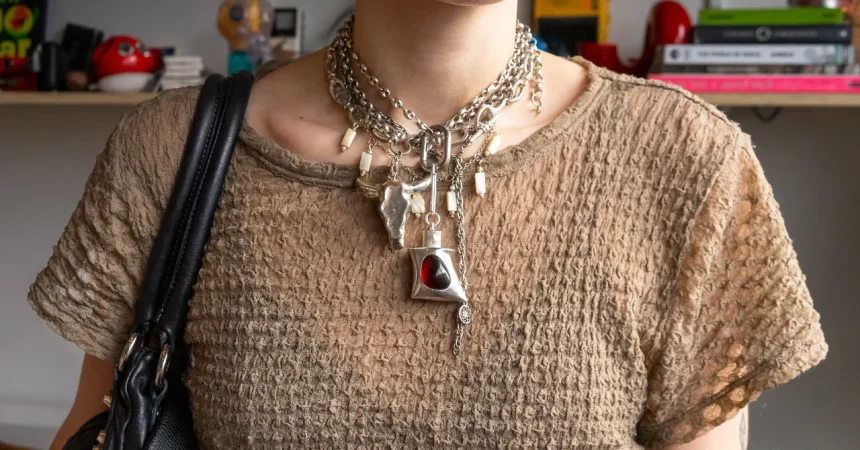
The design ethos behind the Puff is a delicate, high-wire act between pure ornamentation and hard-nosed utility. Their marketing materials reveal a carefully calibrated mind: one mood board shot features a “cool girl” with the Puff clipped nonchalantly onto her leather handbag, right where a Labubu figurine might have perched last year, its orange dome subtly echoing the Y2K-era charms of a coach bag. Another spread showcases it layered against a model’s sternum, nestled artfully among a curated menagerie of oxidized silver chains and heirloom pendants. The goal is subversive: to make it irresistible as a fashion statement first and a storage device a distant, delightful second. The creators explain that their design inspirations are wonderfully eclectic, pulling from the “squishy, doughy” textures of artisan bread and ripe fruit, the organic, fractal curvatures of cellular biology, and the deeply satisfying tactile feedback of older, analog devices that demanded physical interaction—rotary phones with their weighted dials, cracked radios with their satisfying clicks. This obsession with tactility is the philosophical core of their creation. “On one end, I want anyone to be able to wear it, just if they think it’s pretty,” Bidegain says, gesturing to his own pendant. “Though, I also want people who actually find utility in flash drives as part of their workflow—photographers moving RAW image files on set, DJs swapping entire club sets on the fly, IT professionals carrying bootable diagnostic tools in their pockets.” This dual focus is refreshingly practical in a tech landscape that too often defaults to sterile minimalism. In a world dominated by uniform aluminum slabs, glassy touchscreens, and white braided cables, the Puff dares to reintroduce purposeful texture, vibrant color, and an authentic sense of the human hand. It acknowledges a subtle, unspoken truth about our digital lives: our files are ephemeral, existing as quantum pulses on silicon, but the physical containers we choose to house them in can become intimately personal heirlooms, worn against the skin for decades. The materiality of the brushed stainless steel and the glossy, UV-stable resin is chosen not merely for maximum sleekness, but for maximum comfort against bare skin, a pleasing weight that swings with the rhythm of walking, and an undeniable visual curiosity that invites conversation from complete strangers.
But the crowning jewel of the Puff, and the aspect that had me hypnotized during our entire conversation, is undeniably the small, brilliant OLED screen nestled into the center of its weirdly beautiful body. When the drive is plugged into a phone or a laptop, that innocuous center panel bursts into life with a customizable design that feels less like a static wallpaper and more like housing a tiny, digital pet. During our meeting at WIRED, Isaac and Bidegain eagerly queued up several demonstration modes. First, they showed me goopy, gelatinous animations that stretched, dripped, and deformed based on the precise angle I held the phone in my hand, an internal gyroscope working furiously to translate physical movement into digital deformation. Then, with a tap, they switched to an “aquarium” mode, where minuscule, iridescent digital fish darted and followed the trajectory of my thumb as it traced patterns across the host screen. And to my absolute delight, they even typed in the WIRED logo—a blocky, retro-futuristic monospace that pulsed with a soft neon glow against the dark OLED backdrop—all crafted via a bespoke piece of software they’ve designed to be childishly simple. Anyone can use this software to upload their own custom pixels, looping GIFs, or cryptic text messages, effectively turning the necklace into a constantly morphing billboard for personal identity. The true genius, however, resides in the deliberate absence of any internal battery. Unlike smartwatches, fitness trackers, and the myriad other wearables that demand daily charging and ultimately become landfill-destined bricks when their lithium-ion cells inevitably degrade, the Puff contains absolutely zero internal power storage. It is a dormant ghost until it is summoned forth by a USB connection. This is a masterstroke of sustainable, anti-consumerist design. That necklace can sit on your nightstand, be nestled in a jewelry box, or swing from a chain for years—decades, even—completely inert and silent, deriving its life entirely from the host device it connects to for a few minutes of file transfer. The moment you unplug it, it recedes back into being a beautifully crafted piece of steel and glass, immune to the battery-rot that clutters drawers across the globe. The screen is effectively a waking dream, a potent reminder that our most magical digital experiences can be ephemeral, fleeting, and deeply personal, rather than constantly humming and draining our attention (or our battery percentage).
After our meeting wraps up, I clip my loaner Puff back onto my shirt collar and step out into the mundane, concrete jungle of the city. I find myself instinctively patting my chest, checking the reassuring bulge of the pendant beneath my jacket, even though I know logically it hasn’t moved. The novelty hasn’t worn off; it’s a small, heavy, delightful secret tucked against my sternum, a counterweight to the intangible, invisible cloud storage that swallows the rest of my digital life. The Puff represents a broader cultural craving simmering beneath the surface of our always-on, glass-slab existence—a profound desire to physically touch our data, to make our bytes bend to our fingers, to reverse the relentless dematerialization that has stripped our cherished objects of their souls and reduced them to icons on a touchscreen. By giving a humble flash drive a face, a weight, and a mischievous personality, Noware has masterfully tapped into a deep nostalgia for an era when technology felt chunky, individual, and fundamentally alive. They have also elegantly solved the existential problem plaguing the wearables sector: longevity. Because the Puff doesn’t require power to simply exist, it will never become a brick in a drawer, a casualty of a dead battery or an obsolete charging port. It will simply wait, eternally patient and stoic, holding your family photos, your backup documents, and your favorite soundtracks until the precise moment you need them again. As I walk along the edge of Golden Gate Park, the last rays of the sun painting the eucalyptus trees in shades of orange to match my pendant, I think back to the lavender-haired stranger and her giddy, disbelieving laughter. In a few short months, thousands of these Puffs will be swinging from the necks of photographers, DJs, and fashion-forward civilians. They will be a quiet, persistent rebellion against the cold, gray, energy-starved future we’ve been promised. This little piece of sculpture proves that the future can be warm, squishy, glowing, and gloriously, defiantly weird. It is not merely a USB storage device; it is a talisman for a more tactile, human-centric, and playful era of technology—one where our gadgets aren’t just tools, but companions with their own secret lives, waiting patiently for us to plug in and play.