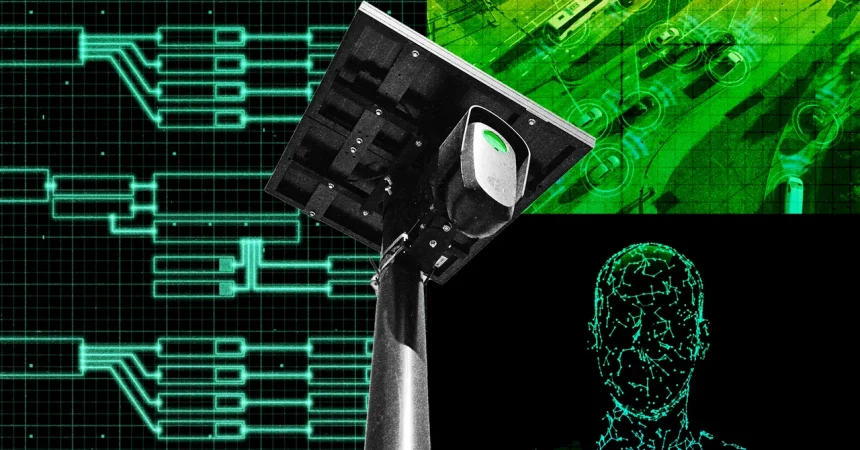
At a time when police departments are increasingly eager to turn to artificial intelligence, one company has quietly built a system that promises to turn an entire city’s web of cameras into a single, searchable mind. That company is Flock Safety, and the tool at the center of this story is a kind of AI-powered assistant designed for law enforcement. WIRED recently took a deep look under the hood of that software, and what they found offers both a fascinating glimpse and a troubling puzzle. The investigation began with public-facing parts of Flock’s login portals. By loading these pages, reporters were able to see a user interface for screens that would ordinarily appear only after a police officer signed in. They could reconstruct search fields, prompts, controls, and tools exactly as an officer might see them. The files appeared to contain everything needed to recreate the interface from scratch, even without ever logging in as an actual user. It is a bit like finding the manual to a locked room: you can’t go inside, but you can read every instruction, every label, and every button. What the code showed was an AI product that sits on top of Flock’s massive network of cameras and license plate readers, allowing officers to query millions of images and data points in plain language. The company’s own suggested prompts are baked right into the interface, and the entire experience is designed to feel less like typing a search query and more like asking a helpful partner to go find something.
Before an officer runs a search, the software can ask for a justification. At first glance, that sounds like a safeguard. The code shows that by default, an officer has to type a reason into a box. But then the cracks begin to appear. The form places no requirements on what that reason says, how long it must be, or whether it is actually connected to the search at all. If a department also requires a case number, the system only checks that the number contains at least three characters. That means someone could type “abc” and satisfy the requirement. WIRED could not determine whether Flock applies additional checks on its own servers after the information is submitted, but the lack of visible constraints is striking. Independent security and privacy researcher Buchodi, who has spent years reverse engineering consumer software and surveillance technologies, examined Flock’s code separately and reproduced key parts of the analysis. The conclusion is less a critique of Flock specifically and more a broader concern: the justification step is a formality, not a meaningful oversight. It feels like asking someone why they want to enter a building and then accepting the answer “because” without any further questions. For citizens, this is unsettling because the entire point of requiring a justification is supposed to be accountability. Yet the software’s default design appears to make that accountability almost entirely symbolic.
But the code WIRED reviewed cannot show the whole picture, and that is perhaps the most important caveat. It contains no instructions given to the AI model itself, and it does not reveal what Flock’s servers do with a request once it is submitted, what they send back, or whether they refuse certain commands. In other words, the visible pieces are like stage directions without the actual play. You can see where the actors stand, what they are supposed to hold, and what lines they are expected to deliver, but you cannot see whether the actors will improvise, refuse, or silently do something unexpected. References to the tools Flock offers, the data they can apparently reach, and the suggested prompts Flock authored for police are fixed in the code. Those are real, and they matter. They tell us what Flock intends the system to be used for and the kinds of questions police can ask. But they do not tell us whether the system is actually checking anything, whether it limits itself according to the law, or whether it has any hidden rules. The gap between interface and server is where some of the most consequential decisions happen, and that gap remains closed to outsiders. In an era when AI systems are often judged by their outputs, this opacity is a reminder that what users see and what machines are actually doing can be very different.
Flock’s leadership has said remarkably little about the AI tool in public, but the few statements that exist are evocative. Garrett Langley, the company’s chief executive, once described the system as a crime analyst who is, in his words, “always awake, always watching out for you.” That is a powerful image, especially for police chiefs and public safety officials who have to make decisions with limited information. At a demonstration for police chiefs in Denver last year, Langley painted a vivid picture of what the technology could do. He described searching every camera in a city for cars tailing an armored truck, pulling up the registered owners of those vehicles, and checking their arrest records—all in under a minute. To a room full of law enforcement leaders, the pitch was seductive. Langley said that investigators who try the tool get “addicted.” That word is interesting. Addicted suggests something more than a convenience; it suggests a habit, a craving, a reliance that becomes difficult to break. The demonstration was designed to show speed and ease, and by all accounts it did. But it also raised uncomfortable questions about how much surveillance is reasonable, how long data should be kept, and whether an AI trained on all of that data can ever truly be neutral or fair. The line between helpful assistant and tireless watcher is thin, and Flock appears to be standing right on it.
The company behind this technology has grown at a dizzying pace. Flock was founded in Atlanta, and its earliest days were far from glamorous. Langley’s first camera was a phone inside a waterproof box. Now the company logs 20 billion license plate scans a month, a number that is almost impossible to wrap your head around. Andreessen Horowitz, Founders Fund, and other prominent venture capital firms have poured money into the business, and its valuation has reached $7.5 billion in the most recent funding round. Flock’s original tagline was equally ambitious: “the first public safety operating system that eliminates crime.” That claim is bold, and Langley continues to make grand promises. He recently told Vanity Fair that Flock would have solved the disappearance of Nancy Guthrie, the mother of Today show host Savannah Guthrie, had its cameras been deployed where she vanished. The company now counts roughly 140,000 monthly active users, meaning tens of thousands of officers are logging in and using this system on a regular basis. Inside Flock’s new Atlanta headquarters, there is a striking artifact: a gold-painted camera covered in signatures. It commemorates an earlier corporate ritual. In the company’s early days, every time Flock added another million dollars in revenue, employees would mark the occasion by signing a new camera. “Now we do more like a million a day,” Langley recently said. That simple sentence captures the enormous gap between Flock’s modest origins and its current scale. The gold camera is not just a quirky piece of office decor; it is a monument to a company that has transformed itself from a garage project into a major force in American policing.
Andrew Guthrie Ferguson, a law professor at George Washington University, has been watching this evolution with a sense of inevitability. “To use all the data collected, you need to build in the ability to query it,” he says. “To make things easier for police officers who are not going to create their own agentic tools, you must preprogram the system with some natural language prompts and automated workflows.” His point is important because it reframes the debate. Flock is not an accident; it is the natural next step in the story of mass surveillance. Once you put cameras on every corner, once every license plate is scanned and stored, once every vehicle’s location becomes a data point, the obvious next move is to build an interface that lets officers make sense of it all. Ferguson’s words also remind us that police officers are not software engineers. They are not going to write complex database queries or develop their own AI agents. So a company like Flock steps in and provides the prompts, the workflows, and the shortcuts. That preprogramming is deeply consequential. It shapes what officers can ask, which questions are easy to ask, and which ones are never even suggested. A system that offers a prompt about suspicious vehicles but not about mistaken identities is not neutral; it is steering attention in a particular direction. The question is whether anyone outside the company, or outside law enforcement, will ever be able to see how the steering happens. The code WIRED reviewed shows the outlines of this system, but the full picture remains obscured, somewhere between the interface and the server, between the promise and the practice. As Flock continues to grow, that hidden space deserves more light.