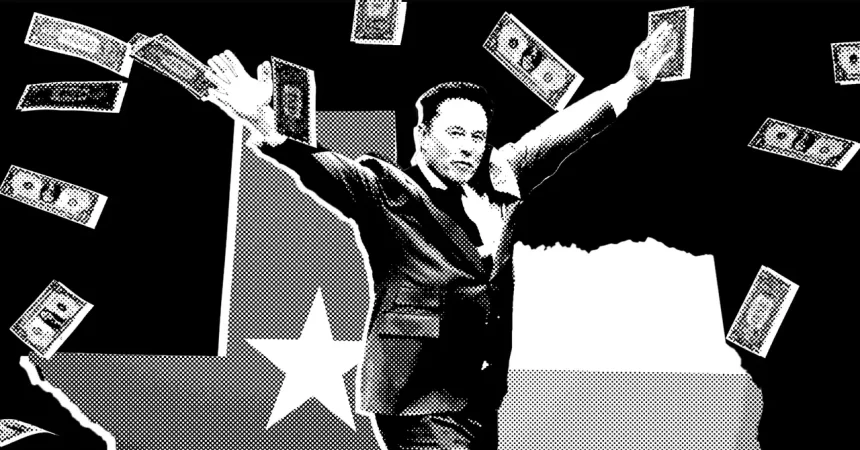
The High-Stakes Gambit: Inside Musk’s $200 Million Midterm Power Play
The price of American democracy has never been higher, and no one knows that better than the operatives, strategists, and restless billionaires quietly reshaping the political landscape ahead of November’s midterms. Word is circulating through Washington’s power corridors that Elon Musk is prepared to open his formidable wallet once again, funneling somewhere between $100 million and $200 million into the Republican machine with a laser focus on voter turnout operations. The sheer scale of this projected spending spree—confirmed by Trump officials briefed on the matter—signals something deeper than mere political enthusiasm. This is a statement of intent, a flex of financial muscle that could very well determine the balance of power in Washington. And at the heart of this high-stakes chess match sits Texas, where the special election has suddenly become the center of the political universe. The fate of Republican candidate Ken Paxton hangs in the balance, but so does control of the US Senate, making every dollar spent, every door knocked, and every phone call made a potential turning point in American political history.
At the center of this high-stakes game sits Ken Paxton, a political survivor who’s been fighting with one hand tied behind his back. The financial disparity is almost laughable—his opponent, James Talarico, has been swimming in campaign cash, having raised a staggering $69 million compared to Paxton’s measly $9 million, according to the latest Federal Election Commission filings. That’s money that talks, money that powers the get-out-the-vote operations, the TV ads, the digital outreach, the field offices staffed with enthusiastic young operatives fueled by cold pizza and ambition. Paxton, meanwhile, has been left to run an austerity campaign in a state where everything moves big. It wasn’t supposed to be this way. He slogged through a brutal primary against Senator John Cornyn that left him bloodied and financially depleted, with old scandals resurrected and re-litigated in the harsh light of campaign season. And the cavalry isn’t exactly thundering over the hill to save him—the two largest national Republican groups have been conspicuously quiet, their checkbooks firmly closed and their powder dry. The Senate Leadership Fund, helmed by allies of Majority Leader John Thune, threw their support behind Cornyn during the primary, and they haven’t exactly been warming up to Paxton since. Even MAGA Inc., which typically rides to the rescue of embattled GOP candidates, hasn’t announced any spending plans that would throw Paxton a lifeline. For a candidate who won the nomination, Paxton is remarkably alone, a fact not lost on seasoned political observers watching this all unfold.
But here’s the dirty secret of this election cycle: Paxton isn’t the only Republican running low on funds, and the GOP has a problem that goes way beyond Texas. Across the map, in the suburbs and exurbs where close elections are decided, Democratic candidates are out-raising and out-spending their Republican counterparts with an intensity that has GOP insiders quietly panicking into their $20 cocktails at fundraisers. It’s a strange role reversal in a country where a strange cash gap has emerged: Democrats have all the small donors while Republicans have the institutional machine money. The Republican National Committee is sitting on a not-insubstantial $128 million war chest, money that could buy a lot of yard signs and ad slots in battleground states. But on the other side of the aisle, the Democratic National Committee finds itself $2 million in debt, a rounding error in today’s political economy but a symbol of the broader struggles both parties are facing. The real action, as always, is in the super PACs, those shadowy vehicles for unlimited and often opaque spending. The two main GOP super PACs have amassed a staggering $380 million for the House and Senate races, absolutely dwarfing the Democrats’ $116 million and buying up the kind of TV airtime that wins elections. And then there’s MAGA Inc., with roughly $400 million sitting in the bank, a war chest so vast that there’s simply no Democratic equivalent that can compete on the same scale.
Which brings us to the trillion-dollar question: does any of this money even work? Musk’s 2024 track record, as it turns out, is about as predictable as grabbing a greased pig. The plan was audacious in its reach and scale. For months, the 2024 Trump campaign outsourced its ground game to the dark money group America PAC, which in turn funneled more than $46 million into the pockets of third-party canvassing firms scattered across a handful of battleground states. The mission: convince the legions of disaffected, disengaged voters who like Donald Trump but have a hard time remembering they’re registered. The canvassers were supposed to be the tip of the spear in the fight for the soul of the Republican majority. But in practice, as countless interviews and internal documents have since revealed, the ground operation turned out to be less fearsome, less effective than intended, résumé-padding and clock-punching often eclipsing actual voter contact. The election came and went with Trump sweeping all six battleground states, but Trump’s team is quick to point out that their man’s celebrity status and uncanny ability to mobilize his base is what really moved the needle, not some canvasser with an iPad.
Still, for every success story of a high-dollar, high-tech political spending spree, there’s a cautionary tale hiding just beneath the surface. The 2024 ground war saw a sense of disillusionment and chaos behind the scenes that should give any donor pause before they write that massive check. Payroll complaints trickled in, with staff and workers reportedly stiffed on paychecks and facing impossible quotas where they were essentially strong-armed into reaching out to more voters while being forced to pay for their own lodging out-of-pocket if they didn’t hit the numbers. The daily reality for these workers was a contractor-to-canvasser dynamic that rewarded speed over significance, with minimal oversight and maximum opportunity for slippage.
And yet, as we approach the 2026 midterms, the question looms larger than ever: what is the return on investment? Because holding the House or losing the Senate isn’t worth what it used to be—political observers and institutionalists on both sides of the aisle are asking whether we’re entering the political ceasefire or the open political warfare era. Both parties are starting to realize you can’t govern through the loudest voice in the room. The bill always comes due. For now, Musk, a man of few filters and many tantrums, seems to be betting the farm on the idea that the party’s future is tied to whatever person can out-conservative the last, to whoever shows they can go hardest at the border and the economy, and that voters won’t lose the appetite for the chaos when the money runs out. Maybe they won’t. Maybe we’re just seeing the beginning of a new era of American political perfection. Either way, the checks have been written, and the circus is coming to town.