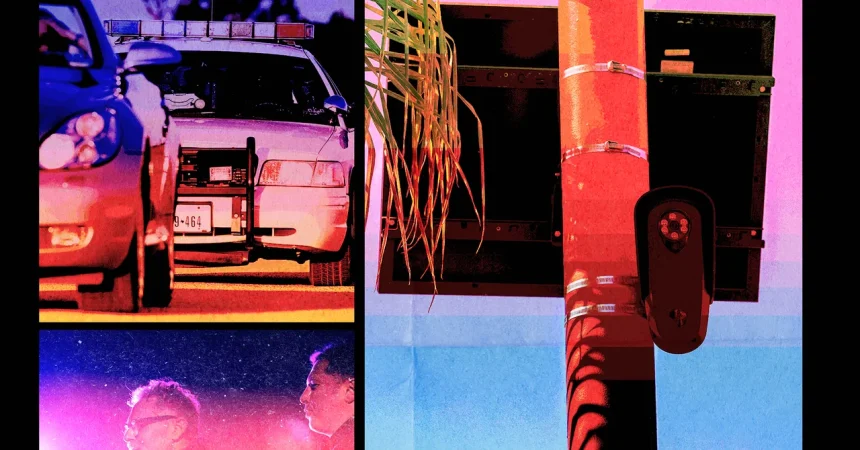
For anyone who’s ever felt a creeping unease under the gaze of surveillance cameras, or who’s read one too many police scanner stories about drivers being pulled over by mistake, there’s now a unique—and very cathartic—way to push back. Grand Theft Auto V, the sprawling satirical open-world game that’s been around for over a decade, now offers a mod called Grand Theft Automated License Plate Reader (GTALPR). It’s a fan-made creation by artist and programmer Morry Kolman, and it does exactly what it sounds like: it installs 235 automated license plate readers (ALPRs) scattered across the fictional city of Los Santos, a stand-in for Los Angeles. These aren’t just decorative—they work just like the real machines, scanning plates, logging everything, and communicating with the in-game police. The mod turns the city into a dystopian surveillance nightmare, giving players an option to fight back: they can smash, shoot, or even blow up the cameras, each one netting a small cash reward. It’s cathartic, but also eerie, because the cameras watch everything you do, and each interaction is meticulously tracked and displayed in a personal, creepy album. It’s a brilliant, darkly humorous commentary on how surveillance tech has become woven into the fabric of daily life, especially in places like Los Angeles, where real-life Flock cameras are present in huge numbers.
The mod’s origin story is as fascinating as its execution. Kolman, who’s been building artful mods for years, was deeply inspired by the rising wave of public outrage against Flock Safety—a private surveillance company that sells high-tech ALPRs to law enforcement and community groups. Kolman studied a teardown report by an Iowa civil liberties group called Eyes Off Cedar Rapids, which broke down the Falcon Cam—the camera’s parts and costs. This gave him the inspiration for the game’s reward: $600 for each camera you destroy, a fun workshop figure that matches the real-world costs of parts and repair. He couldn’t install the mod officially, but he made it available for free online, so players everywhere can install it and experience a small scale version of the surveillance dilemma and sometimes the need to physically eliminate these boxes. The mod doesn’t condone vandalism in real life, but it does give players a way to let off steam in a fictional world where the consequences aren’t real, and where that cathartic release can feel oddly satisfying.
When you install GTALPR, you’ll immediately notice: the cameras aren’t just there for decoration. They are fully integrated into the game’s police AI, but in a more sinister way. If you happen to drive past one while you’re already being chased by the cops, the camera will extend the chase’s duration, meaning the police will stay on you longer, as if the camera relayed your position to them. But that’s not all. There’s also a 5% chance that just driving by a camera triggers a police response for no reason at all—even if you’re driving perfectly legally. This is intended to mimic the real-world problem, as reported in news stories, where innocent citizens have been wrongfully pulled over or even held at gunpoint because of ALPR errors. Kolman explained his design here: “There are violent responses and these dangerous situations created by these cameras and their inaccuracies,” he said. So the mod simulates that living in a surveillance state isn’t just about being watched—it’s about the constant anxiety of not knowing when the wrong algorithm is cause to accuse you. The game thus becomes a surveillance nightmare, but that’s exactly the point.
There’s a rich history of mods in the GTA V if community, and it’s not surprising that an artistic critique could land so well. The game has been out since 2013, and for over a decade, players have created thousands of custom mods that span gameplay tweaks, visual overhauls, even creating a whole world of their own. The GTALPR mod has a special niche—it’s not just a tool but a commentary. Kolmid is deliberately not an endorsement of real-world vandalism, but the mod itself feels like a dark, cathartic release for many. He notes, “I don’t endorse it as a real-life action. But there is a public appetite for some kind of cathartic release against these machines.” That’s clear from the facts: real Flock cameras have been vandalized in at least 36 states, using methods like spray paint, saws, and even flaming projectiles, according to an NPR analysis. This suggests the DIY protests aren’t uncommon, and Kolmant’s mod taps into that widely felt frustration by allowing players to smash these cameras in a fictional space, where they can experience the feeling of taking back control without real-world harm. Even GTA itself is a world of crime and chaos, so the mod feels like the natural next step, allowing players to push back against the cityscape that normally works against them.
The timing of this release is another layer. Real-world use of Flock cameras has been under fire as well. The Los Angeles Police Department suspended its usage this summer after recommendations from its own inspector general, which echoed concerns about the ineffectiveness and equity of the tech. Moreover, Texas and Florida governors have recently taken steps to curb Flock’s use, and across the US, there were 131 contract terminations in August alone, according to an anti-surveillance group. This means that Kolman’s satirical mod isn’t just a virtual fantasy—it mirrors a real shift in public and administrative opinion. But Kolman doesn’t just want to demoralize players; he hopes they’ll feel the pervasive unease of this technology in a personal way. He says, “I know you could read a thousand reports about why surveillance is bad, but it’s a different thing to try to drive around Los Santos and hit every camera. You suddenly realize they’re everywhere, and you can’t escape them.” That’s the design’s careful intention. The mod isn’t just about breaking things; it’s about teaching to see the world anew.
Looking ahead, the venerated comedian of this mod points to the future of the franchise. Grand Theft Auto VI is scheduled to release this November, set in a fictionalized Miami, and it will be a new playground for modders. Kolman jokes he doesn’t plan to create a specific version for Vice City, but he adds “We’ll probably wait and see what the people of Vice City have installed around the map.” That line is a nod to the real-world spread of these surveillance networks in some cities, and hints that his modding concept could be adapted to any locale. The underlying message is clear: strategic surveillance exists everywhere, quietly embedding itself into daily life. In the end, GT App LPR is about letting you fight back for a while, and then ultimately, it makes you feel in your bones how inescapable—and equally insidious—these systems are. It’s a perfect example of how art can meet play to foster understanding, tapping into current events in a microcosm. With the mod, the player can feel both the satisfaction of destruction and the deeper unease of living within a grid of watchful eyes, a hybrid where gameplay and social commentary are turn into one solid unit. The game may be fake, but the lesson is all too real.# The Cathartic Virtual Revolt Against Automated Surveillance
For anyone who has ever felt a creeping unease under the tireless gaze of a surveillance camera, or who has flinched at the sight of yet another metal box perched on a streetlight, there is now a uniquely satisfying way to vent those frustrations—inside the fictional chaos of Grand Theft Auto V. The game, a sprawling interactive world famous for its criminal liberties, now offers a subversive mod called Grand Theft Automated License Plate Reader (GTALPR). Created by artist and programmer Morry Kolman, the mod plants 235 automated license plate readers around the game’s city of Los Santos, a thinly veiled stand‑in for Los Angeles. But these aren’t just scenic props. The cameras are fully functional, scanning every car that passes, logging plates, and relaying information to the in‑game police. Players can smash, shoot, or blow them up, earning a digital reward for each fraudulent act. Yet the mod is not mindless destruction—it’s a satirical mirror. Kolman designed it to replicate the real‑world systems used by Flock Safety, a private surveillance company that provides ALPRs to police and neighborhood associations across the US, while also capturing the public’s rising resentment toward those systems. As you drive through the streets of Los Santos, the cameras are everywhere, some in clusters, some hidden at intersections, and your interaction with them brings the mod’s central theme home: the innocent drive to “escape” surveillance—and the guilt that comes from watching them—feels both thrilling and unsettling.
Entering this virtual world of rebellion, players quickly discover the mod’s complexity. On the surface, it’s straightforward: find a camera and smash it, shoot it, or use explosives. The simplest act yields a $600 in‑game bounty, a sum derived not from a wild guess but from a careful breakdown of the actual costs of a Flock Falcon Flex camera, as cataloged by a teardown report from the Iowa-based civil liberties group Eyes Off of Cedar Rapids. That financial footnote adds a precise and almost poignant touch—it tells the player that, yes, in the real world, these cameras are worth something, and here you’re “claiming” that value back. But the mod doesn’t stop at the destruction. Every time a player destroys a camera or even just drives past one, the mod quietly logs the event, building a personal “photo album” of each encounter. The player sees their car’s plate, a timestamp, and a snapshot—the same way a real ALPR does—but now they are on the administrator side. This feature turns the game into a data‐guzzler itself, forcing you to reflect on your own privacy while you play with it. Is the mod itself a surveillance tool? In a way, yes. It’s a clever, often deeply characterful metaphor once more: the player, in destroying the cameras, creates yet another record of their actions, echoing the absurdity of the surveillance state. Kolmogorov explained in an interview, “The mod is not an endorsement of vandalism any more than GTA is an endorsement of real-life crime, but the game is about catharsis.” And indeed, there is a deep catharsis in turning the tables on the eyes that seem to watch you everywhere.
But the mod is more than a fancy target range. Kolmogorov integrated the cameras into the core gameplay loop. A driver being chased by the police will find that their cooldown period—the time after which the heat fades—gets extended when they pass near one of the 235 installed cameras. The camera instantly relays their location, making escape much harder. In some dense neighborhoods, a player can find themselves perpetually chased because of the sheer number of cameras. This reflects the real-world effect of ALPRs, where a Conga network of cameras can track a car across a city and facilitate constant police tailing, even if the driver isn’t breaking a law at the moment. But the to top it off, there’s also a random chance, a 5% trigger, that just driving past a camera will send police to the player’s location—no crime committed, no excuse. This was inspired by real news reports: innocent people have been held at gunpoint, cuffed, or even shot at due to ALPR mistakes—for instance, a plate number misread or a false flag. Kolman says this feature is meant to reproduce the panic and injustice that emerges from systems that are supposed to “prevent crime” but often treat everyone as suspect. The mod becomes not just a fantasy but a stress ball of social commentary: it’s a joy to destroy these machines, but also it makes you feel the oppressive weight of being watched and accused at any rueful moment. This dual experience forces the player to confront the dystopian possibility of a world where surveillance is not just a passive tool but an active, potentially violent system of control.
(This creative tribute doesn’t exist in a vacuum; it comes from a long tradition of GTA modding culture, but it aligns perfectly with the current times.) In real life, across the United States, Flock cameras have become a target for activists and outraged citizens. Reports show they’ve been destroyed in at least 36 states, with methods as varied as spray-painting lenses, using saws, cutting power cables, or even trying to incinerate them with flaming projectiles. This mod taps directly into that energy. The real-world altercation, however, often carries serious criminal penalties, and the mod offers an alternative: a safe space to “smash” the machines without consequences. The mod’s creator is not oblivious to this line; he in fact, he carefully chosen the name and design to strike a balance. He doesn’t want to encourage real-world vandalism (and the mod’s official description explicitly warns against it), but he wants to provide a therapeutic outlet for the powerlessness people feel when they realize the constant watching. The mod’s design is a extremely responsive to the current landscape: over the past few years, scrutiny of Flock’s technology has emerged. The LAPD suspended its use of Flock cameras in the summer of 2025 after its inspector general recommended it—citing issues with accountability, accuracy, and disproportionate impact on minorities. This happened in the very city the game is named after. Not only that, but Texas and Florida state governors have taken action to limit the proliferation of these cameras, and outside the US, there were 131 Flock contract terminations in a single month in November, according to the advocacy group Secure Justice, showing that the political tide is slowly turning.
The timing of this mod, then, is not just an artistic coincidence; it’s a spicy reflection of a transition point in the national surveillance debate. As more communities become alert to the dangers of unrequested, pervasive data collection, Kolman sees his mod as being part of that wake-up call. When asked if he plans to adapt the mod for the upcoming Grand Theft Auto VI, set in the fictional Vice City (inspired by Miami), he jokingly says, “I’ll probably wait to see what the people of Vice City and their local government have installed around their map first.” This is a clever confidence that reflects his approach—the mod’s commentary is deeply localized, yet adaptable. The note he adds, “I can read a thousand articles about why surveillance is bad, but having to drive across Los Santos and feel the constant replica of the cameras, you’re never out of range—it makes you realize you can’t escape them. I want to create that feeling.” And indeed, the mod achieves that: it turns a city that was once a playground for crime into a place saturated with the machine gaze, inescapable, nearly claustrophobic. Through a blend of dark humor, targeted satire, and video game agency, GTALPR gives players a chance to fight back—albeit in a virtual world—while inviting them to reflect on the very real privacy concerns that have become embedded in our lives. Once you’ve taste the thrill of toppling those cameras, you can’t shake the eerie feeling that this may be the closest any of us get to a real revolt—but it’s a powerful reminder. And that is exactly the intent. For a game, it’s more than just extended entertainment; it’s a v7 vector for empathy and a thought‑politics hike through the storm of the modern surveillance state.