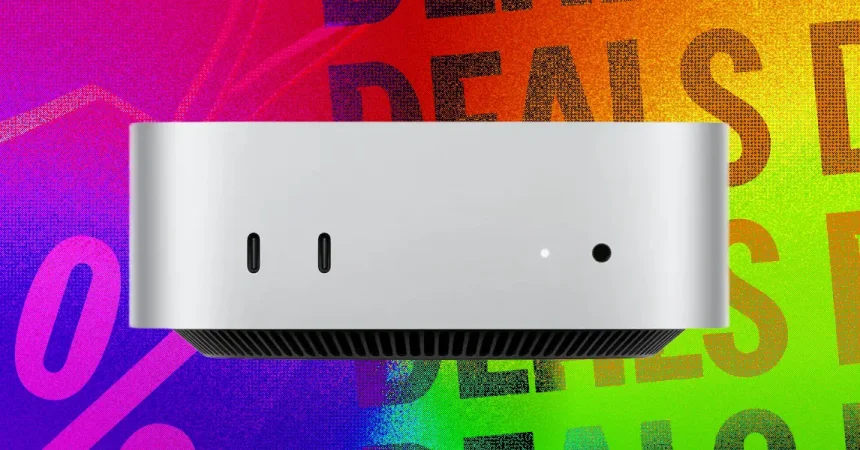
If you’ve spent any time in the tech or AI communities over the past year, you’ve probably noticed a strange and wonderful obsession forming around a little silver box: the Mac Mini M4. It’s not flashy. It doesn’t have a screen, a keyboard, or even a particularly exciting design. But it became the quiet workhorse of a surprising movement—people running local agentic AI on their desktops, 24 hours a day, seven days a week. Agentic AI, for the uninitiated, refers to AI systems that don’t just answer questions but actually take actions, make decisions, and complete multi-step tasks on their own. These systems are hungry for compute, memory, and reliability, and the Mac Mini M4 turned out to be a shockingly good fit. It was powerful enough to handle serious local models, efficient enough to run around the clock without turning your electricity bill into a nightmare, and affordable enough that hobbyists, researchers, and tinkerers could justify buying one just to experiment. The demand was so intense that the M4 Mac Mini was out of stock for months. Retailers couldn’t keep it on shelves. Apple’s supply chain, no matter how sophisticated, simply couldn’t keep up with the appetite of a crowd that had suddenly discovered the joy of owning a genuinely capable AI workstation for less than the price of a flagship smartphone. It became a cult classic in real time, a machine that people talked about in reverent tones, sharing tips on Reddit and YouTube about how to squeeze every last drop of performance out of it.
Now, fast-forward to the present, and the landscape has shifted in a way that makes this little computer even more interesting. Apple has introduced the new Mac Mini M6, and here’s where things get a bit quirky: there was no M5 Mac Mini. Apple jumped straight from the M4 to the M6, skipping an entire generation, which means the M4 isn’t just one generation old—it’s technically two steps behind in naming, though in practice it’s not nearly as outdated as that sounds. With the M6 arriving, the M4 Mac Mini has finally become available again, and retailers are eager to clear out the older stock. The base model, which comes with a 256-gigabyte hard drive and 16 gigabytes of unified memory, is currently on sale for $649. That’s $150 off the official MSRP, and it’s a whopping $250 cheaper than the new M6, which starts at $899. On the surface, that sounds like a great deal. But there’s a catch, and it’s a sticky one for anyone who’s been paying attention to Apple’s pricing history. When the M4 Mac Mini originally launched in 2024, its base price was just $599. That was already an impressive price for a machine with this kind of power. But then something happened: Apple raised prices across its entire hardware lineup, driven by global chip and memory shortages that made components more expensive. By the time the dust settled, the M4 Mac Mini was selling for $799. So now, seeing it at $649 feels like a discount, and it is. But it’s also hard to ignore the fact that this same computer used to be $150 cheaper than that. Depending on how you look at it, you’re either getting a solid deal or swallowing a bitter pill wrapped in a shiny aluminum case.
Let’s take a step back and talk about what the M4 Mac Mini actually offers, because the numbers and the nostalgia can obscure the real story: this is still a genuinely fantastic computer. It may no longer be Apple’s most powerful tiny machine—that crown now belongs to the M6 and the M5 Pro models—but the M4 processor remains an incredibly strong and efficient piece of silicon. When tech reviewers and AI enthusiasts first discovered that it could easily run agentic AI locally, the reaction was something close to disbelief. Here was a machine that could handle complex language models, run autonomous agents, process data, and do it all without needing a massive tower case or a room full of servers. It was efficient, quiet, and surprisingly fast. The M4 was designed to deliver excellent performance per watt, which means it doesn’t just perform well; it performs well without generating a ton of heat or sucking down power like a vacuum cleaner. For people who wanted to run AI tasks around the clock, that efficiency was a game-changer. It meant you could leave the Mac Mini running overnight, let it churn through data, train a small model, or keep an AI agent active and waiting for instructions, and you wouldn’t have to worry about your energy bill or the fan noise waking you up. That combination of power, efficiency, and compactness made the M4 Mac Mini a darling of the maker community, the AI hobbyist scene, and even some small businesses that needed a reliable always-on machine without breaking the bank.
Of course, there are limits, and it’s important to be honest about them. If you’re planning to use the Mac Mini M4 for intensive tasks like heavy AI training, complex video editing, or running massive local models with huge context windows, you’re going to need more than 16 gigabytes of memory. That’s not a knock against the machine; it’s just the reality of modern computing. The base model with 16GB is fine for everyday use, and it can handle a surprising amount of AI work, but serious enthusiasts who bought the M4 specifically for agentic AI purposes knew this, and they often loaded it up with 32 gigabytes of RAM instead. That configuration cost more, but it transformed the little Mac Mini into a genuine AI powerhouse. For the average user, though—the person who browses the web, writes documents, manages spreadsheets, streams video, and maybe does a little light photo editing—the base-specs machine is more than enough. You will not feel like you’re missing out. The M6 system on a chip is undeniably more powerful, thanks to having more CPU and GPU cores, additional Neural Accelerators, and higher memory bandwidth. But here’s the thing: for the vast majority of everyday tasks, you’re not going to notice much of a difference. Opening a web browser, writing an email, watching a YouTube video, or even doing some coding in a text editor won’t strain either chip. The M4 is not lagging far behind the M6 in any meaningful way that affects day-to-day life. It’s only when you start pushing serious workloads, rendering 4K video, compiling huge codebases, or running large AI models that the M6 starts to pull ahead.
So who should actually buy this M4 Mac Mini? That’s the question that matters most, and the answer depends on what you value. If you’re the kind of person who needs the absolute latest technology, who wants the best possible performance for professional-grade work, or who plans to run extremely demanding AI workloads that push the limits of what a small computer can do, then you should probably skip this deal and go for the newer M6. It’s $899, which is more expensive, but it offers future-proofing and raw power that the M4 can’t match. If your work depends on those extra cores and that higher memory bandwidth, the investment is worth it. But for everyone else—and honestly, that’s most people—the M4 Mac Mini at $649 is an extraordinary value. You’re getting a computer that is faster than what the vast majority of people are currently using, in a compact and quiet design, with Apple’s excellent build quality and ecosystem. It will handle everything you throw at it for years to come. The fact that it’s not the newest model doesn’t matter if you’re not going to use the extra performance. It’s like buying a slightly older car that still runs beautifully, gets great gas mileage, and has all the features you actually need, just because the new model has a few more horsepower. Unless you’re a racing driver, you’re not going to miss those extra horses. And if you’re someone who’s been curious about running local AI, the M4 Mac Mini is still a fantastic entry point, especially at this price. It’s a way to dip your toes into the world of agentic AI without spending a fortune or committing to a complicated setup.
There’s also an emotional dimension to this purchase that’s worth acknowledging, and it’s where the whole “discount vs. hard pill” tension comes into play. Buying technology is rarely just a rational decision. We all carry the memory of what things used to cost, and that shapes how we feel about current prices. Seeing the M4 Mac Mini at $649 feels like a win, but only if you weren’t around to see it at $599. If you were, it’s hard not to feel a little resentful, especially because the price increase wasn’t due to any dramatic improvement in the hardware—it was due to supply chain pressures and market conditions. That’s the world we live in now, though. Prices go up, and they rarely come back down to where they were. Apple, like every other company, is dealing with a global shortage of memory and chips, and that cost gets passed on to consumers. The M6 starting at $899 is a reflection of that new reality. So when you see the M4 at $649, you have to decide whether you’re going to focus on the fact that it used to be cheaper or appreciate the fact that it’s $150 off what it was just a few months ago. It’s a matter of perspective, and both perspectives are valid. But if you’ve been eyeing a new Mac Mini, and you don’t absolutely need the extra performance of the M6, you’re unlikely to find a lower price than this. The supply of M4 units is finite, and once they’re gone, they’re gone. Retailers aren’t going to keep discounting them forever, and eventually, the inventory will dry up, leaving only the more expensive M6 on the shelves.
At the end of the day, the M4 Mac Mini is a reminder that “older” doesn’t mean “obsolete.” It’s a testament to how far desktop computing has come that a machine this small, this quiet, and this affordable can handle tasks that would have required a massive server just a decade ago. The M4 is still capable, still efficient, and still very much relevant. It’s not the flashiest choice, and it’s not the most powerful, but it’s the kind of computer that gets the job done without drawing attention to itself. It sits on your desk, hums quietly in the background, runs your applications, serves your files, powers your AI experiments, and asks for very little in return. For most people, that’s exactly what they need. So if you’ve been waiting for the right moment to buy a Mac Mini, this might be it. The discount is real, the hardware is solid, and the value is hard to beat. You can spend more for the M6 if you want to be on the cutting edge, but you don’t have to. The M4 will serve you well, whether you’re a student, a professional, a hobbyist, or just someone who wants a reliable computer that doesn’t cost a small fortune. It’s a little box with a big heart, and at $649, it’s a deal that’s worth taking seriously—if you can get your hands on one before they disappear again.