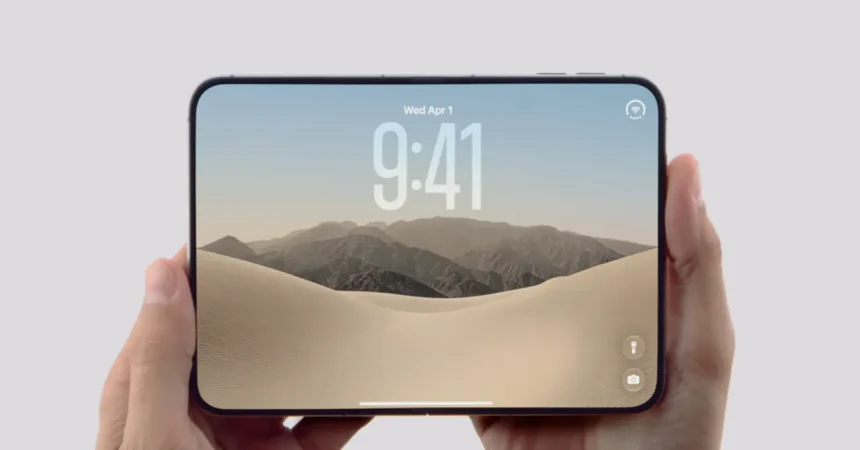
Paragraph 1: The Moment of Revelation at Apple Park
The air in Cupertino was thick with the familiar buzz of anticipation, yet there was an undercurrent of something different this time—a palpable sense that history was about to be made. When Tim Cook finally took the stage at Apple Park, flanked by the sleek, incremental upgrades of the iPhone 18 Pro, the audience knew the real star of the show was yet to come. And then, it appeared. The iPhone Duo, Apple’s first-ever folding smartphone, was unveiled amidst a cascade of dramatic lighting and sweeping drone footage of the campus. This wasn’t just another product drop; it was Apple stepping onto a battleground it had conspicuously avoided for nearly a decade. For years, the company had watched from the sidelines as the category was explored, refined, and at times, painfully mishandled by others. Now, they were finally ready to stake their claim. The Duo was presented with Apple’s signature confidence, as if the foldable form factor had been waiting for this exact moment of validation. The device looked stunning—a “book-like” design that unfolded into a spacious, square-ish display, meant to be held and consumed, rather than merely used. But as the applause echoed through the Steve Jobs Theater, a lingering question hung in the air: Could the latecomer actually out-pace the pioneers? The iPhone Duo is not a gimmick; it is a declaration of war, a promise that Apple intends to redefine the standard for a technology that has struggled to break beyond the early-adopter enthusiast crowd and capture the mainstream imagination. From the outset, the device feels less like a novelty and more like a necessary evolution, a sign that the smartphone itself is ready to be reborn.
Paragraph 2: A Decade of Trials, Tribulations, and the Evolution of the Fold
To truly appreciate the iPhone Duo, one must look back at the volatile history of the foldable phone market. It was Samsung who dared to open Pandora’s box back in 2019 with the Galaxy Fold, a device that launched to immense fanfare but crumbled under the weight of its own ambition, with reviewers’ screen protectors peeling off and screens breaking within days. That disastrous debut could have killed the category entirely, but instead, it forced the industry to mature. Honor, Google, Motorola, and Oppo took up the mantle, racing to build hinges that felt less like brittle joints and more like precision machinery, silky-smooth creases that hid the seam, and ultra-thin glass that could withstand thousands of folds. They shaved ounces off the weight, made the bezels disappear, and perfected the software to handle the dual-screen experience. By the time Apple was rumored to be entering the fray, the technology had finally reached a point where it wasn’t just a party trick; it was a legitimate, if niche, alternative to the slab phone. Yet, despite these incredible leaps in engineering, the market has persistently struggled. For five straight quarters, foldable sales have declined by a staggering 13 percent year over year. The early adopters bought the first generations, but the general public remained hesitant—worried about durability, repairability, and the sheer price tag. This is the shaky ground on which the iPhone Duo enters. It does not arrive with any groundbreaking hinge secrets that competitors haven’t already solved; instead, it arrives with something far more valuable: the Apple brand. With a design that draws clear inspiration from Samsung’s Galaxy Z Fold8 and Google’s slimmed-down Pixel Fold, the Duo represents less of a technological leap and more of a masterful consolidation of existing ideas, polished to a degree only Apple can achieve, and wrapped in the reassuring ecosystem that makes millions of users feel strangely safe about spending nearly two thousand dollars.
Paragraph 3: The “Passport” Philosophy and the Reclamation of the Media Experience
The industrial design of the iPhone Duo is where Apple’s obsessive attention to user experience first shines through. It adopts what has become known as the “passport-style” form factor, a design that is noticeably shorter in stature but wider when unfolded compared to the tall, narrow rectangles of the first foldable wave. This is a deliberate, philosophical choice that prioritizes media consumption above all else. Anyone who has watched a movie on an early foldable knows the bizarre, melancholic frustration of witnessing a cinematic masterpiece confined to a tiny, central strip on the screen, surrounded by thick, black letterboxing bars that consume more than half of the display. It felt like watching a widescreen epic through a keyhole. The iPhone Duo refuses to subject its users to that indignity. When unfolded, the display adopts a nearly perfect 4:3 landscape orientation, which beautifully matches cinematic and streaming content, allowing a movie to breathe and fill the entire surface without those dreaded black bars. It transforms the device from a fragile piece of tech into a genuine pocket cinema. Whether you are binge-watching a gripping series on a red-eye flight or editing a personal video essay, the Duo offers an immersive, tablet-like canvas that is still small enough to slip into a jacket pocket. The form factor also makes multitasking feel less frantic and more fluid, allowing users to have a video playing on one half while scrolling through Twitter or writing an email on the other, without the cramped sensation that plagues other devices. It is a clear signal that Apple sees the foldable not just as a phone that opens, but as a portal to a richer, more absorbing digital world—one that prioritizes the dedicated viewing experience as the ultimate benchmark of success.
Paragraph 4: The Psychology of the Brand, Market Resurgence, and Consumer Hope
Beyond the mechanics of the hinge and the screen, the iPhone Duo represents a massive psychological shift in the foldable market. Industry analysts have watched the segment plateau and decay, but the arrival of Apple changes the entire calculus. According to IDC’s Nabila Popal, the folding phone market is currently a fraction of the global smartphone pie—a mere 2 percent by the end of this year. However, the interest in the Duo reveals a fascinating paradox in consumer behavior. In a recent IDC survey, a full 60 percent of consumers declared they were highly unlikely to buy any foldable phone on the market today. Yet, when that same question was posed with the caveat of Apple producing one, the results shifted dramatically—an immediate 33 percent said they would “absolutely” buy it. This is the raw, undeniable power of brand trust. The average consumer might not care about the intricate hinge mechanisms or the UTG glass layers, but they care deeply about the reliability, the customer support, and the seamless integration that Apple promises. Popal notes that Apple has such a strong market pull that it can single-handedly drive awareness for an entire category. Just as the company raised prices on memory once it announced its own changes, it has the power to validate the foldable form factor in the eyes of the mainstream. By the end of 2026, analysts predict Apple could capture up to 30 percent of the foldable market share, effectively injecting a massive surge of adrenaline into a dying ecosystem. For the consumer, this is the ultimate win. More competition means better hardware, better software, and ultimately, lower prices. The arrival of the Duo is not merely an Apple event; it is a shockwave that will force Samsung, Google, and others to innovate faster and compete harder, all to win the hearts of a fickle, yet ultimately hopeful, mobile audience.
Paragraph 5: The Elephant in the Room—Durability, Repairability, and the Crease of Anxiety
Even as the applause fades, one chilling reality looms over the iPhone Duo: the enduring fragility of the foldable form. Despite Apple’s flawless marketing and the svelte design, the truth remains that foldable phones are inherently more vulnerable than their slab counterparts. The innovative hinge, the flexible inner display, and the delicate layers of polymer and glass are all potential failure points. Any drop on a hard surface could mean a cracked inner screen or, worse, a hinge that refuses to bend, rendering the device a very expensive brick. Elizabeth Chamberlain, the Director of Sustainability at iFixit, offers a sobering perspective. Her team has painstakingly taken apart every major foldable on the market, and she has never once encountered one she would consider truly repairable. “Manufacturers have come a long way since the Galaxy Fold first dropped,” she notes, “but the gains in durability haven’t come with gains in repairability.” This is a critical Achilles’ heel. While you can easily replace the battery or screen on a traditional iPhone, the complex, interlocking machinery of a foldable makes surgical repairs nearly impossible. The adhesive is brutal, the cables are impossibly thin, and the spare parts are prohibitively expensive. This creates an underlying anxiety for the average owner—a constant, nagging fear of the $2,000 investment shattering in a moment of carelessness. Will Apple, with its “genius” bars and its vast repair ecosystem, breakthrough of these limitations, or will it simply rely on its premium AppleCare+ subscription to mitigate the fear? For now, the durability is a gamble—a leap of faith that the mechanical wizardry inside the Duo will withstand the rigors of daily life, crumpled pockets, and accidental drops, and that if it doesn’t, the cost of repair won’t make the user weep. It is the one area where Apple’s “it just works” ethos may face its most profound stress test.
Paragraph 6: The Gauntlet Thrown—A Shifting of the Global Mobile Landscape
The arrival of the iPhone Duo is more than an update to the product line; it is a seismic shift in the global mobile landscape. It signals that Apple believes the future of the smartphone is no longer completely flat. As we look forward, the implications are vast. For Samsung, the pioneer that spent nearly a decade evangelizing the foldable, the Duo is a formidable competitor that will force a desperate need to innovate faster on design, weight, and durability. For Google and the rest of the Android ecosystem, it’s a wake-up call to refine their web of split-screen apps and ensure their folding software feels as fluid and intuitive as the hardware. But most importantly, for the everyday user, this is a moment of validation. Finally, the foldable is no longer a niche curiosity used by tech enthusiasts obsessing over hinge angles; it’s a mainstream option, polished and backed by the largest consumer tech company in the world. As the initial dust settles, the resounding verdict is that the iPhone Duo has the potential to pull the industry out of its five-quarter slump, revitalizing the passion for hardware design and offering a new canvas for how we interact with digital life. However, this is very much a developing story. The true test will come not in the pre-order sales numbers or the glowing first-impression reviews, but months down the line when these devices have been folded 100,000 times, dropped in parking lots, and wrestled into jean pockets. Will the crease hold? Will the software integrate seamlessly? Only time will tell. But one thing is certain: Apple has re-entered the arena not as a follower, but as a crusader, and the horizon of mobile technology will never look quite the same again. The gauntlet has been thrown, and the world is watching, eager to see if the magic of Cupertino can finally make the future fold into the palm of our hands.