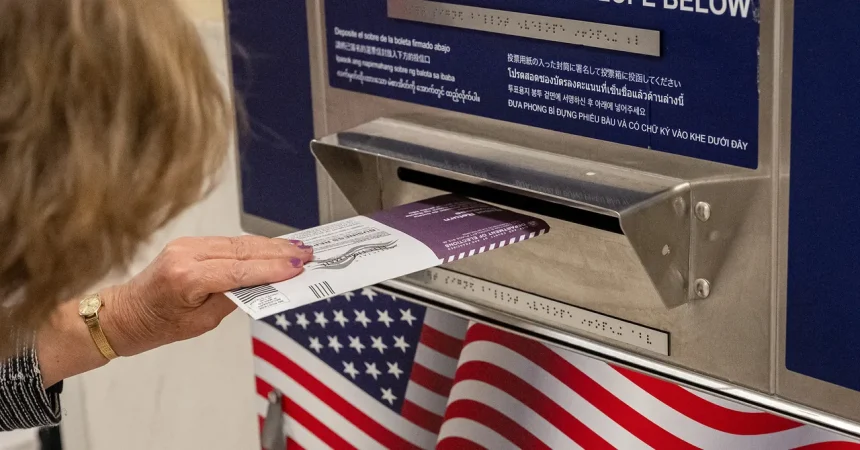
Election Day in America rarely begins with drama. It begins with ordinary people doing small, quiet things: poll workers fumbling with keys, retirees arriving before sunrise, parents bringing kids along because they couldn’t find a sitter, and people in heavy coats waiting outside community centers and school gyms. It begins with the smell of coffee, the fold of paper ballots, the low hum of voting machines warming up. That sense of civic ritual is what makes the day feel familiar, even sacred. But in this hyper-charged political moment, it doesn’t take long for that ordinary atmosphere to crack. On the morning of this Election Day, voting had been underway for only a few hours, and in some parts of the country the polls hadn’t even opened. Yet Republican strategist and pro-Trump influencer Joey Mannarino was already sounding the alarm. “MASSIVE AMOUNTS OF VOTER FRAUD BEING REPORTED ALL OVER THE COUNTRY!” he wrote on X at 9:02 a.m. EST. There was no evidence behind the claim, no data, no sources—just a certainty that the election was being stolen in real time. “The Democrats are stealing our country right out from under us!” he added. Within seconds, that message was being liked, shared, and absorbed by thousands of anxious Americans, many of whom were just heading to the polls or refreshing their feeds while standing in line. It was a striking example of how quickly fear can travel, and how little proof it needs to take hold.
But the truth, as it often is on Election Day, was far more mundane. Every election year brings with it a handful of technical hiccups and logistical headaches. This year was no different. In Florida’s Space Coast region, severe flooding forced around twenty polling places to be relocated, leaving election workers scrambling to send voters to new addresses. In Arizona’s Maricopa County, bad storms over the weekend had apparently caused brief power outages, which in turn forced several polling locations to close temporarily. In Pennsylvania’s Luzerne County, a scanner box had gone missing—an inconvenience that delayed voting but hardly suggested a conspiracy. These are the kinds of issues that have been part of American elections for as long as machines have been used, often the result of aging equipment, clumsy setup, or simple bad weather. But in the eye of the political storm, such routine glitches become something else entirely. They become ammunition. They become stories that confirm what people have already been told to believe: that the system is broken, that someone is trying to cheat, that the election cannot be trusted. What was once a story about a misplaced scanner or a waterlogged parking lot now becomes a national alarm bell, pulled loudly and repeatedly by the very voices who need chaos to thrive.
Nowhere was this more visible than in Westchester County, New York, where a real problem did unfold early in the morning. In a tightly contested House race between incumbent Republican Mike Lawler and Democrat Cait Conley, voters arrived at their polling places expecting a normal experience. Instead, they found machines that wouldn’t accept paper ballots. Imagine the scene: You’ve waited in line. You’ve shown your identification. You’ve been handed a ballot, marked your choices, and carefully carried it over to the scanner. You slide it in, but nothing happens. The machine doesn’t beep. The screen doesn’t light up. A poll worker shrugs and tries again. Another machine, same result. Lines begin to grow. Phones come out. Someone in line gets a text from a friend across town who says her machine is broken too. Soon, there’s a murmur moving through the room, a collective anxiety that feels both personal and political. Is this just a technical issue? Or is something else going on? In that moment, the distinction doesn’t seem so clear. For voters who had been absorbing warnings about election sabotage for years, the malfunction wasn’t an accident. It was a sign. And within minutes of the news breaking, some of the most prominent voices in the election conspiracy movement pushed that suspicion into overdrive, claiming that Democrats were deliberately breaking the machines to prevent Lawler from winning. There was no evidence for that claim, but evidence wasn’t really the point. The point was to erode confidence, to cast doubt, and to control the narrative while the votes were still being counted.
This is not an accident. There is a well-organized network of MAGA influencers, Republican lawmakers, pro-Trump trolls, and administration-aligned figures with massive online followings who are waiting for anything—literally anything—that can be presented as proof of voter fraud. They are primed to react, and they have spent years conditioning their audiences to see American elections as a battlefield between righteous truth-tellers and shadowy saboteurs. The groundwork has been laid carefully and deliberately, with endless streams of misleading videos, selectively edited clips, and dramatic but baseless accusations. When a scanner fails, they don’t see a worn-out piece of machinery. They see a plot. When a polling place moves because of flooding, they don’t see a logistics problem. They see a coordinated attempt to suppress certain communities. The Westchester glitch was a gift to them: a tangible, real story that could be twisted into something far darker. It didn’t matter that the county board of elections initially blamed the fault on “the thickness of the paper ballots,” only to update that explanation twenty minutes later by removing the reference to paper thickness and instead mentioning a general “issue involving paper ballots.” The confusion was enough. The uncertainty was fuel. And the emotional weight of the moment—people waiting in long lines, worried their votes wouldn’t count—made it all the easier to sell a story of deliberate sabotage.
The official response tried, at least, to address the damage. Westchester County Executive Ken Jenkins issued a statement promising that once the machines were fixed, he would convene a bipartisan team to conduct a thorough review of the decisions and failures that led to what he called “this debacle.” “I want to be absolutely clear,” Jenkins wrote. “This situation is unacceptable.” The words were strong, but they also revealed something uncomfortable: even the officials in charge didn’t fully know why the machines had failed. Later in the day, New York State officials added another explanation, saying that most of the machines in the county had outdated programming and therefore could not recognize and process Election Day ballots. That sounded like a real, technical answer—but by then, it hardly mattered. The story had already moved beyond facts. For many voters, the damage to their trust had already been done. They had waited in lines, doubted the system, watched the internet explode with warnings of a stolen election. No statement from a county executive could undo that feeling. What this moment revealed is how fragile public confidence can be, especially when institutions are slow to explain, quick to correct themselves, and visibly unprepared. It also underscored the human stakes: election officials, many of them volunteers or local workers, suddenly thrust into the center of national controversy, doing their best under enormous pressure while the entire country watches and judges.
In the end, this is a story about the machinery of democracy—not just the voting machines, but the emotional and psychological machinery that surrounds them. Elections have always had imperfections. There have always been long lines, broken scanners, lost ballots, and logistical headaches. But in an era defined by distrust and division, those imperfections have become more than inconveniences. They have become opportunities to weaponize doubt. The people who spread these claims are not concerned with making elections better. They are concerned with maintaining a state of constant suspicion, because suspicion keeps audiences engaged, keeps donors giving, and keeps the political machinery moving. But the real story of Election Day is not the glitch itself. It is the response to the glitch. It is the way a scanner failure in a New York suburb can become a national symbol of corruption within minutes. It is the way ordinary voters, waiting patiently in gymnasiums and church basements, are forced to wonder whether their participation is meaningless. And it is the way democracy, despite all this, keeps moving forward. Poll workers eventually got the scanners running. Ballots were counted. Lines moved again. The sun set, and the work continued. The system is not perfect. It never has been. But it is made of people—flawed, exhausted, often uncertain people—who continue to show up, hand out stickers, and try to make the process work. That is the part of the story that doesn’t trend online. And perhaps that is the part we need to remember most.