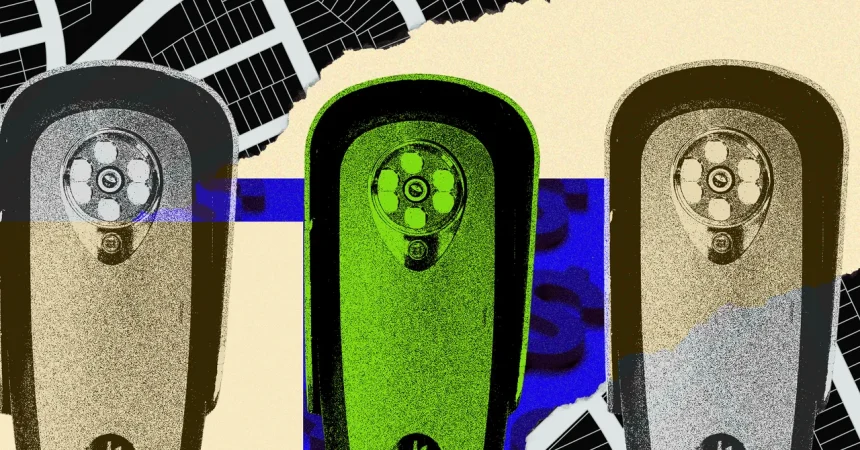
In the heart of Covington, Georgia, a small Southern city known for its quietly charming courthouse square and tree-lined streets, a quiet transformation has been taking place. The local police department has spent the past half-decade slowly and steadily wiring the town with a layer of digital eyes, turning everyday streets into points on a surveillance map. The technology behind this shift is Flock Safety, an Atlanta-based company that sells automatic license plate readers and, increasingly, a whole suite of public safety tools. On paper, the dollar amounts seem small against Covington’s overall budget, at least at first. In 2020, the department paid Flock $40,000 to keep twenty cameras running around the city. In 2021, it paid the same amount. But then the costs began to climb, not in sudden leaps but in the way a household utility bill climbs: a little here, a little there, until the annual total no longer matches the modest line item from the first year. By 2022, Covington was paying $81,250, with fifteen new cameras, called “Falcon” cameras, accounting for $37,500 of that amount. Another $3,750 went toward installation, and the rest was simply the cost of keeping the original cameras alive. This is the story of how a small-town police department, and many others like it, can find itself bound to a surveillance company in a relationship that seems impossible to end.
What happened next in Covington reveals the shape of these deals. In 2024, the police department paid Flock $113,225. Most of that money—$87,500—was not for new equipment. It was for maintenance of the existing thirty-five cameras, at a rate the city had agreed to pay for the next five years. The remainder went toward eight more Falcon cameras. Then, in 2025, the bill grew again to $159,000. That payment included camera maintenance but also enrolled Covington in Flock’s “Drone as First Responder” program, a service that sends drones out to emergency scenes and streams live footage back to police headquarters. The numbers are hard to wrap your head around: through August of that same year, Covington had already paid Flock about $201,000. That figure included $100,000 to maintain existing cameras, $800 to replace one damaged camera, and another $100,200 for new software products. Taken together, the trajectory shows a simple, predictable pattern: each year, the city pays more than it did the year before, and the hardware and software become more embedded in daily policing. The Covington Police Department has not responded to requests for comment, so we are left with the public records and the invoices, which tell a story of escalating commitment dressed in the language of public safety.
Covington is not alone. In fact, its experience is becoming a template for how Flock Safety does business across the country. Flock was founded in 2017, and its first customers were not police departments but private homeowner associations, which bought license plate readers to monitor gates and entryways. When Flock decided to pivot to police agencies in 2019, it already had a foot in the door: many communities were already dotted with Flock cameras installed by HOA boards, and police could simply tap into those existing networks instead of building from scratch. The company has since become a familiar name in law enforcement circles, celebrated by some for helping solve hit-and-runs and catch stolen cars, and criticized by others for creating a permanent dragnet over public spaces. The contracts, as WIRED found by obtaining documents from a dozen Flock customers across the country, vary widely in size and scope, but they share a common DNA. They often start small and inexpensive, then expand through add-ons, upgrades, and long-term service agreements. The maintenance fees are particularly telling: after the initial purchase, the real revenue stream comes from keeping the cameras running year after year. That means a police department that thought it was buying a tool is actually entering into a long-term financial relationship, with no clear end in sight. Matthew Guariglia, a senior policy analyst at the Electronic Frontier Foundation, put it bluntly: “Once you let police officers try a tool,” he said, “it becomes really hard to get the political will and motivation to take that tool away from them.”
That dynamic is visible in Alpharetta, Georgia, a suburb north of Atlanta that followed a familiar path into Flock’s orbit. In 2020, Alpharetta’s police department paid Flock $17,680 for five Falcon cameras and for access to a Flock software product called Wing, which lets police extract vehicle and license plate information from ordinary security camera footage. The following year, as the city bought a few more cameras, a payment justification noted that several private homeowner associations in the area had already purchased Flock cameras and had granted the police access to them. The city wanted to add more of its own cameras to the Flock system, and according to the payment justification, other vendors would “not integrate with our existing Flock system.” That is the quiet power of the business model: once a community has Flock cameras—even if some of them were bought and paid for by private neighborhoods—it becomes harder and more expensive to switch to a competitor. A police department that wants to avoid a patchwork of incompatible systems is locked into the same vendor, not because no other option exists, but because leaving would mean tearing out the foundation and starting over. Over the next several years, Alpharetta’s work with Flock expanded dramatically. By 2025, the city’s annual Flock bill had ballooned to $381,000. The jump from roughly $17,000 to nearly $400,000 in five years did not happen because the city suddenly decided it wanted a massive surveillance apparatus; it happened through incremental decisions, each one sensible on its own terms. A camera here, a software update there, a new drone program and another maintenance contract, and suddenly the modest experiment has become an essential line in the police budget.
The deeper concern is not simply the money, though the money matters to residents who eventually pay the bill through taxes. It is what this kind of surveillance does to a community before anyone realizes how much is being spent and what is being collected. License plate readers are not just cameras pointed at the road; they are data collection devices that can create a record of where every car has been, when it passed, and at what hour of the day or night. When that information is stored, searchable, and shared with police across jurisdictions, the system can feel less like a helpful tool and more like a silent map of people’s lives. Supporters argue that the system helps solve crimes quickly and that the technology is no different from a police officer writing down a license plate number at a traffic stop. But privacy advocates point out that an officer can only write down a few plates at a time, while a networked camera system can capture thousands of plates in a single day, without anyone’s knowing it is being recorded. With Flock moving into drones, the reach extends even further into the sky, offering police the ability to hover over a scene before officers even arrive. That may save critical minutes in an emergency, but it also raises questions about how long those aerial recordings are kept and who can access them later. When the contracts grow year after year, cities rarely hold a public conversation about whether the trade-off is worth it. Instead, the decision happens through invoices and budget lines, often without much public debate. The documents WIRED reviewed show a pattern: few cities seem to have conducted an open, rigorous review of the privacy implications before signing on, and many appear to have expanded their systems simply because the technology was already there.
All of this leaves residents and local leaders with a hard choice, one that is much easier to ignore than to confront. On the one hand, there is the promise of security. A Flock camera might help deter a burglary in a quiet neighborhood, or it might help find a vulnerable missing person quickly, or it might identify the car of a violent suspect before they can strike again. For many people, that promise is enough to justify the cost and the intrusion. On the other hand, there is the feeling that the town you grew up in is no longer just a place where people know each other’s names; it is also a place where every trip to the grocery store leaves a trace in a corporate database. The story of Covington and Alpharetta is not a story about evil empires or sinister motives. It is a story about incremental decisions, about the ease of saying yes to a helpful tool, and about the difficulty of ever turning back. The police departments were not hiding anything; they were buying what seemed like the future. But the future has a price, and because the price keeps rising, communities need to ask themselves whether they are getting something in return that is worth the quiet loss of anonymity. Flock Safety, for its part, did not provide a comment for this story, leaving the numbers and the contracts to speak for themselves. As the company expands into new products and new cities, the question is no longer whether this technology works—it clearly does something. The question is whether we, as communities, are prepared to live with the answer, and whether we will wake up one day to find that we have built a surveillance system not because we made a deliberate decision, but because the invoices kept coming, and it was easier to pay them than to ask what we had really bought.