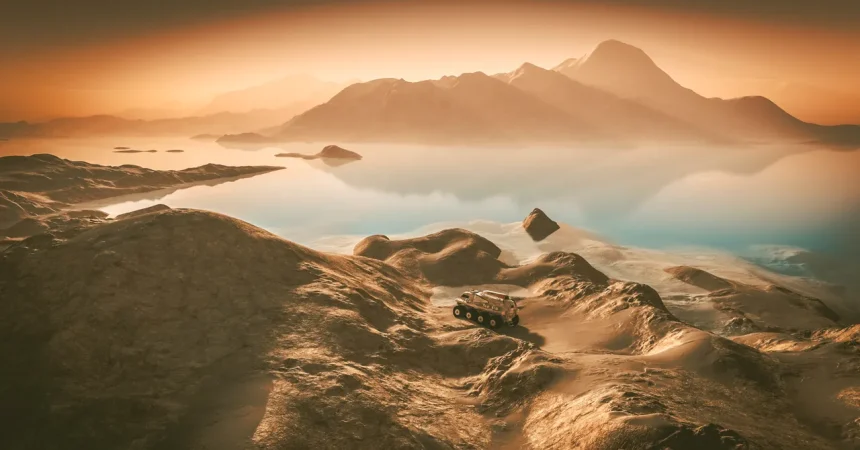
In 2022, the vast, unforgiving expanse of the Sahara Desert yielded a treasure that transcended human imagination. Ahem, a strange, dark rock weighing just over two pounds was discovered amidst the endless waves of golden sand, and while it might have been dismissed as an unusual geological oddity, scientists immediately recognized it for what it truly was: a messenger from another world. This fragment, now known as Teghaza 001, had been forged deep within the crust of Mars, blasted into space by a cataclysmic asteroid impact eons ago, and had spent millions—perhaps billions—of years drifting through the cold, silent void before finally plummeting to Earth. The initial excitement of its discovery, however, has now been surpassed by a revelation that solidifies its status as one of the most scientifically precious objects ever found on our planet. For when researchers began to probe its ancient interior, they realized that this was not just a chunk of Martian rock, but a time capsule preserving chemical traces of a world that existed at the dawn of our solar system, offering a tantalizing glimpse into the environmental conditions of a young and dynamic Mars.
To understand the immense significance of Teghaza 001, one must first appreciate the cosmic journey it undertook. This rock is estimated to be at least 4.1 billion years old, a staggering age that makes it one of the oldest known samples of Martian material ever recovered. To put this in perspective, consider Earth at that very moment: our planet was a young, geologically violent world, shrouded in a thick atmosphere, likely covered by primitive oceans, yet completely bereft of any complex life—no animals, no plants, not even the simplest multicellular organisms. This ancient stone was literally a contemporary of our own planet’s infancy. The Sahara Desert, as it turns out, is not just a barren wasteland but a natural archive of the history of our solar system. Over millions of years, the dry, shifting sands have acted as a perfect collection point for meteorites, preserving them against the corrosive forces of moisture and biological decay. Among its dunes, researchers have found 40-million-year-old fossils and other meteorites, including a 4.5-billion-year-old fragment that may have originated from a long-lost protoplanet as large as the Moon. Yet Teghaza 001 stands apart from its celestial companions due to a unique characteristic that subsequent studies have now revealed, making it a cornerstone of planetary science.
For decades, Martian meteorites have served as our only physical connection to the Red Planet, providing invaluable data about its mineralogical composition and volcanic processes. However, they have often presented a frustrating limitation. While they tell us what Mars is made of in terms of deep crustal rock, they rarely preserve the delicate chemical fingerprints of surface-level interactions—specifically, the crucial evidence of how the Martian crust reacted with its ancient atmosphere and, most importantly, its ancient water. Because these fragments are ejected with such incredible force, they tend to lose or alter these subtle environmental signatures. But Teghaza 001 defies this expectation. In a groundbreaking series of studies published in the esteemed journals Science and Science Advances, scientists have uncovered within this unassuming rock preserved chemical traces of a profound interaction: the meeting point between the Martian crust and its ancient hydrosphere. This means that billions of years ago, liquid water was not merely a passing feature of the Martian landscape; it actively permeated the very rocks, dissolving minerals, triggering chemical reactions, and leaving behind a distinct signature that has remained locked within Teghaza 001 since the depths of geological time.
The implications of this discovery are so monumental that one of the peer reviewers for the paper likened Teghaza 001 to the “Rosetta Stone” for Mars, a metaphor that perfectly encapsulates the rock’s unparalleled ability to unlock planetary history. The original Rosetta Stone was the key that deciphered the language of ancient Egypt; in a similar fashion, this Martian fragment is the key that can help us decode the history of water and habitable conditions on our neighboring planet. According to Yang Liu, a research scientist at NASA’s Jet Propulsion Laboratory who was involved in the analysis, this meteorite provides a direct window into the environmental conditions of early Mars, allowing us to witness a period when the planet was far different from the arid, frozen desert we see today. We are not just looking at a piece of rock; we are looking at a preserved record of a time when Mars possessed a thick atmosphere, flowing rivers, and possibly vast oceans. Understanding how that water chemically interacted with the crust is essential for determining whether conditions ever favored the emergence of life. Were those ancient waters acidic or alkaline? Were they rich in nutrients? These are not academic questions but fundamental inquiries into whether the stage was set for biology to begin on a world beyond Earth.
Beyond the rigorous scientific data, the story of Teghaza 001 is profoundly human, embodying our relentless curiosity and our yearning to understand our place in the cosmos. Consider the sheer improbability of its existence and discovery. An impact of unimaginable magnitude had to launch this specific rock off the Martian surface, allowing it to escape the gravity of its home world. It then embarked on a random odyssey through interplanetary space, a journey of hundreds of millions of miles, until it just so happened to cross Earth’s orbital path and survive the fiery passage through our atmosphere. Finally, it landed in one of the most isolated and inhospitable regions on our planet, where it waited silently for human eyes to spot it among tens of millions of square miles of sand. For a researcher to stumble upon it is akin to finding a needle in an infinite haystack. Then, in sterile laboratories around the world, scientists meticulously polished microscopic slices of the rock, using state-of-the-art instruments to read the chemical hieroglyphics written within its mineral lattice. This is a testament to the dogged persistence of the scientific method, a collaboration that transcends national boundaries and decades of collective effort, all united by the pursuit of a single, profound truth: Are we alone? By studying these tiny fragments of Mars, we are effectively attempting to answer the existential question of life’s potential distribution throughout the universe.
As we look toward the future of space exploration, Teghaza 001 serves as both a humbling reminder and an inspiring preview of what awaits. With NASA’s Perseverance rover currently collecting samples directly from ancient river deltas on Mars, slated to return to Earth in the coming decade, this meteorite acts as a calibration point, a yardstick against which we can measure and validate our future findings. While a crewed mission to Mars remains an ambitious dream for the coming decades, the ability to hold a piece of another planet in our hands today is a profound achievement. It reminds us that the universe is not a static, distant void but a dynamic, deeply interconnected system where the debris of one world can seed the soil of another. The Sahara Desert, a place we often associate with emptiness and desolation, has given us a gift of staggering value—a piece of a sibling planet that may have once cradled life. In its silent, unassuming way, Teghaza 001 speaks volumes about the magnificent resilience of matter, the dizzying passage of deep time, and the eternal human spirit of discovery. It is a poetic reminder that the answers to our grandest, most fundamental questions often lie hidden in the smallest, most unexpected places, patiently waiting beneath the sands of time for someone to look down, pick them up, and ask the right questions.