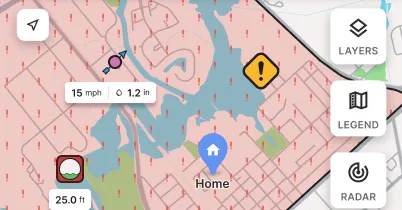
Since its inception in 2021, Watch Duty has evolved from a grassroots tool for Californians tracking wildfires into a nationwide lifeline, fundamentally changing how everyday people prepare for environmental emergencies. What began as a localized effort—relying on a dedicated team of paid reporters and a network of volunteers monitoring emergency radio channels—has blossomed into a tech-driven community resource. The app’s strength lies in its ability to translate raw, often chaotic scanner traffic into actionable clarity. After proving its necessity during harrowing events like the Palisades and Eaton fires in Los Angeles, the nonprofit has gained the traction and partnerships, including an integration with Ring cameras, needed to scale its mission. Now, the platform is taking a major leap forward by expanding its scope beyond fire, introducing a comprehensive, real-time flood alert system available to all users as a free update.
The transition from tracking smoke and flames to monitoring rising waters requires a shift in strategy, though the core mission remains the same: simplifying complex data for those who need it most. While wildfire behavior can be erratic and fast-moving, flood dynamics are often more predictable, governed by terrain and water-gauge data. However, the sheer volume of information can be just as overwhelming as a fire. Currently, updates on flood conditions are dispersed across a fragmented landscape of government entities, including FEMA, the National Weather Service, the U.S. Geological Survey, and the National Oceanic and Atmospheric Administration. For a regular citizen, trying to synthesize these disparate warnings into a coherent plan of action is nearly impossible, often resulting in confusion that leaves people paralyzed or inadequately prepared.
John Mills, the CEO of Watch Duty, recognizes this frustration all too well, noting that many people often realize they are in danger only when it is already too late. By consolidating these high-level data streams into one accessible interface, the app aims to bridge the gap between “information overload” and “informed decision-making.” Rather than forcing users to navigate multiple government dashboards or attempt to interpret complex data maps, Watch Duty distills these alerts into a clear, simplified outlook on a single screen. The goal is to provide a user-friendly layer of context that helps individuals understand their specific environmental threats without needing a degree in meteorology to parse the warnings.
To achieve this, the app has adopted a more targeted approach to water monitoring. While the system cannot necessarily predict minute-by-minute changes like a specific tree falling or a culvert overflowing, it leverages the vast network of water-height buoys across the country. Users can now identify the nearest monitoring stations to their homes and set personalized alerts that trigger when water levels reach critical, flood-prone thresholds. This proactive feature empowers residents to take precautions before the situation becomes life-threatening, marking a significant improvement over the reactive or delayed alerts that many people have grown accustomed to receiving.
Integrating this new functionality has been a careful, intentional process for the nonprofit. While the team had always envisioned a multi-disaster monitoring platform, they were understandably cautious, working to ensure the technology was robust enough to handle the workload without compromising their primary mission during busy wildfire seasons. This expansion into flood reporting represents a long-term goal finally coming to fruition, building on the lessons learned from their earlier, one-off attempts at monitoring flood events. By treating the flood-alert system as a core service rather than an incidental add-on, Watch Duty is demonstrating its commitment to building a comprehensive resilience tool for the climate-challenged reality of the 21st century.
Ultimately, Watch Duty’s expansion is about restoring a sense of agency to a public that increasingly feels at the mercy of extreme weather. By allowing the app to track your location, you gain a persistent, quiet guardian that only alerts you when it truly matters, cutting through the noise of constant, non-specific global warnings. As environmental disasters become more frequent, tools like this provide something more valuable than just data: they provide peace of mind. By translating the complex language of government agencies into a simple, responsive service, Watch Duty is empowering neighbors and families to protect their livelihoods, ensuring that in the face of nature’s volatility, no one is left waiting in the dark for information.