There is something quietly radical about paying attention to birds right now. We are living in an age when every algorithm wants to hold our attention, when the news hammers us with recession forecasts, when social media convinces us that we will somehow miss out on something vitally important if we blink. Birds, though, are entirely immune to all of it. They do not know that artificial intelligence exists, and they wouldn’t care if they did. They have never once worried about mortgage rates or watched a webinar about productivity. In fact, birds don’t even know you exist. That sounds like a cold thought, but it’s actually a relief. A chickadee outside your window is not thinking about you. It is thinking about seeds, about predators, about the feathery drama of its own tiny life. There is a profound comfort in interacting with a creature whose brain is the size of a garbanzo bean and who cannot drive, vote, or file taxes. It is a reminder that the universe is bigger than our anxious human concerns, and that the world is still full of small, vivid, absolutely unconcerned lives happening right under our noses. There are probably entertaining dramas playing out in your yard at this very moment that you know nothing about. In my own yard, there is a crow with one eye who outsmarts every squirrel, and a greedy Steller’s jay who stuffs his crop with peanuts until it becomes almost translucent, like a tiny feathered hoarder with no self-control. These are real characters, living their own soap operas, and you could have a front-row seat if you were willing to look.
That’s where technology comes in, ironically enough. Smart bird feeders have been around since roughly 2020, but they’ve gotten remarkably good in a very short span of time. Even moderately priced models now come with high-resolution cameras, 4K video recording, and AI-powered species identification that seldom misses. You can sit on the couch and watch a rare warbler visit your feeder from the workshop where you’re pretending to work. You can learn the name of the woodpecker that keeps coming back for breakfast. You can get push notifications that say “You have spotted a Red-bellied Woodpecker!” and feel an absurd flash of pride, even though you had nothing to do with the bird’s arrival other than remembering to buy sunflower hearts. The best part is that these feeders require almost no ongoing effort. As long as you fill them with seeds and follow something called the 5-7-9 rule of pole-mount placement, which keeps squirrels from jumping onto the feeder, you’re basically done. The feeder takes the pictures, identifies the birds, stores the footage, and keeps a little life list for you. It is a beautiful, low-stakes way to reconnect with nature from the comfort of your own porch. And because Black Friday has arrived early, some of the best models I have used for years are now discounted. These aren’t cheap knockoffs that will fall apart in a storm; they are tried-and-true feeders that I would not hesitate to buy as a gift for someone I love, or for myself, if I were being honest.
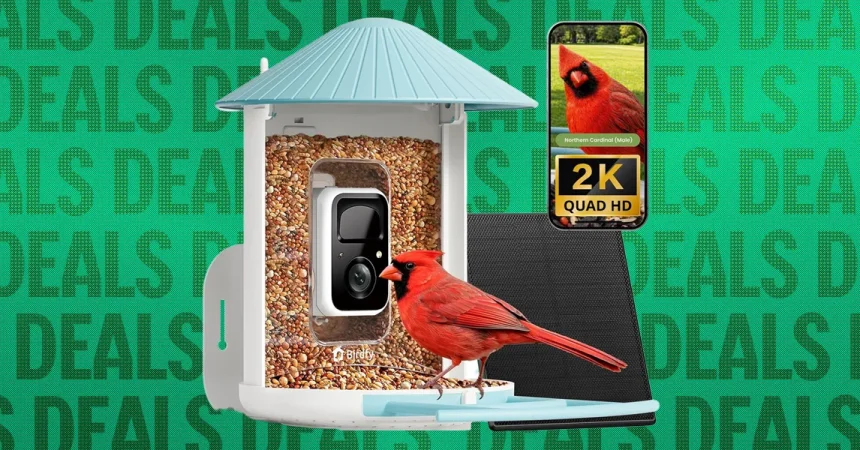
If you only have about $130 to spend, the Birdfy Feeder Lite with Solar is the enduring original that I keep coming back to. The current deal is on the blue version, which for some reason is $127 instead of the yellow one that costs an extra $13. It’s a strange little quirk, but for that price, I wouldn’t complain about the color. Is it the sturdiest feeder ever made? No. Is it the most beautiful piece of backyard equipment you could own? Probably not, and there are better-designed options like the Kiwibit feeder I’ll get to below. And if you want the absolute sharpest camera, you might want to look at a higher-end model with a 32-megapixel sensor. But the Birdfy Lite is the most reliable, least fussy smart feeder I have used. It has a high-quality, easy-to-use app that doesn’t try to guilt you into paying for a subscription every time you open it. It lasts through seasons of rain, snow, heat, and the occasional squirrel assault. It comes with an auxiliary solar panel that mounts separately, so you can charge the battery without worrying about dragging the feeder inside and hunting for the right cable. If you want to skip the solar panel, the feeder is just $110, but honestly, I would recommend spending the extra seventeen dollars. The solar panel has been rock-solid in my testing, and it is worth the money to never have to think about charging. One small caveat: this model only works on 2.4 GHz Wi-Fi. If your home network runs only on 5 GHz, or if your router insists on putting everything on the same band, you may need to fiddle with settings to get it connected. Once you’re connected, though, the whole experience is wonderfully smooth. It simply works, with birds being identified quickly and notifications arriving on your phone in real time. For the price, the two-year warranty is a nice bonus, and knowing that Birdfy has been around long enough to refine its software and hardware gives me a lot of confidence.
The Kiwibit Feeder 2 with Solar Roof at $170, which is 29 percent off, is arguably the best design deal of the bunch. This isn’t the newest and greatest Kiwibit model—that would be the Feeder 2 Pro, which costs $220—but the regular Feeder 2 is still an exceptionally well-crafted piece of equipment, and this is the lowest price I have ever seen it sell for. The first thing you notice is the seed hopper. It is generously sized, holding 1.5 liters of seed, and it is split into two compartments, so you can offer two different types of feed at the same time. If you have ever tried to attract both finches that love Nyjer and cardinals that prefer sunflower seeds, you will understand how magical this is. The hopper pulls right out of the body with a little handle on top, so you don’t have to take the entire feeder down to refill it. That sounds like a small thing, but trust me, when it is freezing cold outside and the birds are hungry, you will be grateful for every second you don’t have to spend undoing bolts and brackets. The camera is excellent, too, with 8-megapixel photos and 4K video quality that is top-tier at this price point. The solar roof on top kept everything fully charged through all kinds of weather during my test, which means I never had to bring it inside to charge. The app is easy to navigate and works perfectly fine without a Kiwibit Plus subscription, though I should mention that more and more features are starting to get paywalled as time goes on. I ran into this when I recently reviewed the Feeder 2 Pro, and I didn’t love it. For now, the basic experience is still functional and enjoyable, but if you want access to all the historical data and advanced features in the future, you might have to pay. There are also a couple of other things to keep in mind: the feeder only works on 2.4-GHz Wi-Fi, same as the Birdfy, and the warranty is one year instead of Birdfy’s two years. That shorter warranty is a bit disappointing for a device that lives outdoors, but the build quality feels solid enough that I wouldn’t worry a ton about it.
If you like the sound of the Kiwibit’s sturdy build and beautiful footage but don’t want to spend $170, the Kiwibit 4K Feeder with Auxiliary Solar is currently $140, which is 26 percent off. Despite having a slightly different name, this model actually shares the same camera and hardware as the Feeder 2. The biggest difference is that it does not have a solar roof built into the feeder top. Instead, it comes with a three-watt solar panel that you can install on the back of the wall mount. I used this setup myself, and I had no issues getting it mounted. For what it’s worth, I always pole-mount my feeders anyway because it keeps squirrels from treating them like a buffet, and the included panel fit neatly onto the mount without causing any wobble or awkward wiring. The panel is powerful enough to keep the battery topped up in most weather, and if you have a spot that gets good sunlight for part of the day, you probably won’t have to think about charging until deep winter. If you’re interested in Kiwibit’s excellent image quality and durable design, and you want to save an extra thirty dollars into the bargain, this is a totally viable option. You are essentially paying $30 less for the privilege of having the solar panel separate instead of built into the roof, and to be honest, that trade-off is worth it for a lot of people. The feeder attracts the same birds, collects the same sharp video footage, and works with the same app. The only real difference is aesthetic and a tiny bit of convenience. If you don’t mind the look of a small solar panel mounted behind the feeder, you get all of the Kiwibit advantages at a much friendlier price. In a strange way, it might feel even more personal, because you get to angle the panel toward the sun and feel a little more involved in the setup. It’s the kind of decision that, once you’re feeding birds and checking your phone for updates, will seem silly to have agonized over. The birds don’t care. You will, and that’s the whole point.
At the end of the day, choosing between these feeders comes down to your priorities. If you want the most straightforward, reliable experience with the best app and a longer warranty, the Birdfy Feeder Lite with Solar is nearly impossible to beat at $127. If you are willing to spend a little more for a more refined design, a split seed hopper, and gorgeous 4K footage, the Kiwibit Feeder 2 with Solar Roof at $170 is an outstanding investment. And if you want to save some money without giving up picture quality or solid build, the Kiwibit 4K with Auxiliary Solar at $140 is the middle path that makes a lot of sense. All three options will connect to your home Wi-Fi, all of them will send you notifications when a bird lands, and all of them will give you a front-row seat to the entertaining dramas unfolding in your yard. But perhaps more importantly, any one of them will invite you to slow down and pay attention to something that has absolutely nothing to do with the state of the world. Watching a bird shake water off its feathers or argue with its own reflection is a small moment of peace in a life that is constantly asking you to do more, worry more, and keep up with everything. Birds will never see your notifications, never care about your follower count, and never show up late to a meeting. They will simply land on the feeder, look around with one bright eye, and start eating. In a world that seems determined to keep us distracted, there is something life-affirming about a creature that doesn’t think about the future at all, and that is exactly why smart bird feeders have become such a wonderful antidote to modern overwhelm. They let us share in that bird-like simplicity, if only for a few minutes a day, and remind us that some things are still easy, beautiful, and entirely without pretense.