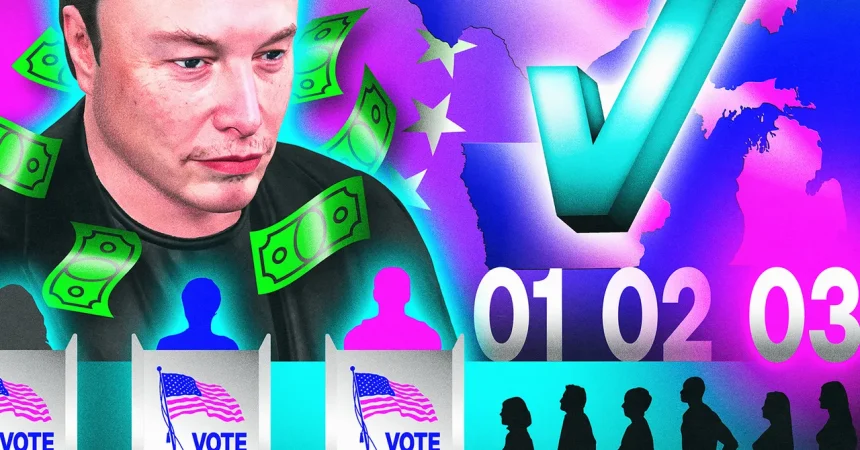
On the evening the results of the midterm elections began to flood in, the most conspicuous place on the internet—Elon Musk’s X account—fell into an uncharacteristic, almost eerie silence. For months, the world’s richest man had dominated the platform with bombastic predictions, relentless promotion of Republican candidates, and a sense of unshakeable certainty that his billions would bend the political will of the nation to his designs. But as the tallies crept upward, district by district, state by state, the digital megaphone that had thundered for months suddenly went quiet. It was the silence of a man watching a tsunami, frozen on the shore, realizing that the tide was not coming in his direction. Shortly after 1 a.m., when the scale of the disaster was undeniable, Musk broke his silence with a pair of cryptic, almost existential posts. “Data centers in space looking pretty appealing right now,” he wrote, followed a minute later by a wry, defensive quip: “Guess my election-interfering space lasers didn’t work this time,” accompanied by a shrugging emoji. The humor was strained, the deflection transparent. Beneath the casual veneer of a tech billionaire making a joke about escaping to orbit, there was the raw, unmistakable ache of a man watching his political empire collapse in real time, a man who had staked his fortune, his credibility, and his ego on a single night’s verdict from the American people.
The final scorecard was a brutal indictment of wealth without resonance. According to a WIRED analysis of the election data, candidates backed by Musk’s America PAC had lost twenty races by Wednesday morning, winning a single solitary contest, with twenty-one races remaining uncalled and likely leaning against him. The financial carnage was staggering: Musk and his PAC had poured more than $400 million into the Republican war chest since Donald Trump retook the presidency, with nearly $87 million specifically earmarked for advertising across forty-two midterm races. Beyond that, he had funnelled an additional $229 million into other political groups, principally the main Republican super PACs for the House and Senate, alongside smaller, bespoke operations designed to tilt single races in Kentucky and Texas. But the most devastating statistic, the one that stripped away all pretense of political acumen, was this: of every traceable dollar Musk invested in a race that has now been decided, more than 99 cents funneled directly into a campaign he lost. It was not merely a bad bet; it was a wholesale rejection of a buyer’s attempt to purchase the United States Senate and House, a resounding “no” uttered by millions of ordinary voters who, despite being outgunned in advertising, found their collective will more formidable than any cable television buy or targeted digital barrage.
The Senate races proved to be the site of his most humiliating defeats, a graveyard of billion-dollar dreams buried under the unglamorous weight of municipal polling stations. America PAC had saturated seven Senate contests this cycle; six have been called, and Musk’s side lost every single one. In Ohio, Sherrod Brown, a labor-friendly incumbent who had been counted out by the political class, clawed back a decisive victory, riding a wave of working-class resentment toward out-of-state money. In Michigan, Abdul El-Sayed, a public health advocate running on a platform of community and basic decency, overcame the nearly $9.2 million that America PAC dumped into the state, proving that a doctor’s stethoscope could outweigh twelve thousand hours of attack ads. Iowa delivered a similar rebuke, where Josh Turek, a candidate of quiet perseverance, flipped the state in a stunning upset. But the most poetic, human victory came in Maine, where Troy Jackson unseated Susan Collins, a thirty-year political institution and a supposed titan of the Senate. Democrats had long believed Collins untouchable, a fixture wrapped in the cold, pragmatic culture of New England politics, yet Jackson’s grassroots campaign, powered by door-knocks and town hall conversations, struck her down. As the night wore on, Musk’s loss in Maine felt less like a political statistic and more like a Shakespearean tragedy—the fall of a dynasty under the weight of a candidate who rarely spoke, only listened. In each of these races, the voters recognized the invisible hand gripping the strings of their elections, and they deliberately, decisively snipped those strings.
Nowhere was the raw, absurd power of Musk’s money more visible—and more spectacularly wasted—than in Texas, which hosted the most expensive Senate race in American history. Here, Musk’s strategy was maximal: he paid for more of the contest than any single human being has ever paid for a political seat. Through mid-October, Texas PAC, a group funded entirely with money he routed through the Senate Leadership Fund, had already burned $148 million on the race, with nearly $79 million of it dedicated to attacking Democrat James Talarico and almost $70 million propping up Ken Paxton, the state’s scandal-plagued attorney general. To this heedless bonfire, America PAC added another $47 million straight from Musk’s own accounts. In October, Musk had posted with characteristic arrogance: “There is something deeply wrong with Talarico.” The Democrat’s response was the kind of human retort that money cannot buy: “There is something deeply wrong with a political system that allows one trillionaire to buy his own personal US Senator.” That exchange captured the fundamental disconnect between Musk’s worldview and the lived reality of the electorate. Talarico, a young progressive with a history of legislative achievements, became the living symbol of the rejection of plutocracy. When the Associated Press called the race for Talarico shortly after 11 p.m., sealing Paxton’s defeat, it also sealed the end of the Republican leadership in Austin—a leadership that had spent years wooing Musk’s companies with tax breaks and grants, only to be jettisoned by the very voters who had funded their extravagance with their own dignity.
The consequences of this electoral catastrophe rippled far beyond the political arena, bleeding into the cold, merciless world of capital markets. By Wednesday morning, Tesla and SpaceX stocks had plunged in value, reflecting investor anxiety not just about Musk’s political judgment, but about the viability of an empire so deeply entangled with a failed cause. The blow was personal as much as financial. Musk has always styled himself as a visionary—a man who builds rockets to escape a dying planet, who tunnels through cities to solve traffic, who surgically implants chips into brains to merge with machines. His entire public persona is predicated on the notion that he can see the future clearly, that his intellect and resources can bend reality to his will. To have that persona shattered by a bunch of precinct captains in Maine and Michigan is a kind of psychological emasculation that no amount of Tesla stock can repair. The “space lasers” joke was his attempt to laugh off the fact that he had tried to buy a narrative and the narrative refused to be bought. In the quiet aftermath, as he stared at a screen full of red numbers turning blue, Musk surely experienced a profound sense of isolation—the cold realization that no amount of rocket fuel can escape the gravity of a nation’s disfavor. His normally relentless timeline, usually a firehose of memes, conspiracies, and self-aggrandizement, remained muted for hours, a digital tombstone marking the death of a politically invincible self-image.
Yet, for all the despair and hubris on display, the morning after brought with it a quiet, deeply human vindication for the American experiment. Musk’s defeat was not a victory for any single political ideology; rather, it was a resounding affirmation of the fundamental principle that a vote is not an asset to be acquired but an act of conscience to be earned. Across the country, in living rooms, diners, and union halls, ordinary people looked at the flood of advertising funded by a single trillionaire and recognized it for what it was: an attempt to drown out their voices with sheer volume. And they chose to speak anyway. They chose to vote for the candidate who knocked on their door, the one who listened to their concerns about healthcare and infrastructure, the one who didn’t have a satellite constellation but had a record of showing up. In Ohio, Sherrod Brown’s win signified a rejection of corporate paternalism. In Texas, Talarico’s victory proved that a clean message and authentic connection can outweigh $195 million of synthetic outrage. The “space lasers” quip, so flippant and hollow, became the final epitaph for an era of mega-donor absolutism. Musk’s tens of billions could buy him the loudest megaphone, the most sophisticated targeting algorithms, and the most relentless cadence of attack ads, but it could not buy a single soul. As the sun rose on Wednesday, the world’s richest man found himself strangely powerless, humbled by the collective intelligence of a electorate that, for one shining night, remembered that democracy belongs to them, not to their oligarchs. The silence on his timeline was not just the silence of a man counting his losses; it was the silence of a system, vast and intricate, briefly reasserting its own sovereignty over the vanity of a single, solitary, human bank account.