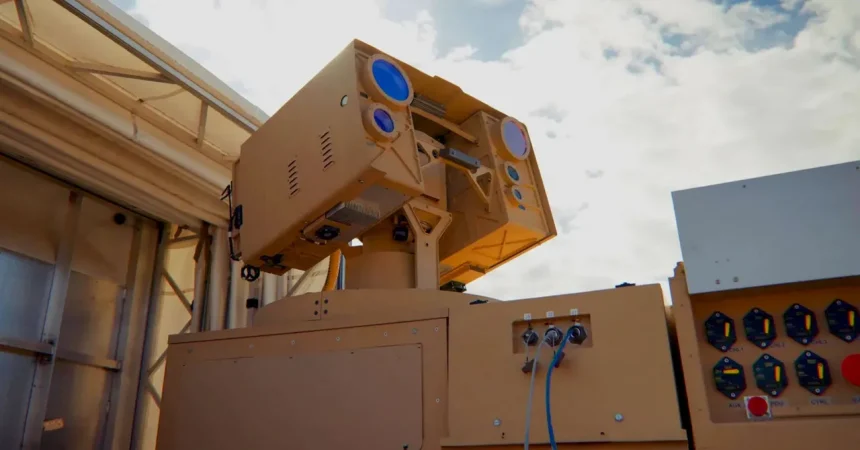
On a warm, heavy night in the Rio Grande Valley, the silence along the U.S.-Mexico border was broken not by gunfire, but by something far stranger: a concentrated beam of light that cut through the darkness and brought three drones out of the sky. Between the night of August 25 and the early hours of August 26, U.S. Army personnel working with the Joint Task Force Southern Border (JTF-SB) used a high-energy laser system to neutralize the unmanned aircraft. The official reason was stark: the drones were “posing a physical threat to US military personnel and CBP partners,” the latter referring to Customs and Border Protection. For years, agents patrolling the border have grown accustomed to the faint hum of drones overhead, carrying drugs, scouting patrol routes, or simply testing the limits of enforcement. But this time, the response was not a warning shot, a spike strip, or a jammer. It was a directed-energy weapon that turned those hovering machines into falling wreckage. The operation took place somewhere in the vicinity of the Rio Grande Valley in Texas, a region long defined by smuggling corridors, dusty roads, and the constant cat-and-mouse game between law enforcement and criminal networks. The exact location remains undisclosed, but the message was unmistakable: the military is now using science-fiction-grade technology to defend the border. One can almost imagine the scene inside the command center—soldiers in front of glowing screens, watching radar blips and thermal signatures, waiting for the moment when a distant dot becomes a confirmed threat. Then, with a quiet command, a laser locks on, heats the drone’s frame, and disables it in seconds. It is a clinical, almost antiseptic way to fight a small battle in a much larger war, one that has been waged along the southern border for generations. The use of lasers represents a fundamental shift in tactics. Instead of scrambling helicopters, firing guns, or risking lives in a pursuit, the military can now eliminate aerial threats from a safe distance, quietly and with minimal collateral damage. It is a glimpse of the future, unfolding on a contested stretch of desert that most Americans will never see.
The technology behind this operation is known as the Locust Laser Weapon System, a product of the Army’s High-Energy Multipurpose Laser, or AMP-HEL, program. Developed by AeroVironment, a defense technology company already known for its work with drones and advanced weapons, the Locust has been quietly evolving for months. According to available information, the program took a major step forward in September 2025, when AeroVironment delivered the first two functional prototypes to the U.S. Armed Forces. Those early versions were essentially experimental, a proof of concept meant to show that the technology could work outside a laboratory. But by December of the same year, two new and improved systems had been delivered, indicating that the military was already confident enough to demand more refined versions. The Locust is not a handheld weapon or something mounted on a simple tripod. It is designed to be attached to military vehicles, and the Army has done exactly that with the versions it received. At its core, the system operates at 20 kilowatts of power. That number may not sound enormous in an industrial context, but when concentrated into a single, narrow beam of light, it becomes devastating. The process is methodical and precise. First, the system uses sensors, cameras, radars, or other detection tools to locate an object. Once a target is identified, the laser focuses its beam with incredible accuracy, even if the target is moving. Then, an additional charge of electrical energy boosts the beam’s power, converting it into heat. That heat is what ultimately damages or disables the drone. The exact outcome depends on several factors: how far away the target is, how long the beam remains on it, and what the target is made of. A small commercial drone might fall from the sky almost instantly, while a larger, more rugged aircraft might take longer to break down. But the principle is the same—light becomes heat, heat becomes destruction, and the threat disappears. For the soldiers operating the system, it is less like firing a weapon and more like managing a complex piece of machinery, watching data streams and ensuring that every component works in perfect harmony.
The Locust system is not just a single laser; it is an evolving weapons platform designed to fit into a larger defense network. The most recent versions, including the ones delivered in December 2025, come with radar and command-and-control systems built directly into the platform. This is a crucial upgrade. Earlier versions may have required separate equipment to detect targets and coordinate fire, but the new model is engineered to be part of a more complex mobile defense system. In practical terms, this means the laser can be integrated into a convoy, a forward operating base, or a border outpost, sharing data with other sensors and weapons in real time. It can operate alongside traditional defenses, adding another layer of protection against a threat that has become increasingly common. For the Army, this represents a significant shift in thinking. In the past, defending against drones meant using guns, missiles, or electronic jamming. Each of those methods has drawbacks. Bullets and missiles are expensive, can miss their targets, and risk collateral damage. Jammers can interfere with friendly communications and may not stop a drone that is flying on a pre-programmed route. A laser offers a different approach. It is precise, relatively quiet, and, in theory, can continue firing as long as there is power. The human element is just as important as the technology itself. The soldiers who operate the Locust have to trust it, understand its quirks, and know when to engage. The rapid development of the system—from the first prototypes in September to the improved versions in December—speaks to the urgency of the drone threat. The fact that the laser was already being used in a real-world operation less than a year after the first delivery is remarkable. It suggests that the technology has matured faster than many expected, and that the Army is willing to push new tools into the field at the first opportunity. The border is serving as a testing ground for weapons that may one day be used on battlefields around the world.
Despite the success of the operation, many details remain unknown. The military has not disclosed the exact location where the drones were shot down, nor has it provided concrete information about where they came from or who was flying them. This has naturally led to speculation. Maj. Gen. Curtis Taylor, the commander of JTF-SB, offered a strong hint in a press release. He said that cartel networks are increasingly using unmanned aircraft to facilitate human smuggling and to spy on U.S. personnel and law enforcement partners. His full statement painted a vivid picture of the challenge: “Cartel networks are increasingly employing unmanned aircraft systems to facilitate illicit human smuggling and actively spy on our personnel and law enforcement partners. By integrating layered countermeasures alongside advanced directed-energy capabilities like this laser system, we have made it clear that we will not tolerate hostile surveillance. We also greatly appreciate the support of our Mexican Army partners as we work together to combat this threat to the border region.” The quote is revealing on multiple levels. It describes a border region where drones are no longer just a nuisance but a strategic tool of organized crime. Cartels use them to scout for Border Patrol agents, to carry small payloads, and to create an atmosphere of constant surveillance over law enforcement. For the men and women stationed along the border, this means every shift could be watched from above by an unseen eye. The use of a laser to bring down these drones sends a clear message to the cartels: their eyes in the sky are no longer safe. Taylor’s explicit thank-you to the Mexican Army is also noteworthy. The border is a shared space, and cooperation between the United States and Mexico is essential to any effective enforcement strategy. While the exact details of the operation remain classified, the public response suggests that the military is eager to showcase the technology and deter future threats. The silence around the drones’ origin, however, leaves room for unanswered questions. Were they operated by a specific cartel? Were they launched from U.S. soil or from across the river? These are details that may never be released, but they matter to anyone trying to understand the full scope of the threat. For now, the official story is simple: three drones posed a threat, and a laser stopped them.
The timing of this announcement is no coincidence. Since President Donald Trump began his second term, his administration has made border security one of its defining priorities. During his election campaign, Trump promised to crack down on illegal immigration and drug cartels with drastic measures, especially along the U.S.-Mexico border. The deployment of the Locust laser system fits neatly into that broader narrative. It is a visible, high-tech example of the administration’s commitment to using every available tool to secure the border. International press outlets have linked this operation to the larger political campaign, and it is easy to see why. The border has become a political battleground, and every new technology is presented as a way to gain an edge. The use of directed-energy weapons is particularly appealing because it sounds futuristic, powerful, and decisive. It suggests that the government is not just sending more agents or building more barriers, but is investing in advanced capabilities usually reserved for science fiction. For Trump’s supporters, the laser is a symbol of strength and innovation. For critics, it raises concerns about the increasing militarization of the border and the potential consequences of using such weapons in civilian areas. But for the administration, the message is straightforward: the border is a front line, and the military is fighting back with the best tools available. The AMP-HEL program and the Locust system are just part of a growing toolkit that includes drones, sensors, artificial intelligence, and a range of surveillance technologies. The border of the future will not look like the border of the past. It will be a networked, automated, and increasingly lethal environment, where threats can be detected, tracked, and neutralized in seconds. Whether that is a comforting thought or a troubling one depends largely on perspective, but it is undeniably the direction in which the United States is heading. The political and technological forces driving this change are not going to reverse course anytime soon.
What does this mean for the future? The successful use of a laser to shoot down drones near the border is a milestone, but it is also just the beginning. As drone technology becomes cheaper and more accessible, the threat will only grow. Cartels, smugglers, and other criminal groups will continue to adapt, finding new ways to use unmanned aircraft for their operations. The military will need to respond with even more advanced countermeasures. The Locust system, with its 20-kilowatt laser and integrated radar, is a powerful start, but it is likely just the first of many directed-energy weapons to be deployed along the border. There are also broader implications beyond the border itself. If lasers can be used to defend against drones in the Rio Grande Valley, they can be used to protect military bases, convoys, and installations around the world. The lessons learned here will be studied and applied elsewhere. Yet the human side of this story is worth remembering as well. Behind every technological achievement are the people who make it happen—the engineers who designed the Locust, the soldiers who operated it, the border agents who first spotted the drones, and the commanders who made the decision to engage. They are the ones who will live with the consequences, both good and bad. There is something almost surreal about the image of a laser shooting down a drone in the desert night. It feels like a scene from a movie, yet it is real. For the people living along the border, it is another reminder that their region is on the front lines of a changing world. The drones that fell that night were not just machines; they were symbols of a new kind of conflict, one fought with light and heat and code as much as with bullets and boots. The border has entered a new era, and there is no going back. As the sun rises over the Rio Grande Valley, the sky may seem empty, but the technology is watching. And the next time a drone crosses the line, it may never make it home.