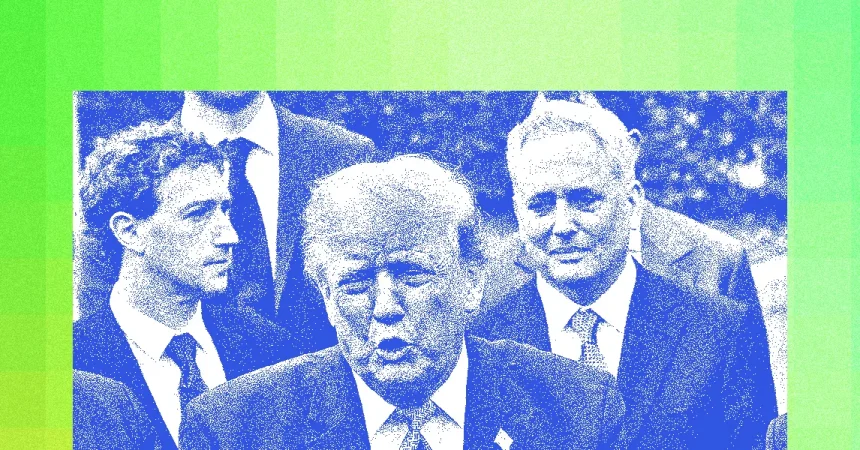
This week’s episode of “Uncanny Valley” opens with a familiar feeling: the world is moving too fast, and the humans in charge are trying to look like they’re keeping up. The hosts walk through three big stories that seem separate at first but keep crashing into one another. There is the voluntary AI safety agreement that a group of tech executives signed, a fresh wave of AI agents designed not for programmers or early adopters but for what they affectionately call “normies,” and a troubling spread of extremist candidates running for office in the US midterms. It sounds like the setup for a very strange night of news, and in many ways it is. But the episode’s real theme is not just the headlines. It is the strange place where technology, power, and ordinary life meet—the uncanny valley where things look almost human, feel almost safe, and yet remain deeply, unsettlingly artificial. The hosts remind us that we are not just consumers of these stories; we are characters in them. Every time we ask an assistant to write an email, every time we scroll past a politician’s tweet, every time we quietly hope someone smarter is handling the future, we are participating in a vast experiment that no one fully controls. The conversation that follows is an attempt to make sense of that experience, not by shouting from the rooftops, but by sitting with the discomfort and asking what we actually want from the machines and the leaders we have chosen to trust.
Let’s start with the voluntary AI safety agreement, because it is both a landmark and a hesitation. The executives who signed it made a series of promises: to develop artificial intelligence responsibly, to subject their models to independent testing, to report vulnerabilities, and to watermark synthetic content so that people can tell when something was made by a machine. On its face, this is wonderful. It is the first time many of the biggest competitors in Silicon Valley have publicly agreed on anything, let alone on the need to restrain their own creations. The hosts are quick to give credit where credit is due. Yet they also spend time on what the agreement lacks. It is voluntary. It is not a law. It has no independent enforcement mechanism, no inspection teams, no penalties for quietly breaking the spirit of the promise. It is, in the words of one host, a little like asking a teenager to promise not to text while driving while handing them the keys to a car that has no brake pedals. The people who sign such agreements are usually sincere, and sincerity matters, but it is not the same as safety. There is also a deeper problem: the agreement focuses on the technology itself, not on the companies that control it. A model can be tested for bias or misinformation, but what about the billions of dollars flowing into election ads, the algorithm that rewards outrage, the infrastructure of surveillance that sits underneath every click? The voluntary agreement treats the symptom while the system that created the disease remains untouched. The hosts don’t want to dismiss it as worthless. They want to appreciate it as a starting point, a fragile open door. But they also want listeners to remember that a promise is not a guarantee. It is a hope written on paper, and hope is only as strong as the pressure people are willing to apply from the outside.
Then there is the other side of the same coin: AI agents for normies. For years, artificial intelligence was a behind-the-scenes assistant, correcting our spelling, recommending movies, sorting spam. Then came the chatbots, which felt like talking to a very confident stranger who had read everything but understood nothing. Now we are entering the age of agents—tools that don’t just answer questions but act in the world. They can schedule meetings, argue with customer service representatives on the phone, book flights, negotiate utility bills, scan a lease, and even send emails on your behalf. The episode paints a vivid picture of what this means for an ordinary person. Imagine someone with a full-time job, two kids, and a leaking roof. They don’t want to write a perfect prompt. They don’t care about the difference between a large language model and a neural network. They want a digital helper that says, “I’ll take care of it.” That is the dream of the AI agent. It is not about making us smarter or more creative; it is about buying back time, absorbing friction, and making the machinery of modern life less exhausting. But the hosts also poke holes in the dream. How much autonomy are you willing to give a program when things go wrong? An agent might confidently schedule a dentist appointment, then cancel it by accident, or misinterpret a tightly worded email and start a minor war with your landlord. More seriously, these agents will be trained on the same messy internet that gave us conspiracy theories, racial bias, and a thousand flavors of nonsense. They will inherit our problems and then present them as solutions. The episode’s thread is not fear of technology itself; it is fear of handing over attention and judgment to systems that have no stakes in our lives. A human assistant might lose their job if they make a terrible mistake. An AI agent will simply apologize and promise to do better next time. That difference matters, especially when the agent is not just managing your calendar but also shaping your access to information. When the line between tool and actor disappears, ordinary people need more than convenience. They need transparency, control, and the ability to say no.
Meanwhile, in the midterms, something older and rawer is happening. Extremist candidates are running for office in numbers that should make anyone pause. These are not fringe figures hiding in the shadows. They are winning primaries, raising money, and, in some cases, expected to hold real power. The episode focuses especially on down-ballot races—secretary of state, county clerk, local election administrator—because those are the quiet rooms where democracy actually happens. The hosts point out that most people never think about these positions until something goes wrong, which is exactly why they are so vulnerable. A candidate who believes the last election was stolen can be placed in charge of the next one. A county official who refuses to certify results can set off a chain reaction that turns a routine election into a constitutional crisis. The story is not new; it has been building for years. But the episode ties it to the wider mood of this moment. Extremism thrives in an environment where people no longer share a factual baseline, where a deepfake can be used to smear a rival, where a viral lie spreads faster than a correction. And here is where the AI safety agreement starts to feel almost irrelevant. What is a watermark on synthetic content when millions of voters already get their news from anonymous accounts with blue checkmarks? What is a voluntary promise when the algorithms that decide what we see are designed to maximize rage? The hosts do not pretend to have a clean solution. They only ask listeners to pay attention to the boring parts of politics, because the boring parts are the ones that matter. If we don’t protect the machinery of elections, then nothing else—not the technology, not the economy, not the culture—will be safe.
The connection between these stories is not accidental. It is the ghost in the machine. The episode argues that we are living through a collision of three great changes: the rise of artificial intelligence that can create, persuade, and act; the collapse of shared trust in institutions; and the emergence of a political landscape where extremism is normalized by constant exposure. These changes feed each other. AI agents are being handed the keys to the information ecosystem at exactly the moment when that ecosystem is most fragile. They will not just read emails and schedule appointments; they will increasingly decide what we see, what we buy, and possibly who we vote for. Meanwhile, the voluntary safety agreement treats the technology as if it can be separated from the society around it. But it cannot. A safe AI in an unsafe society is just a sharper tool. The hosts use a metaphor that sticks: imagine giving everyone a chainsaw and then asking them to sign a promise not to cut down the forest. The chainsaw is not malicious. The people using it might be sincere. But the pressure of a competitive market, the hunger for growth, and the constant need for attention will push someone, eventually, to take off the guardrails. That is not a conspiracy; it is an incentive structure. And every time a platform amplifies an extremist candidate, or an agent quietly accepts a false premise as the basis for action, the structure proves itself. The human problem is not that we have created monsters. It is that we are still pretending technology can be made morally neutral while handing it enormous power. The episode doesn’t offer easy answers, but it does offer a useful question: what would it look like to design AI not for growth, not for engagement, not even for convenience, but for human dignity? That question is not only for tech executives. It is for everyone who uses these tools, votes in these elections, and lives in the world being built around us.
By the end of the episode, the hosts don’t pretend to have clean answers. They do not end with a victory lap or a tidy slogan. Instead, they sit in the uncertainty, the way you sit with a friend who has just told you something difficult. They acknowledge that it is possible to support artificial intelligence and still be scared of it. It is possible to want safer elections and still vote for candidates who are not perfect. It is possible to give up a little convenience in exchange for a little more control. The episode is ultimately an argument for that kind of messy, human balance. It asks us to stop waiting for a hero to save us, whether that hero is a benevolent executive, a charismatic politician, or a perfect AI. The future will not be safe because someone signed an agreement. It will be safe because enough ordinary people stayed curious, asked hard questions, and refused to be swept along by the noise. If there is a takeaway from this week, it is that the uncanny valley is not something we can avoid. It is where we live now. We can either stumble through it half-awake, letting algorithms and extremists choose our path, or we can move through it with our eyes open, carrying the only tools that have ever mattered: attention, judgment, and the willingness to demand better from the people and machines who claim to serve us. That is not a clean answer, but it is an honest one. And in a world like this, honesty is already a kind of courage. Until next time, keep your eyes open, keep your friends close, and remember that the machines are watching—but so are we.