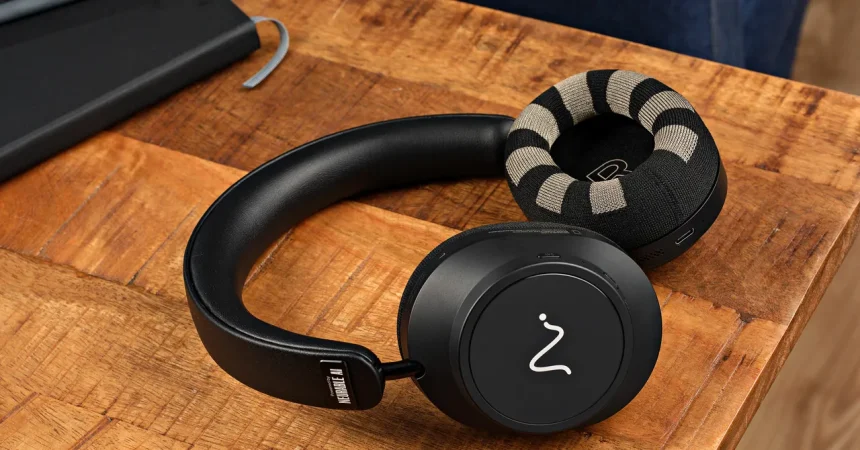
Imagine being able to glance over at your headphones and know, at any given moment, whether your brain is actually locked in or simply going through the motions. That is the promise that Neurable, a Boston-based startup, is making with its first in-house product, the Neurable One. On Thursday, the company unveiled these wireless, over-ear headphones, which it calls “brain-scanning” headphones. They look like a pair of premium audio cans — the kind you’d wear for a long flight or a deep work session — but hidden inside their specially designed nylon earpads are twelve electroencephalography (EEG) sensors. These sensors are meant to monitor the electrical signals your brain sends out through your scalp, and then, through a companion app, translate those signals into a simple, understandable picture of your focus. The company’s claim is bold and appealing: wear these headphones and you’ll have a better chance of concentrating on whatever you’re doing, whether that’s writing a tough report, studying for an exam, or trying to finally win that difficult level in a video game. It’s not the kind of thing you expect from a headphone, and that is exactly the point. Neurable isn’t just trying to sell you another pair of noise-cancelling headphones; it’s trying to sell you a higher level of self-awareness.
The story behind the Neurable One is almost as interesting as the technology itself, because this is a company that very nearly didn’t make its own hardware at all. When Neurable’s cofounder and CEO, Ramses Alcaide, spoke with WIRED earlier in the year, he described a different strategy: the company planned to license its brain-scanning technology to other companies, powering a wave of gadgets that were about to hit the market. That’s a common approach for a young tech company — you invent a clever piece of technology, then let established consumer brands put it in their products, while you stay in the background as the hidden ingredient. But somewhere along the way, Neurable changed its mind. Instead of continuing to supply the “engine” for other people’s products, the company decided to build the whole car itself. “We wanted to take the product in-house,” Alcaide told WIRED. He gave a few reasons: there were many areas where the company wanted to improve the product, and it wanted to move at a much faster rate. He also said that launching its own hardware gives Neurable a little more ability to show off what’s possible with the technology. That last phrase is telling. It suggests that licensing, while financially sensible, can be creatively limiting. When you hand your technology over to another brand, you’re often constrained by their design choices, their marketing timelines, and their appetite for innovation. By going in-house, Neurable gets to control the entire user experience and make sure the product actually works the way its engineers always imagined. It also gives the company a chance to prove its own claims rather than relying on a partner to tell the story.
Neurable’s journey to this moment didn’t happen overnight, and it’s worth looking back at how the company got here. For a long time, Neurable was best known as the brain behind other brands’ experiments in brain-sensing wearables. A few years ago, the company built its technology into some headphones made by Master & Dynamic, a high-end audio brand, creating the M&D MW75 Neuro headphones. These were a quiet but significant statement to the world: brain-scanning doesn’t have to be confined to a hospital or a research lab, with sticky electrodes and tangled wires. It can be woven into the everyday objects we already wear. Then, at the start of this year, Neurable partnered with HP’s HyperX brand to show off a gaming headset with two EEG sensors built in, suggesting that focus-tracking could be useful for gamers who want to understand their mental state during intense matches. These collaborations were helpful stepping stones, but they also had limitations. When you’re working with another company’s product, you’re often adapting your technology to fit their existing design, which means you might not get everything you want. Perhaps that’s why Alcaide felt the need to step out of the shadows. He wanted Neurable to be more than an invisible technology supplier; he wanted it to be a brand in its own right. And by making its own headphones, with its own design, its own earpads, and its own app experience, Neurable can present a clearer and more compelling vision of what brain-sensing consumer technology can be.
So what exactly is the Neurable One, and what do you get for your money? The headphones cost $499 and will be available starting in October from Neurable’s own website. That puts them in the same price range as other high-end wireless headphones, like Sony’s WH-1000XM5 or Apple’s AirPods Max, which is a confident bet that people will be willing to pay a little extra for something that doesn’t just sound good, but also tells you something about your mind. The key feature is the twelve EEG sensors embedded in the nylon earpads. Now, before your imagination runs wild, you should know that these sensors are not reading your thoughts in any literal sense. They are measuring the brain’s electrical activity — the low-voltage signals that fire as neurons communicate with one another. That may sound like something out of a science fiction movie, but the physical reality is quite gentle: you simply put the headphones on, as you would any other pair, and the sensors make contact with your scalp. From there, the headphones analyze patterns in your brain activity and translate them into feedback about your focus level. This is where the companion app comes in. It’s supposed to show you, in real time, how concentrated you are, and it can also store data about your brain activity over time, so you can look back and see when you were most focused, what times of day you tend to be sharpest, and whether your attention is improving. Think of it as a Fitbit for your mind, but one that happens to play music too.
The real question, of course, is whether a product like this can actually help you improve your focus, and that’s where things get more human. Anyone who has ever spent an afternoon staring at a half-finished task knows what it feels like to lose focus. You read the same sentence over and over. You open a new tab. You check your email for the fifth time in ten minutes. And then you feel guilty and go back to work, only to do it all over again. Neurable’s idea is that by making your focus visible, you can break this cycle. When you see your focus score dropping on the app, you can take a breath, readjust, and redirect your attention. It’s a kind of biofeedback: the act of observing your own concentration becomes a tool for improving it. That could be genuinely useful for people who work in open offices, for students with short attention spans, or for anyone who wants to get more out of their gaming sessions. For gamers, focus is especially important — the best players often talk about being in a state of flow, where the game feels like it slows down and their reactions become automatic. A pair of headphones that can tell you whether you’re in that zone, or when you’ve fallen out of it, could be a valuable training companion. Of course, there are also potential downsides. Some people might feel anxious if their focus score is low, and constantly checking an app while you work could become just another kind of distraction. There’s also the privacy question: brain data is incredibly personal, and anyone thinking about buying the Neurable One should consider how the company handles that data and what happens to it after it’s collected. Neurable is making its own hardware now, but it still needs to earn the trust of people who are willing to put sensors against their heads and hand over the signals their brains produce.
In the end, the Neurable One is about more than just one product — it’s a bet on a broader future where our gadgets don’t just respond to our commands, but actually understand our mental states. The fact that Neurable decided to launch its own hardware, rather than simply licensing its technology to established names, says a lot about how much belief the company has in this vision. By going in-house, Neurable is able to refine every detail, from the placement of those twelve sensors in the nylon earpads to the design of the app that interprets the neural data, and it can do so at the speed that a startup needs. It also allows the company to set itself apart in a crowded market; after all, you can brand a headphone as “noise-cancelling” or “premium,” but “brain-scanning” is a different kind of promise. The Neurable One won’t magically make you more intelligent or somehow zap you into a state of perfect concentration. What it offers is something more subtle and arguably more valuable: awareness. Awareness of your own mind, your own habits, and your own moments of drift. That’s a surprisingly intimate feature for a pair of headphones. And while $499 is a fair amount of money, the idea of knowing yourself a little better, and perhaps getting more out of the hours you have each day, is something many people will find difficult to resist. If the Neurable One works as promised, it might just be the beginning of a new relationship between people and their brain activity — a relationship that, for better or worse, is only going to become more common in the coming years.