Every coral colony is wrapped in a secret—a thin, almost invisible layer of water that moves in a different rhythm from the ocean around it. Water is a fluid, but it is also a creature of friction; wherever it touches a solid surface, it slows down, clinging to every rough patch and crevice. Around a coral, this creates a boundary layer, a quiet zone of slow-moving water, often no more than a few millimeters thick. This is the filter through which almost everything vital must pass: oxygen, dissolved food, chemical signals, and even the microscopic life that sustains a reef. For a long time, scientists looked at this layer and assumed it was simply a barrier that corals had to endure. Corals are sessile—they cannot move, cannot chase a meal, cannot retreat from danger. When a coral larva settles on the reef, it lays down roots of a sort and commits to a life of stillness. Imagine waiting for your dinner to drift within reach. Imagine relying on random molecular jiggling, diffusion, to bring you the very air you breathe. Diffusion is a real process, and a beautiful one: drop a single drop of ink into a glass of water, and eventually the color spreads everywhere, no stirring required. But it is painfully slow, especially over the distances that matter to a coral. Oxygen needs to travel a millimeter or more through the boundary layer, yet diffusion can take minutes to cover that distance. The discrepancy between what coral metabolism demands and what diffusion can supply is enormous. For decades, researchers could not fully explain how corals managed. Some assumed that waves and currents provided enough mixing. Others believed that corals had simply evolved to tolerate low oxygen in the boundary layer. But the biggest piece of the puzzle was hiding in plain sight, on the coral’s own skin: microscopic hairs, cilia, that were about to reveal their true role.
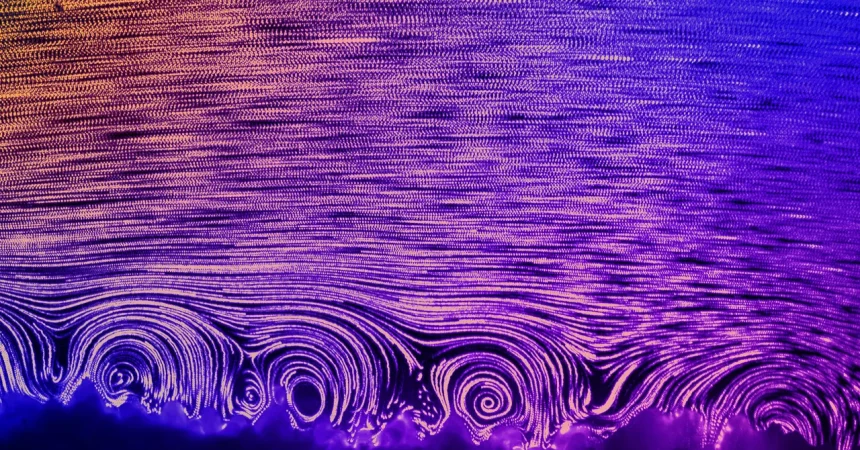
Those cilia are what make corals much more than passive passengers. In 2014, a research team from the Massachusetts Institute of Technology and the Weizmann Institute of Science published a study that would become a landmark in coral biology. The lead author was Orr Shapiro, a microbiologist and environmental engineer who at the time was a postdoctoral fellow at MIT. His original interest was not cilia at all. He wanted to understand how coral diseases spread, specifically how microbial pathogens follow concentration gradients, a behavior called chemotaxis. To study this, he placed samples of coral under a microscope and observed the boundary layer in real time. He expected to see a calm, predictable zone where particles drifted in accordance with diffusion. Instead, he saw something that looked like a tiny storm: particles swirling, mixing, and spinning in regular patterns, as if an invisible force was churning the water. At first, it was almost disorienting. The water was supposed to be still. But the particles were clearly moving in ways that diffusion alone could not explain. The source of the turbulence was the cilia—tiny hair-like proteins that protrude from the surface of coral cells. Cilia were not new to biology; scientists had known about them for decades and had usually described them as simple cleaning tools, like brooms or conveyor belts, that pushed mucus and waste away from the coral. What the 2014 study showed was that they are far more dynamic. They whip rapidly side to side, generating small but powerful vortices. These vortices pull fresh, oxygenated seawater down to the coral’s surface and push depleted, waste-laden water away. For the first time, researchers modeled these vortices mathematically and connected them directly to coral metabolism. Shapiro, now a researcher at the Volcani Institute in Israel, later described the experience as a paradigm shift, not just for himself but for the entire field. The boundary layer, it turned out, was not a dead zone. It was a living, stirred, engineered environment. And the cilia were not just janitors; they were architects of a micro-hydraulic system that keeps corals alive.
To understand why this discovery matters, it helps to appreciate how slow diffusion really is. Oxygen is a small molecule, but water is thick and crowded. When a molecule of oxygen is released into seawater, it doesn’t zip to its destination; it stumbles, bounces, and meanders. As a result, it can take as long as four minutes for oxygen to travel just one millimeter. Coral reefs are places of frantic biological activity, and corals themselves have hungry cells. They use oxygen to power their metabolism, to grow, to repair tissue, and to keep their symbiotic algae happy. Simply relying on diffusion across the boundary layer would be like trying to run a marathon while sipping air through a coffee straw. The cilia solve this problem by dramatically thinning the diffusive boundary layer. Instead of waiting for oxygen to cross the entire quiet zone, the cilia mix the water vigorously, shortening the distance and effectively replacing low-oxygen water with high-oxygen water near the coral’s tissues. They are, in essence, millions of microscopic fans, constantly beating to keep the air supply flowing. Shapiro and his colleagues were so fascinated by this mechanism that they took a detour from their original disease research to map how oxygen flows to coral tissues via cilia. Their results transformed the field’s understanding of the coral microenvironment. As Shapiro later said, diffusion suddenly becomes “no longer really important” because the cilia’s stirring largely replaces it. But this elegant system comes at a cost. Cilia are biological motors, powered by cellular energy. They burn oxygen and nutrients to keep beating. That means corals use oxygen to get oxygen—an arrangement that is efficient and robust under normal conditions, but potentially fragile when stress hits. If the system is working well, it keeps corals supplied. If even one link in the chain weakens, the entire colony may face a crisis.
Water temperature is the great disruptor. Scientists have long understood that corals are exquisitely sensitive to heat, and the most infamous result of overheating is bleaching. Deep inside a coral’s tissues live tiny photosynthetic algae, called zooxanthellae, that give reefs their vivid colors and provide the coral with a steady supply of food and oxygen. In exchange, the coral offers them shelter and nutrients. It is a partnership that powers the entire reef ecosystem. But when sea temperatures rise even a degree or two above normal, the algae become stressed. They begin producing toxic molecules, reactive oxygen species, that damage coral cells. To shield itself from harm, the coral expels its algae, often en masse. Without its symbionts, the coral loses its color, becoming a bleached, ghostly white skeleton. It also loses its primary source of nutrition and oxygen. If the algae do not return soon, the coral starves and dies. This is the story that has become familiar to anyone who follows ocean news, and it is devastating. Record marine heatwaves have triggered mass bleaching events on reefs around the world. But the story is not as simple as it once seemed. In the same reef, some corals bleach while others stay healthy. Some corals die under heat stress without ever expelling their algae, turning brown and decaying rather than white. There are also corals that bleach to normal color but still die weeks later. Scientists were left with a quiet but troubling question: had they been missing a whole other pathway of heat damage? Since the 2014 discovery had revealed cilia as vital for oxygen delivery, it was natural to ask whether heat affects the cilia themselves. Could a coral’s own beating hairs be a hidden weak link, failing long before the visible signs of bleaching appear? An international team of microbiologists, engineers, and physiologists set out to find out.
Their investigations center on the idea that cilia are biological machines, and biological machines are fragile. Each cilium is made of a scaffold of proteins, powered by molecular motors that convert cellular fuel into rhythmic movement. At normal ocean temperatures, these motors work smoothly, bending and whipping in waves that drive water in well-organized patterns. But with each degree of warming, the proteins become more likely to unfold or malfunction. The heat can also drain the coral’s energy reserves, meaning there is less fuel to power the cilia. The result may be slower beating, weaker vortices, or even a complete stop. If the cilia stop, the boundary layer becomes stagnant again. The coral’s oxygen consumption continues, but the supply line is cut. The coral suffocates in place, even while swimming in oxygen-rich water. This is a parallel and invisible pathway from heat stress to coral death, one that might hit some colonies harder than others. It could explain why coral resistance to bleaching does not always match coral survival: a coral might keep its algae but lose its cilia; another might lose its algae but keep its cilia pumping and recover. It also suggests that thermal tolerance is not just about symbiosis; it is also about the mechanical integrity of cilia, the cellular wiring of metabolism, and the ability to repair tiny proteins under stress. Scientists are now studying cilia beat frequency in real time, measuring how heat slows the hairs, and mapping the oxygen gradients that result. What they find will add a new layer to the complex story of reef decline. But it also offers a new set of clues. If some corals have naturally hardier cilia or are better at maintaining energy supplies during heat stress, they may be the survivors that conservationists should be protecting.
This growing understanding of coral cilia changes the way we see reefs, and the way we think about their future. It reminds us that so much of nature’s drama occurs at a scale we rarely notice. Behind the sweeping, colorful vista of a coral reef is a hidden world of tiny swirling currents, the kind of world that can determine the difference between life and death. Corals are often described as simple, stationary animals, but in reality they are engaged in a constant and active dialogue with their environment. They shape the water around themselves, create their own microclimate, and breathe by force of will, one microscopic hair at a time. Learning that cilia are so important, and so vulnerable to heat, is sobering. It means that climate change does not just attack corals on a broad, ecological level; it attacks them on the molecular level, undermining the very machinery they use to stay alive. But knowledge is also a form of hope. The more we understand about cilia, the better we can identify resilient corals, predict which colonies will survive, and design interventions to help them through heat waves. We can search for corals with naturally stronger cilia, breed them into restoration programs, or find ways to shield the boundary layer from stagnation. We might even develop treatments that support cilia during stress, keeping the fans spinning until the water cools. None of this will be easy, and none of it replaces the urgent need to reduce greenhouse emissions. But it gives us something precious: a deeper understanding of the enemy, and of our own allies in the fight. The fate of the reef is often measured in square kilometers and rising temperatures. Yet the fate of a single coral is decided in a space thinner than a fingernail, in the volume of water just above its skin, where tiny hairs beat and whirl and whisper, “I am alive.” If we listen, we may learn how to keep them beating for generations to come.