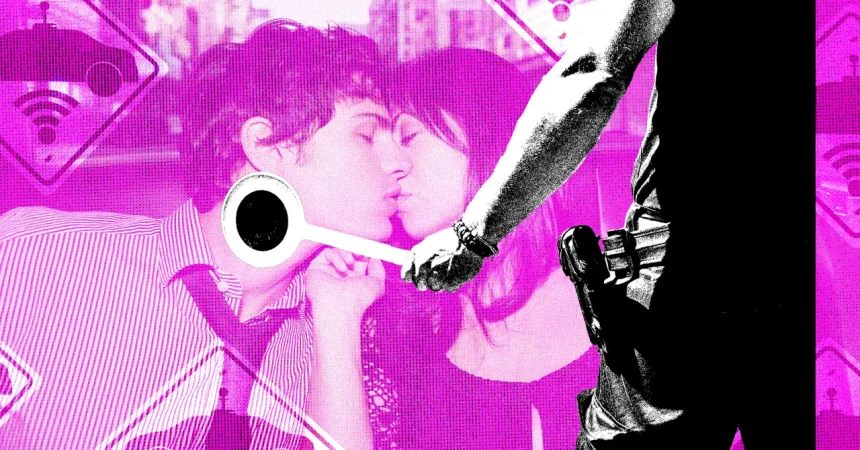
It began, as so many research projects do, with a rabbit hole that Pavlo Bazilinskyy never expected to enter. An assistant professor at Eindhoven University of Technology in the Netherlands, Bazilinskyy has spent more than a decade studying the strange, often unpredictable ways humans and machines interact. He works on artificial intelligence, robotics, and automated driving—serious, technical terrain. But there he was, typing “public transport” into the search bar of PornHub’s amateur section. He got 297 hits. He still can’t quite believe it, but it wasn’t a personal indulgence. It was work. “People are hard to predict,” he says, and that unpredictability is exactly why his research exists. For years, driverless taxis have been appearing in cities around the world, with no human driver to enforce the rules. At the same time, the history of human behavior in vehicles is loaded with all kinds of antisocial, mischievous, and occasionally explicit activity. Think of the prom night limousine, the so-called Mile High Club on airplanes, or Tom Cruise sliding across the Chicago L in Risky Business. What happens when there is no authority figure inside to say, “Hey, stop that”? What do people actually do in a moving, semi-private box with no one watching? And can designers build their way out of the problem before it starts? These are the questions that led a group of academics to organize a workshop with a deliberately provocative title: how do you stop people from doing it in self-driving cars?
The workshop, held this week as part of an industry conference in Gothenburg, Sweden, was not a joke, even though the subject matter made a lot of people smile uncomfortably. It began at 8:30 in the morning and ran for four hours, a slot that suggested the organizers were taking it seriously even if the topic sounded like a comedy sketch. The conference itself was focused on how people interact with vehicles and larger mobility systems, and the workshop was aimed at academics and industry professionals alike. Gothenburg is home to Volvo Cars and the tech supplier SmartEye, and the event carried sponsorship from BMW and Google. The organizers included Bazilinskyy and Alexandros Rouchitsas, an engineering psychologist who studies human-machine interaction, along with colleagues from systems engineering, computer science, psychology, and tourism studies. Their mission was to brainstorm physical and design interventions that could discourage sexual activity in autonomous vehicles. They were careful to state that the workshop was about preventing consensual interactions, not policing criminal behavior. But Rouchitsas was equally careful to admit that he and his colleagues were not exactly the cool people in this conversation. “We are taking the side of the parents, the elderly—we are not the cool people here,” he said. The point was not to judge. The point was to think ahead before the technology gets away from them.
So why would academics dedicate a morning to something that sounds like a punchline? Because they genuinely believe that if self-driving cars get a reputation as places where people have sex, the entire technology could suffer. Bazilinskyy and Rouchitsas are not motivated by moral outrage. They are motivated by acceptance. Autonomous vehicles could be transformative for people who are currently left out of a car-centric world—the elderly, children, people with disabilities, anyone who cannot easily drive or afford a private car. The technology could eventually move beyond sleek private robotaxis and into public transit, where all kinds of people need to travel safely, comfortably, and with dignity. Rouchitsas wants automated mobility to be seen as “equitable, serious, societally minded.” But that vision is fragile. If the first popular image of self-driving cars is a mobile party bus, a place where people do drugs, drink, and hook up, public trust could evaporate before the technology ever gets a fair chance. He pointed to a bleak example from his native Greece: certain islands have been overrun by tourism and hedonism, and he worries the same could happen with autonomous vehicles. “You know ‘Bang Bus’?” he asked. “We don’t want that.” For the record, Bang Bus is exactly what it sounds like—a vehicle used for adult content. The fear is not just that a few people will misbehave. It is that those few will shape the narrative, souring the public on a technology that could otherwise be a force for good.
During the workshop, participants were challenged to come up with creative, practical, and maybe even surprising interventions. Rouchitsas offered some starting points, though he sounded more than a little skeptical of his own suggestions. What if autonomous vehicles were made more transparent, so that riders knew they could be seen from the outside? What if a light started blinking when the vehicle’s sensors detected behavior the system deemed inappropriate? The organizers planned to publish a paper based on what came out of the session, and they hoped the conversation would go far beyond the obvious “don’t do that” signs. Sex, after all, is just the most eye-catching example of a much larger challenge. Bazilinskyy called it “the elephant in the room” for anyone thinking about how humans will interact with machines in the coming decades. It is under-studied, underdiscussed, and strangely difficult to prepare for. But if designers, engineers, and policymakers can figure out how to handle sex in autonomous vehicles, they might also figure out how to handle a whole range of difficult human behaviors. The same physical and digital design tools that discourage intimate misbehavior could discourage robbery, bullying, vandalism, or even violence. “It could be helpful for the industry and academics to use this example to design other things,” Bazilinskyy said. The sex question is not the opposite of the serious question. It is a doorway into it.
That broader implication gives the whole project its weight. Autonomous vehicles are not just machines that move people from point A to point B. They are future communal spaces, tiny social environments where norms get tested, broken, and rewritten every day. People behave differently in a car than they do on a bus, and they behave differently in a bus than they do on a train. Remove the driver, and the social contract shifts again. There is no longer a human authority figure to enforce expectations, no driver’s eyes in the rearview mirror, no gentle cough from a professional who has seen it all. The vehicle itself has to become the authority, or at least the host, setting expectations and responding when they are violated. That is an enormous design challenge, and it is exactly what these researchers are trying to think through while the technology is still young enough to shape. They are not trying to eliminate all behavior that might make someone uncomfortable—they know that would be impossible. They are trying to create an environment where people of all ages, backgrounds, and sensibilities can share space without feeling like they have stumbled into something they never signed up for. If they think about sex now, maybe they can prevent a future where a self-driving bus becomes a mobile back room, and where the people who literally could not get anywhere without the technology are the ones who suffer the consequences.
In the end, the workshop was equal parts absurd and essential, which is exactly how serious human-centered research often looks from the outside. Bazilinskyy and Rouchitsas know how strange it sounds, and they are not pretending otherwise. They are not the cool people. They are not trying to be. But their underlying message is simple and hard to argue with: the future of transportation is coming, and it will be filled with real human beings, with all their hang-ups, desires, bad decisions, and unpredictable impulses. We can bury our heads and pretend that everyone will behave beautifully, or we can have awkward, uncomfortable conversations now, while there is still time to design for the mess. Sex is just the easiest way to get people to pay attention. If you can get a room full of engineers and academics to talk seriously about PornHub research and blinking lights, you can get them to think carefully about the ordinary, everyday moments of public life that are so easy to take for granted. Maybe the real point of the workshop was not to stop people from having sex in self-driving cars. The real point was to get people to imagine what it means to share a space with strangers, trust the machine that is carrying you, and still feel like a human being. The PornHub search was only the beginning. The hard work is everything that comes after.