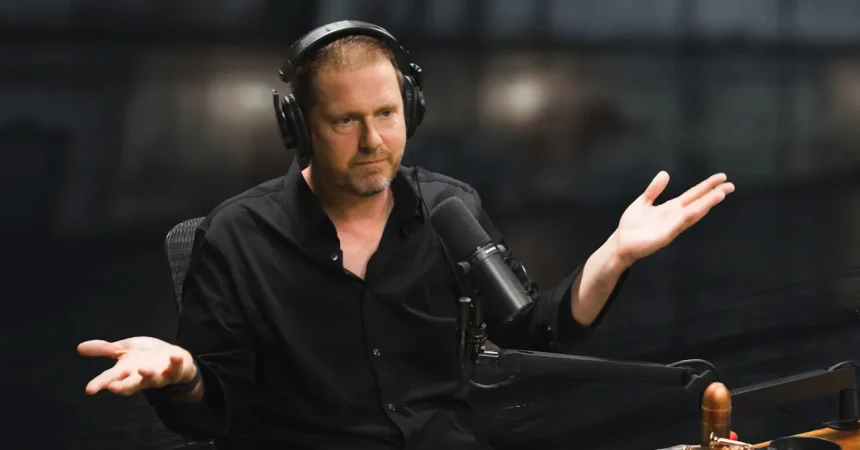
There is a particular kind of comedian who watches the modern media circus and cannot help but reach for a funhouse mirror. Tim Heidecker is precisely that comedian. With his new project, “The Tim Heidecker Podcast,” he has turned his attention to the sprawling, untamed phenomenon of the podcast bro, and in particular to Joe Rogan, the man who has become the unofficial mayor of that strange and endless world. The result is something that feels less like a simple impression and more like a loving autopsy of the genre: the long tangents, the sudden shifts into conspiracy, the weird intimacy between host and guest, the sense that absolutely nothing and absolutely everything is happening at once. In 2026, this is an even braver act of satire than it was when Heidecker first dipped his toes into these waters. Reality has become so absurd that parody has to work twice as hard just to keep up. A representative for Rogan did not immediately return a request for comment on the project, and in a way, that silence is the perfect punchline. It is as if the universe itself decided to collaborate with Heidecker, providing the kind of empty, ambiguous non-response that a satirist could not have scripted any better. The absence of comment becomes part of the joke, a blank space in which the listener can project everything that makes Rogan such an endlessly fascinating target: his massive influence, his casual unpredictability, his astonishing ability to say something profound and something nonsensical in the same breath, and his seeming transcendence of the usual rules of accountability.
Heidecker first lampooned Rogan in 2021, and that initial foray became a viral sensation for good reason. He released what was billed as a twelve-hour podcast, though in truth it was one hour of footage looped a dozen times, which was itself a perfect joke about the bloated, self-indulgent nature of the long-form podcast format. The episode touched on topics that had become staples of the Rogan universe and the broader media conversation: psychedelics and the search for alternative consciousness, cancel culture and the fear of being silenced, and the eternal question of whether Dwayne “The Rock” Johnson would one day run for president. The result was hilariously deadpan, a parody so committed that it occasionally blurred into something almost meditative. It captured the strange rhythm of podcasts that boast about their length as if duration alone were a mark of depth. There is a certain hallucinatory quality to sitting through a marathon conversation that seems to circle the same ideas without ever arriving at a destination, and Heidecker understood that intuitively. His one hour of footage, repeated to the point of absurdity, made all of that tangible. It was not just an impression of Rogan; it was an impression of the audience too, of the strange patience and attention that the format demands, and of the almost hypnotic spell that a charismatic host can cast over a listener who has long since lost track of time. By the end, viewers were not just laughing at Rogan or at Heidecker; they were laughing at the entire culture of pseudo-intellectual rambling that had come to define so much of online media.
Now, with the first episode of “The Tim Heidecker Podcast,” he is doing it all over again, and he has brought along a pair of collaborators who are perfectly suited to the task. Comedy duo Rajat Suresh and Jeremy Levick, both contributors to The Onion, return as guests, and they are the ideal foils for this kind of comedy. They have essentially perfected the art of fake celebrity content, creating interviews and roundtables that are so convincingly vapid that they exist in a strange space between parody and reality. At one point they even managed to get Justin Theroux in on the joke for a mock Hollywood Reporter style actors roundtable, blurring the line between genuine celebrity access and absurdist performance in a way that felt genuinely revolutionary. That ability to inhabit media tropes so completely is on full display in the new episode. They arrive with all the confidence of true experts, offering their authoritative takes on the hot-button issues of the day, and yet their expertise is entirely fictional. That is precisely the point. In the podcasting era, authority is often just a matter of volume and conviction. Anyone with a microphone and a modest following can become a thought leader, a truth teller, a doctor of public opinion. Suresh and Levick embody that phenomenon with a kind of joyful commitment. They do not wink at the camera; they stay in character, allowing the absurdity to unfold naturally. In doing so, they highlight something essential about the media landscape in 2026: the gap between having an opinion and having any actual knowledge has become almost impossible to distinguish from the outside. The format itself is the message, and Heidecker is the maestro orchestrating the whole beautiful mess.
The actual content of the new episode is a masterclass in pointed absurdity. At one point, Levick declares, in the middle of a discussion about diversity, equity, and inclusion policies, that “what is essentially happening is, in place of Christianity, we have the 10 commandments of woke.” It is exactly the kind of rhetorical flourish that sounds profound if you are not listening too closely, and utterly ridiculous if you are. The conversation then wanders into a bizarre concern about bearded men dressing as princesses to visit Disneyland, a moral panic so specific and so nonsensical that it could almost have been lifted directly from some corner of the internet where outrage is manufactured on an industrial scale. Heidecker listens with an expression that is difficult to read, part curiosity, part mild concern, part sheer performance of open-mindedness. Then, with the abruptness of a true podcast host, he informs the boys that he has planned a weekend trip to Glasgow “for Scotch wrestling.” The non-sequitur lands with the force of a revelation. It is meaningless and yet deeply meaningful in context. This is how conversations work in the podcasting world: a serious discussion of social policy can suddenly collapse into a plan for a surreal Scottish wrestling trip, and no one pauses to question it. The joke is not just on Heidecker’s supposed character; it is on the entire medium, on the way it allows for the mingling of the profound, the idiotic, and the utterly irrelevant in a single unbroken flow. By disguising these leaps as perfectly normal, Heidecker and his guests expose the underlying chaos of the form, and by extension, the chaos of a media environment that rewards volume and confidence over coherence and truth.
In 2026, it is more difficult than ever to exaggerate the absurdities of the right-wing media ecosystem. The news cycle is full of fact-free moral panics, bizarre alternative medicines, conspiracy theories that mutate faster than viruses, and public figures who seem to have abandoned any pretense of engagement with reality. Satirists often struggle in such an environment, because the gap between what they invent and what is already real threatens to disappear entirely. A joke about a politician claiming that the moon is made of cheese cannot compete with a real politician claiming that vaccines turn people into magnets. Yet if anyone is up to the task of navigating this terrain, it is Heidecker, whose career has been defined by a tireless, endlessly inventive approach to comedy. He does not just repeat the news; he finds the hidden rhythms and structures that make it so strange. He is a comedian who has never been afraid to go too far, to be too weird, to make his audience uncomfortable, and then to push them just a little further. And after he is done with his run as a Rogan type, he will have no shortage of grifters and lunatics to go after. The pipeline of absurdity is seemingly endless. New gurus, new health fads, new moral panics, new self-appointed saviors appear every day, each one more eager than the last to claim the spotlight. Fortunately for Heidecker, few of those potential targets are as rough on the voice as his Rogan impression, which requires a certain gravelly, emphatic cadence that can wear on the vocal cords over time. There is a strange physicality to this kind of comedy; the comedian becomes the character, not just through words but through muscle, breath, and tone. It is a labor of love, a willingly accepted burden, and it is one that Heildecker seems ready to carry for as long as the absurdity demands.
In the end, what makes “The Tim Heidecker Podcast” more than just a joke is the human need it satisfies. In a time of chaos and confusion, laughter is a survival mechanism. It is a way of making sense of the senseless, of finding a small patch of solid ground in a world that seems to be constantly shifting. Heidecker offers his audience that gift. He holds up a mirror to the online culture that consumes so much of our attention, and he invites us to laugh, not just at the absurdity of others, but at the absurdity of ourselves, at our willingness to sit through twelve hours of rambling, to take seriously the pronouncements of fake experts, to become outraged by bearded princesses and Scotch wrestling. The podcast is a shared experience, a communal acknowledgment that we are all, in some way, stuck in this strange circus together. The fact that a representative for Rogan did not immediately return a request for comment only adds to the strange mythology of the whole venture. It leaves the story open-ended, ripe for further speculation. Will Rogan respond? Will he acknowledge the parody? Or will he simply continue on his own path, forever moving forward, forever talking, forever generating the raw material that comedians like Heidecker need? The silence is a gift. It is an invitation to keep watching, keep listening, keep laughing. And as long as there are people like Tim Heidecker willing to do the work, there will be a way through the noise. The podcast is not merely a parody; it is a lifeline. It is a reminder that even in the strangest of times, there is still room for wit, for intelligence, and for the simple, human act of finding something ridiculous to laugh about together. And if that involves a trip to Glasgow for Scotch wrestling, so be it. The joke, after all, is just beginning.