Justin Blinder was not prepared for what happened to him in the winter of 2020. He lost his job just two weeks before the Covid-19 pandemic brought New York City to a standstill, and suddenly the city he had called home for years became a place of fear, uncertainty, and closed doors. Like many people who found themselves without work, he did what he had to do to survive: he began delivering food. Day after day, he mounted his bicycle and rode through the streets of New York, carrying takeout containers from restaurants to apartment buildings. But as he pedaled, he started to notice patterns that went far beyond the logistics of food delivery. He noticed where the expensive sushi orders were going, and where the cheaper meals went. He noticed which neighborhoods tipped generously and which ones barely tipped at all. He noticed that the distance between wealth and poverty was not measured in miles but in blocks. One street could feel like another world entirely. The pandemic did not create these divisions, but it made them impossible to ignore. As Blinder later told WIRED, “The city started to feel much more economically and psychologically disparate. It really changed so much on a block-by-block level. These inequalities and demographic differences were happening in such close proximity.” What began as a desperate way to pay rent became the seed of an unsettling revelation: the city was not one place, but many, layered together in uncomfortably close quarters.
That revelation gestated in Blinder’s mind for months, slowly taking shape as an idea that was equal parts art, technology, and protest. Today, Blinder—a Brooklyn-based artist and contractor at Meta—has turned his experience into a striking project called Ground Truth. It is not a painting, a sculpture, or a film. It is a device that attaches to a bicycle, specifically a Citi Bike, and makes the physical act of riding through certain neighborhoods dramatically more difficult. The idea is simple in its horror and its elegance: the harder a neighborhood is to afford, the harder the bike becomes to pedal. When a rider passes through a rent-burdened area—where more than 30 percent of household income goes toward rent—the bike’s brakes are subtly applied, adding resistance and slowing progress. But when the rider enters a more economically comfortable neighborhood, the bike glides freely, easy to pedal, almost as if the city itself is cooperating. With support from a $10,000 grant from the Brooklyn arts organization Idle Hands, Blinder built a device that translates abstract statistics about housing affordability into a visceral, physical experience. He wants people to feel inequality in their legs and lungs, not just read about it in a spreadsheet. Ground Truth is designed to make an invisible crisis tangible, and it is impossible to ignore once you are sweating against the invisible hand of rent burden.
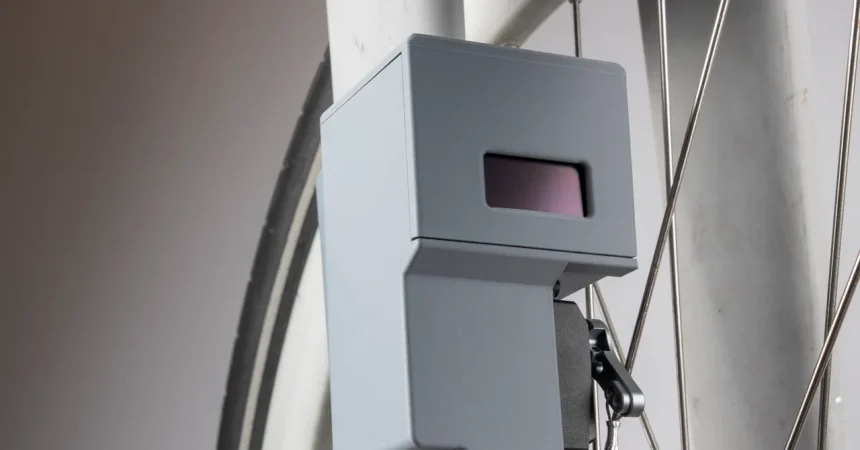
The technology behind the project is both fascinating and deceptively simple. Blinder created two versions of the device: one that works on a regular bicycle and one built specifically for Citi Bike, the ubiquitous blue ebike rental system owned by Lyft that has become a familiar presence across New York City. The core of the device is a small box that mounts on the bike’s fork and connects to the front brake line. Inside the box is a battery-powered GPS component that tracks the bike’s location in real time. As the bike moves, that location is constantly cross-referenced with household economic data pulled from the U.S. Census Bureau’s American Community Survey. That data is stored locally on the device itself, so the bike does not need an internet connection to know where it is or what kind of neighborhood it has entered. When the GPS coordinates indicate that the bike has crossed into a block with a high percentage of rent-burdened households, a microcontroller processes that information and triggers a small motor. The motor applies the brake, adding resistance to the wheels, and the pedal becomes noticeably harder to turn. The further you ride through such a neighborhood, the more the bike resists. There is no alarm, no warning light, no explanation. There is only effort, and the strange, creeping sense that the street itself is pushing back.
What makes Ground Truth so powerful is that it turns data into a lived experience. Most people, even those who consider themselves socially conscious, can easily ignore statistics about the housing crisis. Numbers like “30 percent of income spent on rent” or “thousands of evictions per month” are abstract; they happen to other people, in other places. But Ground Truth removes that distance. It makes inequality a physical obstacle that you must confront with your own body. The term “ground truth” itself comes from fields like remote sensing and machine learning, where it refers to information that is collected on the ground, directly, rather than inferred from a distance. Blinder’s project takes that concept and inverts it: instead of using ground-level observation to calibrate satellite data, he uses the city’s own streets to calibrate the rider’s awareness. When you ride a Ground Truth–modified bike, you are not looking at a map of inequality; you are pedaling through it, feeling it in the strain of your muscles and the slowing of your momentum. The bike becomes a kind of measuring instrument, but it measures not distance or speed—it measures the weight of housing costs pressing down on the people who live below. It humanizes a crisis that has too often been reduced to policy debates and zoning arguments. It asks you to imagine what it feels like to live in a place where simply existing, simply staying, requires more and more effort every year.
The project also arrives at a moment when New York City’s housing crisis has reached startling extremes. Rent burdens have become a defining feature of urban life for millions of people, not just in New York but in cities across the country. Workers have been priced out of neighborhoods they grew up in, families have been forced to double up in apartments, and an entire generation has come to accept that homeownership is out of reach. The pandemic only deepened these divides, as remote workers and investors reshaped housing markets, and the gap between the city’s haves and have-nots grew more visible. Blinder’s work speaks directly to that moment. By using Citi Bike, a public-facing amenity that many New Yorkers take for granted, he forces a conversation about who has access to the city and who is just passing through. The bike is not just a vehicle; it is a metaphor for the fundamental experience of living in a city that moves quickly for some and slowly for others. Ground Truth does not solve the housing crisis, and it does not pretend to. But it does something arguably more important in the short term: it interrupts the routine of city life and makes people think. It takes a comfortable ride and makes it uncomfortable, which is exactly what art should do. It disrupts, it provokes, and it refuses to let you look away.
Ultimately, Ground Truth is an act of empathy made legible through engineering. It comes from a place of personal hardship—Blinder’s own struggle to pay rent during the pandemic—but it is aimed at something much larger. He wants people to understand that the city’s inequality is not natural or inevitable. It is the result of decisions, policies, and economic forces that push against ordinary people every day. The bike is a small, temporary window into that pressure. When you feel the brakes drag as you pass through a neighborhood where families are struggling to stay in their homes, you are experiencing a fraction of the resistance that those residents face every single day. You are, for a moment, aligned with their struggle. And when the bike eases up again as you glide into a wealthier area, you feel the relief that comes with privilege, even if you have not earned it. That contrast is the heart of the project. It is a reminder that our environment shapes us, physically and psychologically, in ways we rarely notice. Blinder wants to make that shaping visible, one block at a time. In doing so, he invites all of us to question what we are willing to accept, and what we are willing to change, about the places we call home. Ground Truth is not just a device for making bikes harder to ride; it is a mirror held up to the city, asking it to look at itself honestly and, perhaps, to start moving in a different direction.