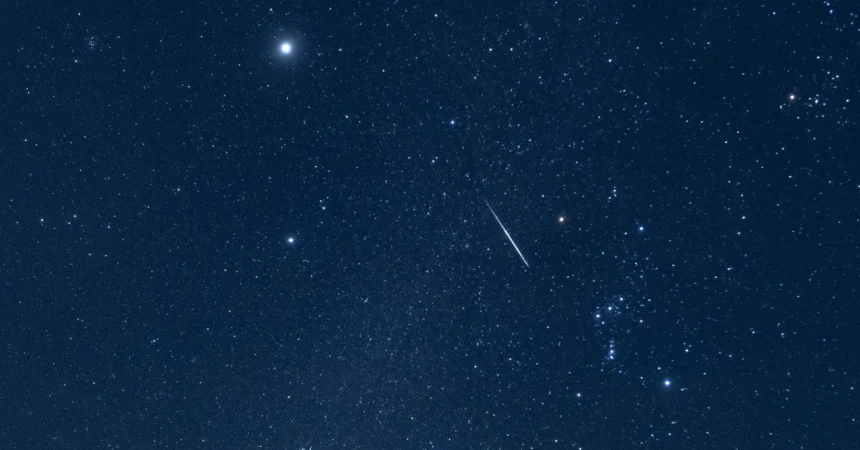
On a clear autumn night, when the air has a crisp edge and the stars seem to hang lower than usual, you might catch a sudden streak of light across the sky. It is over in less than a heartbeat, but it leaves a brief, glowing trail and a feeling that you have witnessed something extraordinary. Those streaks are Orionid meteors, and they are much more than random space debris. They are tiny fragments of Halley’s Comet, the famous wanderer that has been observed by humans for thousands of years. Every October, Earth passes through a trail of dust and ice left behind by Halley on its long journey around the Sun. When those bits slam into our atmosphere at astonishing speeds, they heat up and glow, creating the bright, fast meteors known as the Orionids. What makes them special is not just their origin but their character. These meteors move faster than most others, entering Earth’s atmosphere at roughly 148,000 miles per hour. That speed makes them burn brighter and often produces glowing trains that linger for a few seconds after the meteor itself has faded. To the naked eye, they look like swift, decisive brush strokes of light, as if the universe itself were sketching something just beyond our vision. The fact that they come from Halley’s Comet gives them a kind of intimacy and historical depth. This is not an anonymous rock floating through space; it is a piece of a comet that has been revered, recorded, and remembered for centuries. When you see an Orionid, you are seeing a trace of that ancient traveler, a tiny memorial of its last pass through our neighborhood.
To understand why these meteors are so special, it helps to know a little about their parent body. Halley’s Comet is perhaps the most famous comet in history, a dirty snowball of ice, rock, and organic molecules that orbits the Sun every 76 years or so. Its orbit is highly elongated, carrying it from just inside the orbit of Venus to far beyond Neptune. As it approaches the Sun, the heat causes its icy surface to vaporize, releasing gas and dust into space. This dust spreads out along the comet’s orbit, forming a wide, uneven trail of particles ranging from microscopic grains to pebble-sized bits. Over many centuries, Earth has crossed this trail twice each year, once in May and once in October. In October, the debris produces the Orionids, so named because their radiant point—the spot in the sky where they appear to originate—lies near Orion’s club, not far from the bright red giant Betelgeuse. The particles are small, often no larger than a grain of sand, but they are moving extremely fast relative to Earth. When they collide with our atmosphere, the air in front of them compresses and heats up to several thousand degrees, creating a brilliant streak of ionized gas. The combination of speed and fragile composition is what makes Orionids noticeably brighter and faster than many other meteors. They are also more likely to leave persistent trains: thin, smoky ribbons of glowing gas that can drift in the upper atmosphere for a few seconds or even minutes. This is why an Orionid feels like a live wire in the sky rather than a faint, sleepy spark. It is also worth remembering that Halley’s Comet itself has been a companion to human history. It appears in records from ancient Babylonia and China, and it was captured in the Bayeux Tapestry depicting the Norman conquest of England in 1066. To see its remains fall as meteors is to touch that long, shared human story.
The Orionids are among the most dependable meteor showers of the year, though they are not the most prolific. In a typical year, sky-watchers in dark locations may see anywhere from ten to twenty meteors per hour at the peak, which usually occurs around October 21–22. That might not sound like a lot, but the quality of the individual meteors more than compensates. Because they are swift, they can appear low on the horizon, shoot across large swaths of sky, and occasionally flare into brilliant fireballs that outshine the brightest stars. The shower is active for about a month, from early October to early November, so there are many chances to catch one. The radiant point near Orion rises in the late evening and climbs highest in the hours before dawn, which is the best time to look. The Moon can interfere, as can city lights, but even from suburban skies the fastest meteors can sneak through. What is often most memorable is not the meteor itself but the moment around it: the stillness of the night, the sound of your own breathing, the sudden gasp as light tears across the darkness. There is a particular joy in watching with friends, lying on a blanket, and trying to coordinate “ooh”s and “ahh”s, because no one sees the same meteor at the same time. The Orionids remind us that the sky is not a static painting but a dynamic, ever-changing arena. They also carry a quiet narrative: each speck of dust was once part of a comet that has been circling the Sun for millions of years. When you catch one, you are literally watching a piece of ancient history become a flash of present-tense beauty. Because the meteoroids are small, most do not survive their passage through the atmosphere; they burn up completely, leaving only a fading train. That final act gives them a bittersweet quality—they shine brightest at the moment of their destruction, a little like fireworks that exist only for a heartbeat.
The Orionids are not the only show Halley’s Comet puts on. In May of each year, Earth crosses another part of the same comet’s debris stream, producing the Eta Aquariids. The name comes from the constellation Aquarius, near the star Eta Aquarii. This shower is especially good for observers in the southern hemisphere, but northern sky-watchers can also catch a few meteors in the predawn hours. The Eta Aquariids are also fast and bright, and they are often associated with a higher percentage of persistent trains and occasional fireballs. There is something poetic about this twice-yearly return. Halley’s Comet itself may be far away beyond the outer planets, but its trail wraps around the solar system like a thread in an infinite weaving pattern. We bump into that thread every spring and every autumn, and each bump gives us a small, visible reminder that the universe is full of leftovers dancing along well-worn pathways. The fact that the very same parent comet can produce two distinct showers is a testament to the complex shape of cometary debris trails: the particles are not evenly spread but clumped and twisted by the gravity of planets and the pressure of sunlight. As a result, some years the showers are stronger, some years weaker, and occasionally a dense clump of debris will surprise observers with an outburst of dozens or even hundreds of meteors per hour. Astronomers study these variations to learn more about how comet dust evolves and how the solar system cleans up its mess. But for the rest of us, the showers are simply a gift: two annual festivals of light, one in spring and one in autumn, each timed to the seasons of planting and harvest. They are a reminder that even seemingly chaotic events in the sky follow rhythms that are ancient and reliable, and that our planet is not isolated but is constantly sweeping up the memories of its travels.
If you want to see these Halley heirs for yourself, you do not need a telescope or any special equipment. The best tool is your own eyes, along with patience, warm clothing, and a comfortable seat. Meteor watching is a low-tech, high-touch experience. Pick a night when the Moon is not shining brightly, drive away from city lights if you can, and give your eyes at least twenty minutes to adapt to the darkness. A reclining lawn chair or a blanket on the grass allows you to take in as much sky as possible. You do not need to look at the radiant point; in fact, meteors appear farther away from it, with longer trails, if you look slightly to one side. The hours from midnight to dawn are usually best, because that is when Earth’s rotation combines with its orbital motion to sweep you directly into the debris stream. Bring a thermos of tea or hot chocolate, a friend to whisper with, and a sense of gratitude for the simple fact that you can witness something the most sophisticated instruments in the world still cannot fully explain: the fleeting, beautiful collision between a comet speck and a planet. As you lie under the stars, you may find your mind wandering. Each streak is a tiny piece of Halley’s Comet, but it is also a tiny piece of the solar system, a leftover from its construction. The atoms in your body were once forged in stars; the dust in the meteoroid was once part of a comet’s frozen crust. There is a strange kinship in that. Watching meteors is not just a hobby or a science lesson; it is an act of paying attention to the quiet drama happening above our heads every single day. And when a bright Orionid briefly illuminates the landscape, you are reminded that the universe is not silent and distant but full of sudden, soul-stirring voices.
Eventually, Halley’s Comet itself will return to the inner solar system. Its next perihelion is in 2061, and if you are alive then, you will have a chance to see the actual comet with your own eyes, as generations before you did. But until then, the comet is still present in a scattered form. Every Orionid and every Eta Aquariid is a postcard sent from Halley, a fragment of its journey that finds us instead of us finding it. That is a humbling thought. The pieces are tiny, often smaller than a grain of sand, yet they are moving with enough speed and energy to paint the sky with light. They teach us to appreciate what is small and fleeting, because it can still be glorious. They also teach us patience: a meteor shower is not a fireworks display with a scheduled finale; it is a slow, sporadic lifting of the curtain, one flicker at a time. You wait, you wish, you wonder, and then the sky erupts with a single arrow of fire, and just as quickly it is gone. In that momentary flash, all the vastness and complexity of the solar system is distilled into a personal experience. The next time you hear someone mention Halley’s Comet, you can say that you have seen things left behind by it, even if you have never seen the comet itself. In a way, those small, bright, speedy meteors are better messengers than the comet would ever be. They are accessible, unexpected, and undeniably alive. They come not every seventy-six years, but every year, twice a year, as long as the Earth keeps orbiting and the comet keeps leaving traces of its path. And so, on a crisp autumn night, when a sudden light tears across the sky and leaves a glowing trail behind it, you will know what it is: a tiny fragment of Halley’s Comet, bright and fast, reminding us that we are all, always, moving through a universe that is far bigger than we can imagine.