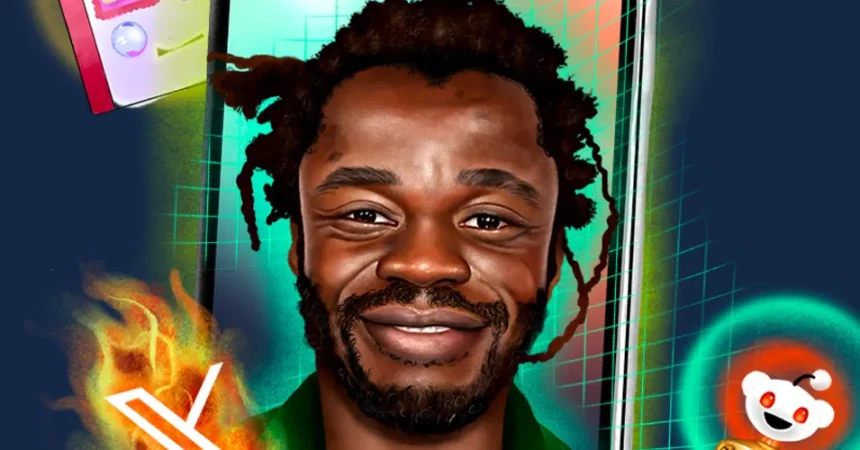
Demi Adejuyigbe is the kind of person who makes you want to dance, even if you’re not sure you know how. On a recent episode of Subway Takes, he told Kareem Rahma that he wants government-mandated dance classes for all men, which is exactly the sort of idea that makes sense coming from a comedian who has built a career on joyful, slightly absurd movement. He’s the man behind the beloved annual music videos set to Earth, Wind & Fire’s “September,” the one-man shows full of ridiculous musical numbers, the Edinburgh Fringe debut that promised he would also do a backflip on stage. He is, by any measure, a 21st-century renaissance man: TV writer, podcaster, DJ, film photographer, occasional deep-diver into visual effects research, and somehow still someone who finds time to reply to every text. But behind all that effortless creativity is a person who lives a deeply digital life, and he’s refreshingly honest about the mess of it all. He uses an iPhone 17e, keeps the default Radial alarm, and works on a 14-inch MacBook Pro. His daily screen time hovers around nine hours, and when the notification arrives, his reaction is a shrug: “That’s none of my business.” He knows he’s on his phone a lot—he uses it in his shows, records things, scrolls through the same feeds as the rest of us—but he carries it with the same easygoing irony he brings to a dance floor. He is, as his favorite meme would put it, smiling through it all.
His relationship with music streaming is a small study in ethical exhaustion. He used to be on Spotify, but after reading that the CEO was investing in AI companies and military contractors, and after years of hearing musician friends complain about terrible residuals, he decided he couldn’t do it anymore. “It’s not a good one to use if you support musicians,” he says. The final straw came when Spotify ran ICE ads; he was done. He switched to Apple Music, even though he knows Apple isn’t a saint either. He missed the interface at first, but now he’s used to it, and he describes it as “the lesser of two evils.” It’s a pragmatic compromise, the kind most of us make when we want to enjoy something without feeling completely complicit. Communication is another area where he’s more disciplined than his screen time suggests. He has 72 unread emails, but that number is purposeful: he leaves emails unread until he’s mentally prepared to answer them. “I get very anxious sometimes when I get an email,” he admits, even when it’s something he’s been waiting for. “I’m not in the place to answer that right now,” he tells himself, and then it slips down the list. Texts are different. He has zero unread texts because he responds immediately. “Why pretend I’m not on my phone all the time?” he asks. If the number ever creeps up, it’s because he just walked out of a movie and a group chat has gotten away from him. His latest content binge was Reel Talk Show, an Instagram game show where people on the street guess movies based on audio clips. He watched twenty in a row. It’s a tiny, low-stakes pleasure, and he seems almost relieved to talk about it.
On social media, Adejuyigbe operates like a visitor at a zoo: happy to observe, not particularly interested in getting involved. He comments on friends’ posts if he thinks it will help the algorithm or if he has something genuinely useful to say, but he mostly stays quiet. “I don’t need to interact with that,” he says. “It’s just a thing that I enjoy, and then I walk away.” Part of it is practical: if he comments and people reply, he gets notifications, and notifications annoy him. So he reserves his engagement for moments when it feels constructive, or when something is so funny that he simply has to write “hahahaha.” His approach to DMs is similarly deliberate. When he was single, he allowed himself roughly one DM slide per quarter. He needed a reason to believe the other person would be receptive, or something clever to say about something they had posted. Without that, he would make a joke and then immediately run out of material. “All right, well, I’m out of stuff now,” he remembers thinking. “I didn’t try very hard, but I’m done.” He doesn’t want to be known as a serial DM-er, and he doesn’t slide into strangers’ messages for sport. There is a strange, almost old-fashioned restraint in that approach, especially for someone in comedy and entertainment, where social media is often treated as a necessary performance. He’d rather let his work speak for itself and keep the rest of his attention close.
His curiosity, however, is broad and wonderfully random. A recent Google search was for “Engelbert Humperdinck,” after a Reddit thread about celebrities who turned out not to be using their real names. He discovered the singer’s real name is Arnold Dorsey, and that was enough to satisfy him. He takes photos the way a proud friend would: when he went to see his friend Sophie’s show in Edinburgh, he snapped a photo of her from the side of the stage, beaming like a proud mom. He already seen the show in Melbourne, but this was a more finished version, and she had invited him to do a little walk-on cameo at the end. His last screenshots were a ticket to a Patti Harrison show on his phone and, on his laptop, a playlist sorted by popularity of songs. He was preparing a mashup megamix for a party he was DJing, using a website that organizes Spotify playlists by genre, year, or popularity. The most popular song in the screenshot was Adele’s “Set Fire to the Rain”; the least popular was Charlie Puth’s “Attention.” It’s a very specific kind of nerdery, the sort of thing a person does when they care about both the craft of a DJ set and the tiny details of shared cultural recognition. His emoji habits are just as intentional. His top three are the sunglasses, the heart, and the eye roll. He uses the sunglasses a lot, the heart because he genuinely likes showing love, and the eye roll almost always ironically—when he’s saying something stupid and pretending everyone should already know it. These small digital artifacts make him feel less like a famous comedian and more like a friend who sends you screenshots and deep-dives into trivia.
The darkest corner of his digital life is X, formerly Twitter, which he describes in terms that border on grief. “I want to burn it to the ground,” he says. “I think it’s awful. I think everyone on there is really bad, myself included.” He stays because every so often, one in a thousand posts is genuinely funny or lovely, and because his news feed effectively lives there. He knows that getting news through an algorithm tailored to him is a good way to stay insular, but it’s easy, and so he remains. His ideal fix is radical: allow everyone exactly three tweets a day. Then people would be more careful and specific, instead of picking fights or quote-tweeting things just to call them stupid. When people suggest Bluesky, he isn’t interested. “You don’t really understand,” he says. “It’s not that I want a replacement. I want to not do it at all.” He compares it to being addicted to cigarettes and being offered a vape: that’s not the thing; it should be banned. He gets his news from X and Reddit, both of which he distrusts, and he acknowledges that this is hugely to his detriment. On Reddit, he spends time on r/movies and admits that he really likes the Oscars race subreddit, r/oscarrace. He loves watching people argue about awards season months in advance, even though he knows it’s insane. “It’s fun to watch everyone fight,” he says, “and think, I care a lot about this, but not in the way that you do, and it makes me feel better about myself.” There is something deeply human about that confession: using other people’s intensity to feel more grounded in your own.
The piece of technology he loves most is not a phone or a laptop but a Canon EOS-1N, a film camera from Japan. He carries it everywhere, and it has broken many times; he has replaced it three times, always with the exact same model. He could get something newer, but he loves that it’s a film camera with enough digital-era conveniences—autofocus, good settings—to feel like an extension of his hand. It represents his larger approach to life: loyal, tactile, willing to repair rather than replace, and nostalgic without being impractical. His favorite meme is either LeBron James “Smiling through it all,” the one of LeBron floating in a pool looking serenely untroubled, or Nathan Fielder’s “What that means.” He tells a story about a friend complaining that guys on dating apps ask her about her favorite meme, which he thinks is a fine question—he’s just trying to bond. When she asked him to describe his favorite memes, he literally didn’t respond. But the LeBron meme is the perfect portrait of Adejuyigbe himself: under water, maybe, but smiling, unbothered, moving through it. He might want to burn down Twitter, he might feel anxious about email, he might spend nine hours a day on his phone, but he also does a backflip on stage, dances to Earth, Wind & Fire, replies to your text, replaces his broken camera with the same model, and keeps going. He wants government-mandated dance classes for all men, but really he just wants us all to feel a little more free. That is the man behind the screen: not a tech obsessive, not a Luddite, just a deeply feeling creative trying to live with humor, grace, and the occasional eye roll.