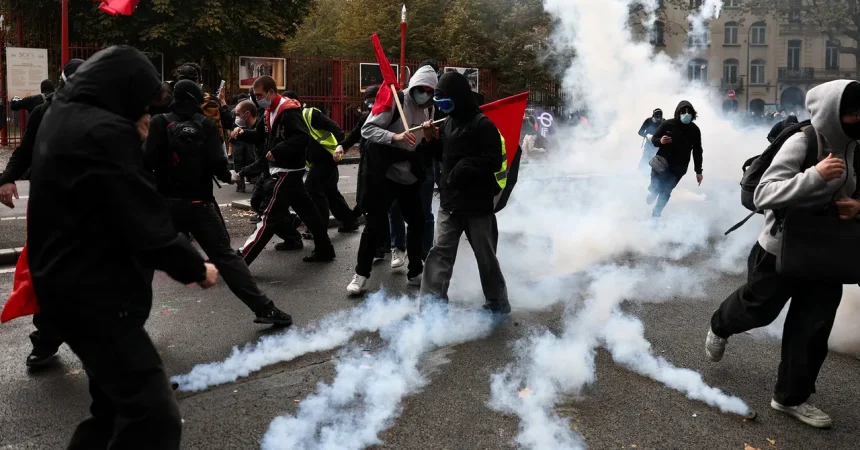
Across France, what began as a raw expression of frustration over the cost of living and the slow crumbling of public services turned, over the weekend, into something far more volatile. Families, students, workers, and retirees had taken to the streets in peaceful demonstrations, hoping to remind the government that everyday life had become painfully expensive and that institutions like schools, hospitals, and public transportation were being stretched to the breaking point. But peaceful anger does not always remain peaceful, and in many cities the demonstrations curdled into rioting, arson, and the looting of more than 1,500 shops and businesses. Storefronts that had served their neighborhoods for decades were shattered in a single night. Luxury boutiques, small grocery stores, electronics shops, and even local pharmacies found their windows broken and their shelves stripped bare. The police, stretched thin and caught off guard by the speed and scale of the destruction, responded with tear gas, water cannons, and batons, but in the chaos, Interior Minister Laurent Nuñez admitted that officers “lost control” in some places. By the time the streets quieted, authorities had arrested more than 2,400 people, and a country already wrestling with economic anxiety and social distrust was left to pick up the pieces. The looting was not just a crime wave; it was a symptom of a deeper fracture, a moment when the frustrations of daily life boiled over into something destructive and self-defeating. For many French citizens, the images of burning cars and shattered shop windows were heartbreaking, not triumphant, and the anger that had initially seemed legitimate to some quickly became overshadowed by fear, grief, and a sense that everything was spiraling out of control.
Now, as the physical damage is being assessed, a quieter but equally important battle is taking place online, because stolen goods do not simply vanish into thin air. They end up, often within hours, on the enormous digital marketplaces where millions of people buy and sell secondhand items every day. A television ripped from a department store, a designer handbag snatched from a boutique, a smartphone grabbed from a kiosk—such items can be listed, sold, and shipped before investigators even know they were taken. In an effort to stop this digital laundering of looted goods, a separate meeting was held on Monday with major online reselling platforms, and it was confirmed by Serge Papin, France’s minister for small and medium-size enterprises, on X that “an agreement was signed” to crack down on the resale of stolen merchandise. According to French newspaper Le Monde, representatives from Vinted, eBay, Amazon, LeBonCoin, Meta, and TikTok were present at the meeting. The platforms agreed to forward reports of suspicious listings to investigators, to actively monitor advertisements for goods believed to have been stolen specifically during the protests, and to send the government regular reports of the actions they had taken, with the first report due within 48 hours. That commitment is significant, because it signals that online marketplaces are being treated not as neutral bystanders but as essential gatekeepers in the fight against organized looting. If a stolen item can be sold with just a few clicks, then the entire resale ecosystem becomes a powerful incentive for future theft. By asking platforms to cooperate with law enforcement, the French government is essentially saying that the internet cannot be a safe haven for those who profit from chaos.
Under French law, the stakes are already high for anyone caught in that underground economy. French penal law can hand down a five-year prison sentence and a fine of €375,000 to anyone who is found to be concealing, possessing, or transferring an item that they knew was obtained through a crime or offense. That is a serious punishment, and it applies not only to the people who smashed windows and grabbed goods but also to the friends, family members, and online traders who try to move those goods through legal-looking channels. The message is clear: if you know it was stolen, and you help sell it, you are just as culpable as the person who took it. But the law is only as effective as its enforcement, and enforcement in the digital age requires cooperation from the platforms where these transactions occur. It is no surprise, then, that police in the Netherlands also issued a warning that online ecommerce sites could see a higher number of stolen goods listed as a result of the riots in neighboring France. Stolen merchandise rarely respects national borders, and a looted item in Paris can easily be advertised on a site accessed in Brussels or Amsterdam within a matter of minutes. That warning underscores the urgency of the moment: the rioting may have ended, but the aftermath is just beginning, and the secondhand market is where much of the stolen property will resurface. For investigators, the challenge is enormous. They must sift through thousands of listings, identify patterns, and build cases against individuals who are often careful to avoid obvious signs of theft. Without the active cooperation of platforms, that task becomes nearly impossible. The new agreement is thus not just a bureaucratic formality; it is an acknowledgment that fighting the aftermath of the riots requires a modern, coordinated response that combines traditional policing with digital surveillance.
The industry itself appears to recognize that it has a responsibility to act. The French Alliance of Marketplaces, a nonprofit organization representing major French online retailers such as Back Market, eBay, Etsy, LeBonCoin, ManoMano, and Vinted, issued a press release outlining how its members intend to respond. The alliance said its members are relying on a combination of user reports, human oversight, and technological tools to monitor advertisements and identify listings that appear to be reselling stolen goods from the riots. This is not a simple task. Sellers who know they are handling stolen merchandise often use vague descriptions, suspiciously low prices, or photographs taken in hurried, poorly lit rooms. They may create new accounts, use fake names, or try to conceal their identity by selling through third parties. To counter these tactics, marketplaces need robust algorithms that can flag suspicious behavior, but they also need human moderators who can understand context and nuance. The alliance acknowledged that this kind of detection requires constant vigilance, and eBay, one of the companies involved, clarified its approach in a statement. When a fake or suspicious ad is identified, it is removed, and “measures are taken against the accounts involved,” which could include the permanent suspension of the seller’s account. eBay also noted, however, that the time it takes to take action “depends on the nature of the report and the necessary verification process.” That last point is important, because due process still matters, even in a crisis. A seller who has made a clerical error, or who is trying to dispose of an old phone they no longer need, should not be banned simply because a listing looks similar to something that was stolen. Platforms have to balance speed with fairness, and that balance is difficult to maintain, especially when public pressure is high and the government is demanding rapid results.
But for all the promises made at the meeting, important questions remain unanswered. Vinted, Amazon, LeBonCoin, Meta, and TikTok did not respond to WIRED’s request for comment, and without their public testimony, it is hard to know exactly how their systems are being adapted to meet the new obligations. How will they distinguish between a listing that is genuinely selling looted goods and a listing that simply resembles one in a low-resolution image? What happens when a seller unknowingly buys a stolen item and then resells it online? Are they expected to prove their innocence, or is the platform expected to prove their guilt? And what about cross-border listings, where an item is sold by a user in another country and shipped to France, or vice versa? These are not abstract legal questions; they are practical dilemmas that will shape whether the agreement actually works. There is also a real risk of over-correction. The secondhand marketplace is a lifeline for many families, especially in times of high inflation and stagnant wages. For students trying to afford textbooks, for parents buying clothes for growing children, for small businesses reselling unused equipment, online marketplaces are a vital source of affordable goods and income. A heavy-handed crackdown that results in wrongful bans and suspicious listings removed without explanation could hurt ordinary users and turn the public against the very measures that are meant to protect them. At the same time, allowing the stolen-goods market to flourish would poison the entire ecosystem. If buyers lose confidence in the legitimacy of what they purchase online, if they fear that every bargain is a stolen item, then trust in these platforms will erode, and that would harm everyone. The government reports due within 48 hours are a good start, but they are only a first step. Sustained oversight, clear communication, and a willingness to correct mistakes will be necessary if this agreement is to have any lasting impact.
Ultimately, the agreement between the French government and online platforms is a small but necessary step in a much larger reckoning. The looting of more than 1,500 shops was not merely property crime; it was an assault on the social fabric. Small business owners who spent years building something from nothing watched their life’s work destroyed in a single night. Employees lost their jobs, not because of poor performance, but because their workplaces were reduced to rubble. And the young people who will face charges for their roles in the riots may carry those criminal records for the rest of their lives, making it harder to find work, housing, and a way forward. The anger that fueled the initial protests—over high living costs, strained public services, and a government that many feel does not listen—has not disappeared. It has been temporarily overwhelmed by the chaos, but it remains simmering beneath the surface. If the response to this crisis is limited to catching looters and tracking stolen goods online, then the underlying conditions that led to the violence will continue to fester. The digital crackdown is an important tool for restoring order and accountability, but it cannot be a substitute for addressing the deeper inequities that make people feel desperate enough to take to the streets. The platforms that have signed this agreement now carry a responsibility not just to police their listings, but to do so with fairness, transparency, and a genuine commitment to justice. They have promised to cooperate with investigators and to report on their actions, but the true test will come in the weeks and months ahead. France is watching, and so is the internet. What happens next will reveal whether this moment of crisis becomes an opportunity for genuine reform, or just another chapter in a cycle of anger, destruction, and half-hearted repair.