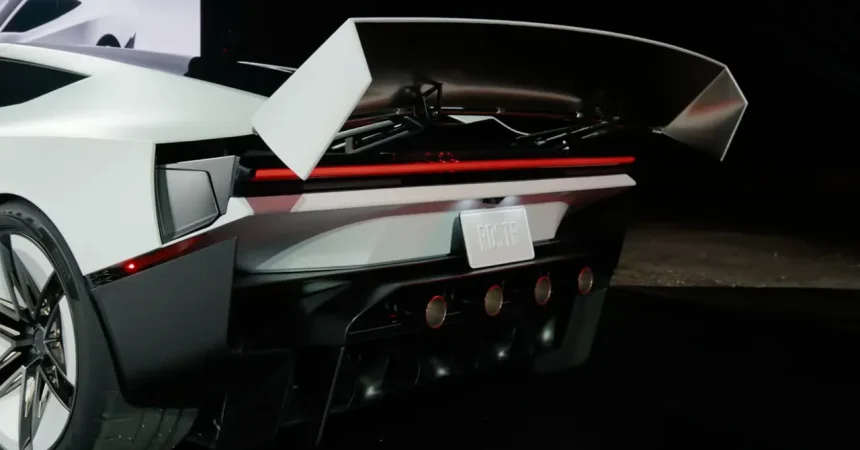
Thursday night in McGregor, Texas, began like many things do at the intersection of Elon Musk’s companies: with the smell of rocket fuel and the low hum of expectation. The site was SpaceX’s rocket development and testing facility, not a convention center or a racetrack, and that alone signaled this was not an ordinary car reveal. Tesla had come to unveil the Roadster 2, the long-promised successor to the sporty little machine that first put Tesla on the map. But this time, the company didn’t just show off a faster coupe. It billed the car as the last human-driven car Tesla will ever make. Then it demonstrated why. In front of an audience that included Tesla owners, employees, and people who had waited eight years for this moment, the Roadster lifted off the ground. A sudden, herky-jerky burst of steam from its thrusters sent it hovering several feet above the company’s electric semi-truck, and for one surreal moment it flipped over the entire line-up of Tesla vehicles, like a performer in a gravity-defying show. It floated long enough to make the impossible feel routine. The car eventually settled back down, but the image lingered. This was a company that had always promised to redefine normal. Tesla executives were quick to supply a number that felt impossible: zero to 60 miles per hour in one second. It was the kind of acceleration that makes the inner ear argue with the eyes, the sort of number that belongs on a launchpad rather than a dealership window. Someone at the event raised the obvious question, and Musk waved it off. “This is not necessarily a safety-optimized car,” he said. The crowd laughed, though perhaps not entirely at ease. After all, a car that can fly a few feet off the ground and sprint to 60 in a single second is thrilling in the same way a fireworks show is thrilling: beautiful, loud, and just a little bit dangerous. But that may be exactly the point. This was not a car for running errands. This was a goodbye letter to the concept of the driver, written in electricity and steam.
For Tesla fans, the Roadster 2 has been a test of patience, faith, and occasionally the ability to stay polite. The car was first announced in 2017, when glamour shots of a sleek, sinister-looking prototype appeared alongside promises that this would be the fastest production vehicle in the world. At the time, 2020 seemed like a reasonable target. It slipped, then slipped again. Tesla kept making other things—Model 3s, Model Ys, Cybertrucks, semis, robots—while the Roadster 2 remained a ghost on the horizon. Yet thousands of enthusiasts did not cancel their reservations. They put down $50,000 each for a car that was advertised at $200,000. Adjusted for inflation, that deposit is worth more than $68,000 in 2026 dollars. That is not the kind of money you give lightly. It is the kind of money you give out of conviction, or maybe because you want to be first in line when the future finally arrives. Some people got tired of waiting. Sam Altman, the CEO of OpenAI, complained publicly on X last year that he found it surprisingly difficult to cancel his reservation. Musk, never one to let a public jab go unanswered, said that Altman received a refund within 24 hours. The exchange was a small glimpse into a much larger drama: the Roadster 2 had become a kind of relationship test between Musk and the people who believe in his promises. For every Altman who wanted out, there were likely a dozen fans who wanted in even more. They had watched for years, refreshing pages, waiting for a sign. On Thursday night, they finally got one. But the long wait also left scars. The word “later” has a way of feeling like “never,” and Tesla’s own schedule was evidence of that. The company now says production will begin in 2028. That is eight years after the originally promised release date, and close to a decade after the first announcement. For some depositors, the reveal felt less like a happy ending and more like an opening act that took nine years to get onstage.
What makes the Roadster 2 different from any other supercar is not just the acceleration or the bodywork. It is the presence of four thrusters, which Tesla’s head of vehicle engineering, Lars Moravy, said make the flying maneuver possible. The thrusters are not a gimmick; they are central to the idea of a car that refuses to be bound by pavement. They are also a reason why Musk’s caveat about not being safety-optimized was probably necessary. A car that can loft itself a few feet off the ground is a car with a new set of risks, and Tesla is not pretending otherwise. In the world of internal combustion, speed is about engines, fuel, and heat. Here, the language is closer to aerospace. That was deliberate. The Roadster 2 is meant to feel like the love child of a sports car and a rocket, and the launch event at a SpaceX facility was chosen to make that connection literal. The result is a vehicle that asks its owner to think about performance differently. A one-second zero-to-60 time is less a measurement than a declaration. It means that when you floor the pedal, the world becomes smeared lines. It means that your own reaction time is the limiting factor, not the machine. For decades, drivers have bought supercars to feel connected to the road; the Roadster 2 might be the first car that makes you feel connected to something closer to orbital mechanics. Yet Tesla executives and Musk himself were careful to frame the car as more than a toy. They described it as a punctuation mark in Tesla’s history. This is the last road car that will be built primarily for a human being to drive. After this, according to Musk, the company’s future belongs to autonomous vehicles, artificial intelligence, and humanoid robots. In that context, the Roadster 2 is a ceremonial farewell, a final chance to feel the wheel in your hands before Tesla hands the controls to software forever. That may be the most important part of the entire reveal: not the speed, not the flying, but the promise that this is the end of an era.
The reveal comes at a strange moment for electric vehicles, one that makes the Roadster 2 feel both braver and more out of step with the market. In the United States, EV sales have stalled. A GOP-led Congress removed federal supports that had helped push adoption, and the resulting slowdown has forced automakers to recalibrate their electric ambitions. Meanwhile, in other parts of the world, a global energy crisis has made electric vehicles more attractive than ever, and sales are booming there. The luxury hypercar segment, which is exactly where the Roadster 2 intends to live, sits in an especially uncomfortable position. Several luxury automakers have discovered that wealthy buyers—the same people who might have been expected to want an electric roadster—are increasingly asking for the sound and power of gasoline. They want the rumble of a V12, the smell of high-octane fuel, the sense that they are operating a machine with a soul. Lamborghini shelved its plans to make an EV earlier this year, a decision that sent a shockwave through the industry. If a company famous for outrageous, emotional machines could not make the electric math work, who could? Tesla’s answer, with the Roadster 2, is that it can—because Tesla has always played by different rules. It does not need to satisfy traditional expectations of sound or soul because it is creating an entirely different category of desire. The Roadster 2 does not hum like an exotic engine; it hisses with steam and snaps with thrusters. It is not trying to sound like a Lamborghini. It is trying to sound like the future. But the timing still raises questions. In a market where some of the richest customers are turning back to gasoline, Tesla is betting that a $200,000 electric car with a decade-long waitlist and flying thrusters can still capture their imagination. Maybe it can. But the company is asking people to pay a lot of money and wait a lot of years for a car that may not be eligible for the same incentives, and that sits in a category where even Lamborghini has conceded defeat. For the moment, the Roadster 2 exists as a promise rather than a product, and promises are easier to make than they are to keep.
To understand the Roadster 2, you have to understand what Musk says it represents: a goodbye. He has said repeatedly that Tesla should no longer be regarded as a carmaker. The company, in his telling, is really an artificial intelligence and robotics operation that happens to put wheels on its products for now. It is building autonomous vehicle technology that will eventually remove the steering wheel altogether, and it is building humanoid robots that may one day do jobs far beyond driving. The Roadster 2, then, is a transitional object, a final artifact of the era in which a human being sat in the driver’s seat and made decisions. That makes the car more than just a product; it becomes a kind of museum piece intended to honor the moment before machines take over. For people who love driving, the news is bittersweet. On one hand, Tesla is giving the human driver one last magnificent machine. On the other hand, it is explicitly promising that this will be the end. The company is not hiding its intentions. It wants to move to a world where cars are not driven at all, where fleets of autonomous vehicles move people and goods without human intervention. The Roadster 2’s flying stunt, with its four thrusters and one-second sprint, is almost a final flex—a demonstration of what engineering can do when a human is allowed to hold the reins. But after this, the reins disappear. Robotaxis, not race cars, are the future. Whether that is a utopia or a loss is a matter of perspective. Musk would probably say both. He has spoken about removing human error from roadways as a mission, but he also still finds time to build a car that accelerates to 60 in one second. The Roadster 2 is an apology and a promise at the same time: I will give you one last dream of driving, and then I will take the wheel away forever. That is a strange thing to cheer for, and yet people cheered. They cheered because the future is arriving, and because it is being stacked with machines that are faster, smarter, and more capable than anything that came before. They also cheered because this particular machine lets them pretend, for a moment, that they are the ones still in control.
Where does that leave the people who actually want to own a Roadster 2? It leaves them in a familiar place: waiting. Tesla says production will begin in 2028, though anyone who remembers the original 2020 promise knows how little those dates have meant in the past. The company has not explained how a flying car fits with regulators or insurance companies, and Musk’s admission that the car is not necessarily safety-optimized is not the kind of phrase that puts cautious minds at ease. There are also practical questions. How much will the final version cost? What kind of charging infrastructure does a car with rocket thrusters require? Will the flying feature be available to all buyers or only as an optional, perhaps legally restricted, upgrade? None of those questions were answered on Thursday night, and the event was less a full product disclosure than a spectacle designed to reignite the religion. For longtime Tesla followers, that may be enough. They have watched Musk move from electric cars to rockets, from satellites to brain chips, from tunnels to humanoid robots. They have learned to treat his timelines as suggestions and his promises as visions rather than contracts. The Roadster 2 is pure vision. It may not arrive on schedule. It may not initially match the one-second sprints or the flying features that have been tossed around. It may even change shape before it reaches a showroom. But for one night in McGregor, Texas, it existed in the most vivid way possible: in the air, above a lineup of Tesla’s own history, with steam pouring from its thrusters and a generation of car lovers looking up at it. That moment was real. Whatever comes next—the autonomous future, the robots, the speed, the delays, the joy, the chaos—is still being written. This is a developing story, and as always with Tesla, the only certainty is that there will be more surprises. Check back; the Roadster 2 will almost certainly be back too.