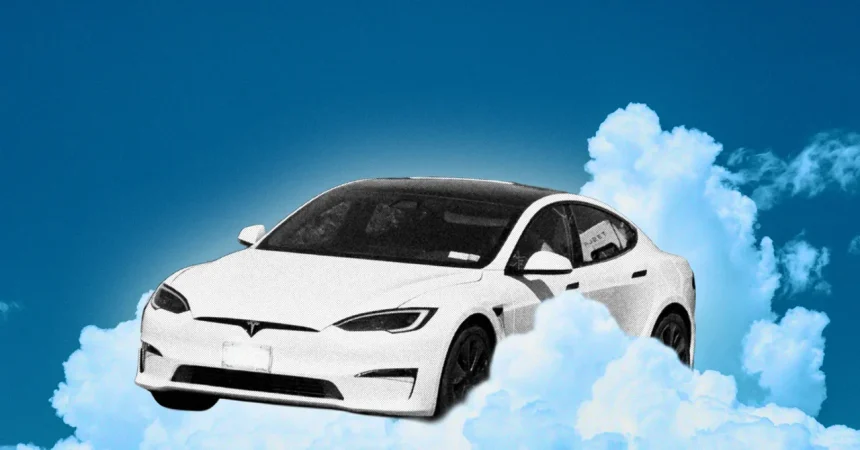
There’s something undeniably romantic about the idea of a flying car. It’s a promise we’ve been handed for decades, from the jetpacks of sci-fi comic books to the flying DeLorean in “Back to the Future.” When a company like Tesla rolls out a concept like the Roadster 2, complete with the suggestion that it might someday hover, glide, or even blast off with rocket thrusters, it’s easy to let your imagination run wild. But the distance between a concept video and your garage is much farther than it looks. The first, most stubborn obstacle is the law. Michael McCormick, a former FAA official who now leads the Air Traffic Management program at Embry-Riddle Aeronautical University, points out that any flying vehicle weighing more than about 250 pounds would have to go through a rigorous FAA approval process. That’s not just a quick safety inspection. It’s a deep, time-consuming review of how the vehicle handles, how it communicates with other aircraft, how it avoids obstacles, and how it performs in an emergency. McCormick estimates that getting full certification could take “at least a year,” though in the real world, new aircraft programs often take far longer than even the most optimistic early predictions. And then there’s the human factor: your standard driver’s license wouldn’t come close to being enough. If a Tesla owner actually wanted to pilot a machine like this, they’d likely need to earn a recreational aviation license, which means flight hours, ground school, medical certification, and a completely different level of responsibility than just navigating traffic. So before anyone can even think about soaring over rush hour, there’s an enormous wall of red tape, testing, and bureaucracy to climb.
But let’s say you somehow clear that hurdle. Let’s say your flying car gets certified, you get your pilot’s license, and you’re ready to take off. Where are you actually allowed to do that? The answer, it turns out, is deeply unglamorous. Most states require aircraft to take off from airports or designated helipads. You can’t just pull over on a suburban street, hit a button, and launch into the sky. That kind of operation would fall under state or local rules, and as John Miller, an expert quoted in the discussion, notes, many places are not exactly welcoming to the idea of a car suddenly lifting off from their roads and highways. He makes a great point: it’s pretty rare to see a helicopter land at a favorite steakhouse, even for someone rich enough to afford it. Why? Because landing an aircraft in unexpected places raises all kinds of safety, liability, and zoning questions. A spinning rotor, a blast of hot exhaust, the sudden appearance of a heavy machine on a public street—these are not things most city councils are excited to legalize. In reality, drivers might only be able to truly operate a flying car on a large, private piece of land. That means your dream of skipping traffic by flying from your driveway to the office would probably be illegal. Instead, you’d have to drive your flying car to an airport, fly it to another airport, and then drive it again on the other side. At that point, you’re not really living in a science fiction future; you’re just driving an expensive car that occasionally gets to fly between the same two places a small plane already could.
This doesn’t mean the idea of flying vehicles is dead, though. In fact, the FAA is currently working on rules, regulations, and pilot projects around a different kind of “flying car,” better known as an electric vertical take-off and landing vehicle, or eVTOL for short. These are the sleek, multi-rotor aircraft that companies like Joby, Archer, and Volocopter have been developing for years. Instead of being a car that also flies, an eVTOL is essentially an air taxi, designed to carry up to four passengers over distances between 20 and 150 miles, sometimes without a human pilot at all. The vision behind these vehicles is more modest, but also more realistic. They wouldn’t take off from your driveway. They’d use small, local “vertipads,” which are basically miniature helipads built into parking garages, rooftops, or dedicated landing zones. The whole point is to let people skip urban traffic by floating above the fray, the same way helicopters do now, but with lower noise, lower cost, and more autonomous operation. The Trump administration actually launched a limited, three-year pilot project this year that lets companies test these aircraft in several states. But even with that government support, the process has been slow. It has taken years for these companies to receive certification from the federal government, and most of them are still years away from flying passengers commercially. So while eVTOLs are closer to reality than the kind of flying car that can also drive on highways, they’re still a lesson in how difficult it is to move any new aircraft through the modern regulatory system.
Beyond the legal and logistical challenges, there’s an even deeper problem with the whole concept of a true flying car: physics. The same design elements that make a car safe, comfortable, and durable on the road are exactly what make it heavy. A good car needs a strong chassis, airbags, crumple zones, seats, windows, a stereo system, and enough weight to feel stable at seventy miles per hour. But in aviation, weight is the enemy. As John Miller puts it, “weight is the enemy of an airplane.” Every extra pound is a pound that has to be lifted into the air, which requires more power, which requires more fuel or more batteries, which adds even more weight. It’s a vicious cycle. That’s why helicopters and planes are so carefully stripped down, why every piece of equipment on board is scrutinized and weighed, and why airline passengers are asked to keep their carry-on bags small. A flying car, by contrast, has to be a car and an aircraft at the same time, and those two identities pull in opposite directions. You need enough power to make it fly, but you also need enough efficiency to make it practical on the road. You need wings or rotors, but you also need four wheels and a suspension system. You need lightweight materials, but you also need to survive a car crash. For decades, engineers have struggled to find that balance between power and weight. Some prototypes have flown. Some have even driven. But very few have done both well, and none have done so at a price or level of reliability that the average consumer could accept. That’s the fundamental reason flying cars have been perpetually “five years away” for the last seventy years. It’s not just a matter of waiting for technology to catch up; it’s a matter of fighting against the laws of nature.
So what should we make of something like Thursday’s demo, when a company shows off a flying car concept and claims it might actually make it into production? The honest answer is a mix of excitement and skepticism. There’s no doubt that the engineering involved is remarkable. Just getting a vehicle that can roll on pavement and lift off into the air is a technical achievement. Miller himself admits he was impressed by the demo, calling it “a truly impressive engineering and production feat” if the vehicle does make it to production. And that’s a real possibility, not a fantasy. We’ve seen extraordinary advancements in battery technology, electric motors, autonomous navigation, and materials science. The drones we use for aerial photography today are essentially tiny flying vehicles, and they operate with remarkable reliability. Scaling that technology up to carry people is hard, but it’s no longer in the realm of pure impossibility. Still, there’s a big difference between a prototype that flies once at a demo and a vehicle that can be sold to the public, insured, licensed, serviced, and operated safely in the real world. A demo is a snapshot. It doesn’t show you the thousands of hours of testing that still need to happen, the regulatory review that’s still pending, or the infrastructure that doesn’t yet exist. It also doesn’t show you the cost. Early flying cars, if they ever do reach showrooms, will almost certainly be luxury toys for the ultra-wealthy, not transportation for the masses. The technology might be genuinely impressive, but the road to mass adoption is still very long.
In the end, the dream of a flying car is really a dream about freedom: freedom from traffic, freedom from roads, freedom from the limitations of everyday life. It’s a beautiful idea, and it’s one that’s worth chasing. But the reality is that aviation is one of the most heavily regulated industries in the world, and for good reason. When something goes wrong at five thousand feet, the consequences are far more serious than a fender bender. That’s why the FAA takes its time. That’s why pilot licenses require so much training. That’s why takeoff and landing rules are so strict. And that’s why the physics of flight are so unforgiving. The Roadster 2, or whatever flying car comes next, isn’t going to arrive with a simple press release and a flashy video. It’s going to have to prove itself over years of testing, certification, and slow, careful integration into the national airspace. It’s going to need places to land, rules for the sky, and a whole new culture of safety. It may very well happen someday. The technology is advancing, and the experts are genuinely impressed by what they’re seeing. But for now, the flying car is still more of a symbol than a solution, a reminder that the future rarely arrives as quickly or as easily as we imagine. So keep dreaming, but also keep your driver’s license handy. You’re going to need it for a while longer.