There are moments when the Supreme Court hands down a ruling that feels less like a legal technicality and more like a decision about the kind of country we want to live in. This week’s decision about mail-in voting was one of those moments. With the midterms just weeks away and ballots already moving through the postal system in many states, the justices rejected the Trump administration’s last-ditch attempt to impose severe new restrictions on mail-in ballots. By a 7-2 vote, the Court upheld a lower court’s injunction blocking the United States Postal Service from implementing new rules about who could receive a mail-in ballot in November. The two dissenting votes came from conservative Justices Samuel Alito and Clarence Thomas, but the rest of the bench — conservative and liberal alike — refused to go along with the plan. The ruling was a major defeat for President Donald Trump, who has spent years attacking mail-in voting and claiming, without evidence, that it opens the door to widespread fraud. More importantly, it was a practical victory for election officials and voters who were facing the very real possibility of chaos at the ballot box. For weeks, state and local election administrators had been sounding alarms. They warned that the new rules could not be implemented in time, that the Postal Service was not prepared for such a role, and that ordinary voters would be caught in a web of delays, lost ballots, and rejected mail. In many states, voters had already received their ballots by the time the case arrived at the Court. To change the system now would have been not only legally dubious but logistically impossible. This was not a ruling about whether mail-in voting is wise or efficient. It was a ruling about fair play: if election officials have been preparing for months under one set of rules, the government cannot abruptly move the goalposts. The decision sent a message that election rules cannot be rewritten at the last minute, especially when doing so would make it harder for Americans to participate in democracy. In a country where trust in institutions is fragile, the timing and tone of the ruling mattered just as much as the legal reasoning.
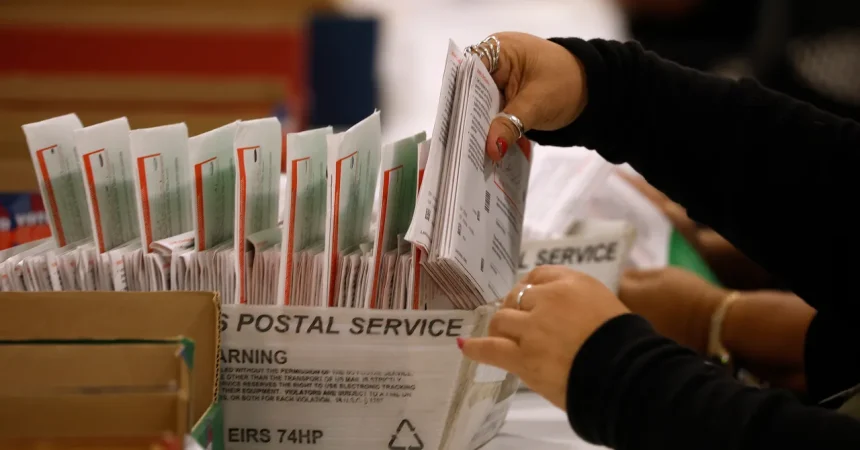
To understand why this ruling carries such weight, it helps to look at what the administration actually wanted to do. In March, President Trump signed an executive order titled “Ensuring Citizenship Verification and Integrity in Federal Elections.” The order required every state to send a list of voters who would receive mail-in ballots to the United States Postal Service. The Postal Service would then be responsible for checking that list against the ballots it was asked to deliver. If a ballot was addressed to someone whose name did not appear on the list, or if the ballot did not comply with new rules around barcodes and envelopes, postal workers could refuse to deliver it. On paper, that might sound like a reasonable attempt to prevent voter fraud. In practice, it would have turned the Postal Service into something it has never been: an election gatekeeper. The USPS is not an election department. It does not maintain voter rolls. It does not know whether a person who recently moved, changed their name, or registered late is actually entitled to vote. Asking postal workers to make these judgments would have created enormous potential for error. Imagine a registered voter whose official name is “Robert” but whose ballot is addressed to “Bob.” Imagine a voter who moved across town and updated her registration, but the list sent to the Postal Service had not caught up with the change. Under the proposed rule, any of those mismatches could result in a legitimate ballot being thrown out, with no clear way for the voter to know what happened. Election officials from both parties warned that they simply did not have enough time to build the systems needed to avoid these mistakes. With mail-in voting already underway, even minor implementation problems could have meant thousands of people losing their votes. That is not an administrative detail. It is a threat to the most basic right in a democracy.
The Supreme Court did not entirely reject the idea that the Postal Service could, under some circumstances, play a role in verifying mail-in ballots. Justice Brett Kavanaugh, writing in a concurring opinion joined by Justice Ketanji Brown Jackson, acknowledged that there was at least a fair prospect that the final rule fell within the Postal Service’s statutory authority. That might sound like a partial victory for the administration, but Kavanaugh went on to explain why the rule could not be imposed now. Applying it in the 2026 elections would be arbitrary and capricious, he wrote, because state and local election officials did not have sufficient time to reasonably implement it. The government, he added, was unlikely to succeed on the merits of its challenge to the lower court’s preliminary injunction. In plain English: even if the Postal Service has the legal power to do this kind of thing in theory, it cannot be done this way, this late, with so much at stake. Administrative law has long recognized that agencies cannot impose major new requirements without giving people a fair chance to understand them and prepare for them. That principle does not disappear because the issue is politically charged. The fact that Kavanaugh — a conservative appointed by Trump — joined with Jackson, one of the Court’s most progressive justices, underscored the strength of the timing argument. This was not a partisan victory for Democrats or a defeat for Republicans. It was a rejection of reckless, last-minute policymaking. The two dissenters, Alito and Thomas, saw things differently. They apparently believed that the Postal Service had the authority to issue the rule and that the courts should not have interfered. But for seven justices, the practical reality of an election already in motion was decisive. There is a time to debate election policy, and there is a time to count votes. The Court made clear that we are now in the season for the latter.
The fight over mail-in voting did not begin with this case, and it will not end with this decision. President Trump has long railed against mail-in voting, a method used by tens of millions of Americans, including members of the military serving overseas. He has repeatedly claimed, without evidence, that mail ballots are a magnet for fraud. Those claims have been rejected by election officials, courts, and fact-checkers, but they have still helped fuel a wave of distrust and stricter voting laws across the country. The March executive order was the most ambitious federal attempt yet to put those claims into practice. It was billed as an election integrity measure, but its practical effect would have been to add an extra hurdle for voters and to give the Postal Service a role in deciding who is eligible to vote. Most of the order’s provisions were quickly blocked by federal courts. The administration appealed to the Supreme Court in July. Last month, a conservative majority on the Court sided with the administration on a narrow procedural point, ruling that the states challenging the rules lacked standing because the rules had not yet been implemented. That was not a decision on the merits, and it did not end the controversy. The rules were challenged again, and this time the circumstances were different. Ballots were already being mailed across the country. Election deadlines were near. Officials were scrambling to understand what the new requirements meant and whether they could comply. The Supreme Court’s decision to block the rules now reflected that changed reality. It also represented another in a string of legal defeats for the administration’s multipronged effort to undermine trust in American elections. For Trump, it was a personal loss: the man who spent years claiming that mail-in voting is corrupt was forced to watch the Supreme Court protect the mail-in voting process from his own administration.
Reaction to the Supreme Court’s decision was swift and pointed. Nevada Secretary of State Cisco Aguilar, a Democrat, issued a statement celebrating the outcome. “Today, Donald Trump lost another battle in his unconstitutional war to choose his own voters, and the American people are winners,” Aguilar wrote. “This ruling affirms what our Constitution has always held: Elections belong to the American people, not a desperate man in Washington. Democratic secretaries of state applaud the court on upholding this fundamental principle, and we stand ready to fight any attempt to cause chaos, fear, and intimidation in our elections.” It was a stark reminder that the fight over voting rights is not just a legal dispute but a deeply political and emotional one. The White House and the Postal Service did not respond to requests for comment, offering no public explanation of how they planned to proceed. Behind the scenes, however, there were already serious concerns about whether the Postal Service could have handled the new rules even if the Court had allowed them. Senator Richard Blumenthal disclosed the warning of a USPS whistleblower who claimed that the online portal for the new program had been hastily thrown together without the necessary care and attention for such critical software. In a letter to the postmaster general, Blumenthal wrote that the whistleblower’s allegations made clear that the USPS lacks the technical or operational capability needed to effectively implement the executive order’s provisions in a way that safeguards every citizen’s right to vote in the upcoming midterm elections. Despite that, Blumenthal said, the Trump administration appeared intent on moving forward with flawed plans, no matter the chaos they might create. The whistleblower’s account painted a troubling picture: an agency being asked to take on a role it was not built for, using software that may not have been reliable, under a deadline that made testing and training impossible.
At its core, this ruling is about more than one rule or one election. It is about the basic principle that elections should be run by election officials, not by a federal agency under political pressure. The United States Postal Service has always played a vital role in American democracy, delivering ballots to millions of voters who cannot or choose not to vote in person. But turning it into an enforcer of voter eligibility would have changed its mission and threatened the guarantee that every eligible citizen can cast a ballot. The Supreme Court’s decision, while narrow, reinforced that guarantee. It also served as a reminder that trust in elections depends on stability and predictability. When rules are changed at the last minute, when officials are forced to scramble, when voters are told their ballots might not count, democracy itself suffers. The fight over mail-in voting is probably not over. The administration has made clear that it wants to pursue restrictions, and the Court has left open the possibility that some version of the rule could survive in the future, provided it is implemented with adequate time and proper safeguards. Elections will continue to be contested, and postal rules will continue to be debated. But for now, in this election, the law has held. The American people — not a desperate man in Washington, as Aguilar put it — remain in charge. That is worth pausing to appreciate. In an era of cynicism and misinformation, it is easy to forget how much depends on the quiet, unglamorous work of running elections fairly. It is easy to forget that the right to vote is not just an abstract ideal but a concrete, everyday practice. This week, the Supreme Court made sure that practice could continue. It protected the ability of millions of Americans to cast their ballots without an unnecessary new obstacle placed in their path. And in doing so, it affirmed something essential: elections belong to the people, and no one — not a president, not a political party, not a postal directive — should be allowed to take that away.