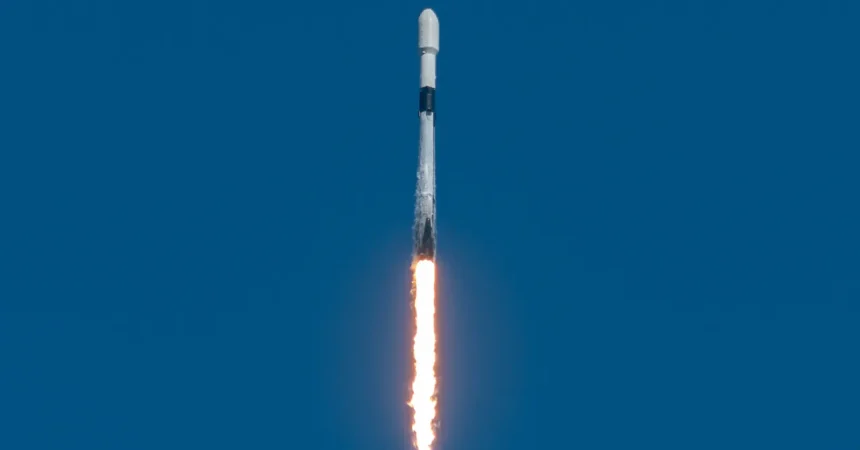
For the first time in history, we are witnessing a unique intersection of space exploration and cosmic irony: a discarded piece of human technology is about to return to the heavens—or rather, the Moon—with a resounding crash. After drifting aimlessly through the void for a year and a half, the upper stage of a SpaceX Falcon 9 rocket is scheduled to slam into the lunar surface this Wednesday. This four-metric-ton hunk of metal, once a powerful vessel used to transport lunar landers, has spent its post-mission life as “space junk,” lacking the fuel to return home or settle into a stable orbit. Now, it finds itself on a terminal trajectory, hurtling toward the Moon at a staggering 5,400 mph. While this event is essentially a high-speed accident, it serves as a stark, tangible reminder of the growing clutter we are leaving behind as we venture further into the solar system.
When this mechanical giant strikes near the Einstein Crater, the sheer physics of the impact will be catastrophic by terrestrial standards. Because the Moon lacks an atmosphere to provide friction or drag, there is nothing to cushion the blow; the rocket will hit with the force of approximately three metric tons of TNT. Experts anticipate a spectacular, albeit silent, explosion that will gouge a crater up to 27 meters wide and five meters deep. For those equipped with high-powered telescopes in the Americas, the collision will briefly throw up a plume of lunar dust and debris, a fleeting visual record of our footprint on the lunar landscape. It is a moment of astronomical theater, yet it carries a weight far greater than the metal and fuel involved.
This incident has ignited a necessary conversation about the “Wild West” nature of our current lunar missions. As nations like the United States and China ramp up their ambitions to build permanent research bases on the lunar surface, the Moon is becoming an increasingly crowded neighborhood. This Falcon 9 stage is not an isolated incident; it follows the 2022 collision of a Chinese Long March 3C rocket, which left a similarly sized scar on the lunar crust. As we transition from short-term visits to long-term residency through programs like NASA’s Artemis, the accumulation of discarded hardware isn’t just an eyesore—it is a logistical hazard that we can no longer afford to ignore.
However, scientists are choosing to view this impending crash through the lens of a “learning opportunity.” Bill Gray, the expert behind Project Pluto who first identified the rocket’s trajectory, has helped turn this collision into a field study. Along with researchers like Benjamin Fernando from the Los Alamos National Laboratory, the scientific community plans to use the data from this crash to map impact events and better understand the seismic effects of such strikes. By analyzing how this debris interacts with the lunar surface, researchers hope to gain critical insights into the environment that future astronauts will inhabit. It is an exercise in preparation, turning an accidental collision into a controlled experiment that informs the safety protocols for the next generation of lunar explorers.
The risks identified by the research team are multifaceted and go well beyond the danger of a direct hit from a rogue rocket stage. Future lunar residents will face a constant gauntlet of threats: not only human-made debris but also the unpredictable and frequent strikes of natural meteorites. Scientists are particularly concerned about the secondary effects of these impacts, such as the cloud of ejected lunar regolith that could blind sensitive equipment, damage solar arrays, or interfere with communication systems in orbit. As we dream of sustainable habitats and research centers, we must recognize that the lunar surface is not a static, safe environment, but a dynamic, hazardous landscape that requires sophisticated mitigation strategies.
Looking forward, this event is a crucial wake-up call for the aerospace industry and global space agencies. With lunar base construction projected to ramp up over the next decade, we have a small but significant window to establish better stewardship of the space around the Moon. The goal is to move past the era of “abandoning in place” and toward a model of sustainable exploration where we account for the debris we create. As Benjamin Fernando rightly suggests, as our presence on the Moon grows, so must our responsibility to protect it—and ourselves. This Wednesday’s crash is a loud, crater-forming lesson, reminding us that if we want to live among the stars, we must learn to clean up after ourselves before we accidentally close the doors to our own future.