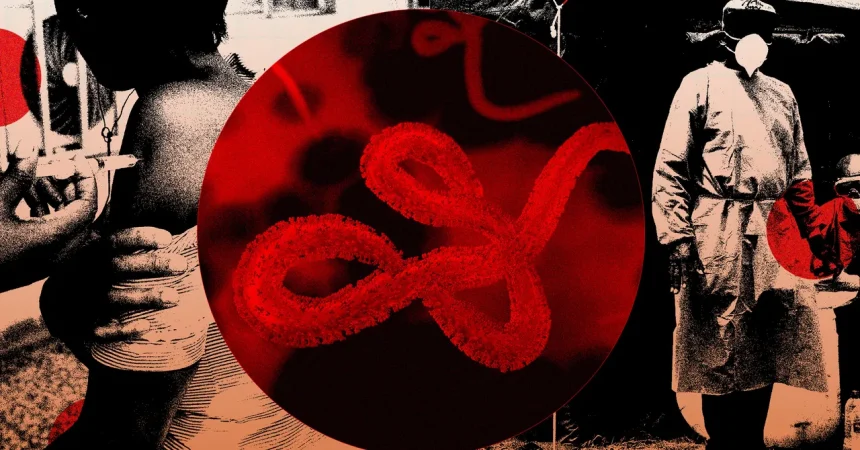
Ebola hasn’t gone away. It’s easy to think of it as a past crisis, a grim chapter in the history of global health that the world somehow survived and then moved on from. But in the Democratic Republic of Congo, the virus is not only present; it is spreading faster than it has in any previous outbreak, and the people responsible for containing it are openly terrified. More than 7,000 people have contracted the Bundibugyo Ebola virus since May, and according to government data compiled by the World Health Organization, around half of them have died. Those numbers are not just statistics; they represent thousands of families who have watched loved ones die in isolation, unable to perform the rituals that make grief bearable. For Nicole Lurie, who has worked at the Coalition for Epidemic Preparedness Innovations since 2017 and now serves as its executive director for preparedness and response, this outbreak is deeply personal. “Other than Covid, which affected the whole world, this is the thing that has frightened me the most,” she says. “This is the most rapidly growing Ebola outbreak that we’ve seen. It’s probably on pace to be the worst the world has ever seen, and it’s quite terrifying.” Lurie has spent years preparing for exactly this kind of emergency, but preparation does not make the reality any less frightening. The world has barely noticed what is happening in the DRC, and that in itself is one of the greatest dangers of this epidemic.
Why is this outbreak so hard to contain? The contrast between Uganda and the DRC makes it painfully clear. In Uganda, health officials were able to end an Ebola outbreak through classic public health tools: contact tracing, isolation, and clinical care. The disease responded to discipline, organization, and trust. But the DRC is a different world. Millions of people have been displaced by ongoing violence, and constant movement makes contact tracing a struggle. Lurie uses that exact word, “struggle,” because it understates the chaos. When people are fleeing fighting, they do not wait for health workers to record their names, locations, and contacts. They scatter. And in many communities, there is deep distrust of outside humanitarian workers. That distrust is not irrational; it has been earned through years of neglect, conflict, and fear. The suspicion has sometimes turned violent. Locals have attacked Red Cross volunteers, destroyed medical equipment including ambulances, and delayed safe burial teams. For families who have already lost someone to Ebola, being prevented from carrying out traditional burial rites is a devastating second blow. Safe burial teams are essential to stopping transmission, but when they arrive with no explanation and no relationship with the community, they are seen as intruders rather than helpers. This creates a tragic cycle: the more the disease spreads, the more desperate communities become, and the more desperate they become, the more likely they are to reject the very help that could save them. Lurie says she does not think the outbreak can be brought to an end without a vaccine. But she also knows that a vaccine only works if people are willing to accept it.
The vaccine effort has moved with extraordinary speed, but it may not be fast enough. Shortly after the first Bundibugyo cases were reported in May, CEPI redirected $100 million of internal funding to develop a vaccine. That money helped fund scientists at the Serum Institute of India, the world’s largest vaccine manufacturer, to produce doses of Oxford University’s ChAdOx1 BDBV vaccine at record speed. Moderna’s vaccine candidate, also supported by CEPI, has moved forward as well. Both vaccines have entered safety trials, and efficacy trials are expected to start this month. In ordinary times, a vaccine against a new outbreak would take years, but this is not ordinary. Every day of delay means more deaths, more orphans, more communities torn apart. The manufacturing speed is a testament to what global collaboration can achieve when funders, scientists, and manufacturers commit to a single goal. Yet there is a painful irony: the same instability and mistrust that allowed the outbreak to grow could now derail the vaccine trials. Clinical trials require contact tracing, follow-up, and consent, all of which are difficult in areas where violence is constant and outsiders are deeply suspected. The researchers are not naive. They know that a perfect vaccine in a laboratory is not the same as a vaccine accepted by a frightened population. The science is moving faster than it ever has, but the human barriers are moving just as quickly. A vaccine alone will not end this outbreak; it will only be effective if it reaches the people who need it and if those people agree to take it.
One of the scientists at the center of this work is Teresa Lambe, a professor of vaccinology and immunology and the lead scientific investigator in the Oxford safety trials. She knows exactly what it feels like to be consumed by this crisis. In May, she was working on a hantavirus vaccine following a cruise ship outbreak when her phone lit up with a message from a former World Health Organization employee about Ebola. The message was so alarming that she swore out loud. She had been following the DRC closely enough to understand that the instability there could let the outbreak escape control very quickly. So she pivoted. She kick-started her vaccine drive with philanthropic funding even before CEPI formally set up its support. Since then, she says, she hasn’t taken a day off. Her exhaustion is not a badge of honor; it is a sign of how serious this moment is. She also sees a strange difference between this outbreak and Covid. “Covid was in some ways easier,” she reflects. “We’re not in a lockdown, we’re not in a situation where people even know or care about what’s going on in the DRC. You’re not all pulling in the same direction because day-to-day life continues.” During Covid, the whole world was focused on a single threat. People changed their behavior, governments poured money into research, and vaccines were developed in record time. With Ebola in the DRC, the rest of the world goes to work, goes to school, scrolls through social media, and barely notices a catastrophic epidemic unfolding. That lack of attention makes her work even harder. It also means that the same urgency that drove the Covid response is missing here.
The global response has also been weakened by political decisions that have nothing to do with the virus itself. Global responder organizations have been short of staff since the United States withdrew from the World Health Organization and dismantled the United States Agency for International Development, known as USAID, at the start of President Donald Trump’s second term. The administration’s cuts to foreign aid have also left responders facing a shortage in basic medical equipment like masks, hand sanitizers, and testing gear. For a disease like Ebola, personal protective equipment is not a luxury; it is the thin line between life and death for health workers. Without enough masks, gowns, and gloves, clinics become sites of transmission rather than places of healing. The State Department did not respond to a request for comment, but the Department of Health and Human Services offered its own account. Press secretary Emily Hillard wrote in an email that CDC teams and partners are strengthening preparedness in the region by supporting surveillance, contact tracing, laboratory diagnostics, infection prevention and control, border health activities, community engagement, and other outbreak containment efforts in coordination with the governments of the DRC, Uganda, and other partners. She added that in the US, the agency is helping provide enhanced travel screening, clinical and public health guidance, laboratory readiness, and coordination with state and local health departments. This official response is reassuring on paper, but on the ground, responders know that words cannot replace funding, staff, and equipment. The gap between what is promised and what is needed is measured in lives.
Ultimately, this outbreak is a test of whether the world has learned anything from past epidemics. The science of vaccines is advancing, but the social science of trust is not moving as quickly. Teresa Lambe articulates the deepest worry: “The thing that worries me is vaccine distrust and mistrust. And even if we get vaccines that are fabulous, will they be used?” That question hangs over every vaccination campaign, every contact tracing effort, every safe burial team. A vaccine is not a magic wand; it is a tool that requires people to accept it, trust it, and come back for a second dose. The DRC has seen too many promises broken, too many outsiders come and go, too many interventions that treated people as case numbers instead of human beings. The only way to break the cycle is to combine the world’s best scientific tools with humble, patient, community-led engagement. Health workers must listen as much as they speak. They must respect local customs, work with community leaders, and offer not just vaccines but also safety, dignity, and care. Nicole Lurie believes the outbreak cannot be ended without a vaccine. But perhaps just as importantly, it cannot be ended without trust. The world has the money, the technology, and the talent to stop Ebola. What it lacks is the collective will to stay focused on a crisis that does not dominate headlines. If that will returns, the outbreak can be stopped. If it does not, the virus will keep spreading, and the world will have only itself to blame. This is not just a Congolese tragedy; it is a warning. Ebola hasn’t gone away, and neither has our responsibility to respond to it.