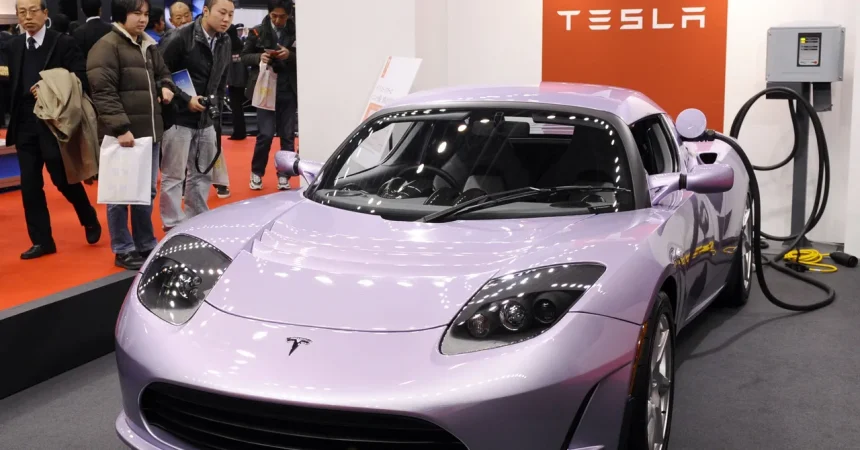
Almost nine years ago, Elon Musk stood on a stage in California looking tanned and, for once, genuinely relaxed. His electric car company, Tesla, was about to show off something new: the Roadster 2. Musk, with that signature mix of bravado and boyish excitement, promised it would be “the fastest sports car ever made, period.” He called it a “hardcore smackdown to gasoline cars.” Behind him, a shiny red prototype zipped around a track, and the crowd cheered. It was pure theater, the kind of launch event Musk does better than almost anyone. At the time, it felt like the beginning of a new era. Electric vehicles were still novelties, something for wealthy tech nerds and environmentalists. The Roadster was going to be the car that proved EVs could be not just practical but thrilling, not just green but brutally fast. The plan was simple: take a Tesla, make it absurdly quick, and let it humiliate every petrol-powered supercar on the planet. Six years ago, it was supposed to be in driveways. It wasn’t. Instead, the Roadster 2 disappeared into a long, strange delay. And now, after all that time, it is finally about to arrive—but the world around it has changed so much that the car’s original promise no longer makes sense.
Musk himself has changed, too. In 2017, he was the darling of climate-conscious investors and car enthusiasts who wanted to see the internal combustion engine die. Today, he is the leading donor to a political party that has actively rolled back electric vehicle incentives and made it easier for automakers to skip building EVs altogether. The Trump administration killed tax credits that made EVs cheaper, and last month it loosened fuel-economy rules that had pushed companies toward electrification. Musk, meanwhile, has told investors to stop thinking of Tesla as a car company at all. He says it’s a robotics and autonomy company, focused on self-driving software and humanoid robots. He has practically moved on from cars. Yet on Thursday night, Tesla will hold what it has called its last unveiling event for a human-driven vehicle. The Roadster 2, the car that was supposed to be the future, will finally get its moment. Deliveries are slated to start next year. But the timing could not be more awkward. In 2017, the Roadster was a declaration of war against gasoline. In 2025, it feels more like a farewell letter from an era that never quite arrived.
The electric vehicle landscape has shifted dramatically since the Roadster was first revealed. Back then, there were only about 15 EVs on sale in the United States, and they were, as one analyst put it, “toys for early adopters.” Charging infrastructure was patchy, range was a constant anxiety, and most mainstream buyers couldn’t imagine spending that much money on something that would leave them stranded. But by 2020, automakers had seen the future—or thought they had. Tesla’s sky-high stock price and ambitious government policies pushed just about every major manufacturer to announce big electric plans. Billions of dollars were poured into battery plants, new platforms, and electric trucks. China, meanwhile, quietly became the world’s dominant EV maker, cranking out affordable cars that flooded global markets. For a while, it looked like the transition to electric was inevitable. Then politics got in the way. The Trump administration reversed course on the powertrain, removing the regulatory and financial pressure that had pushed automakers toward electrics. Now, EV sales are shrinking instead of growing, and many companies are pulling back. But here’s the strange thing: even as the overall market has stumbled, the number of options has exploded. Today, American buyers can choose from nearly 90 different electric vehicles, ranging from tiny commuter cars to luxurious SUVs. The buyers themselves have changed, too. They’re no longer just tech enthusiasts or environmental activists. They’re ordinary people, and ordinary people have practical concerns. They want range, they want reliability, they want fast charging, they want resale value. They don’t care about setting speed records. They care about whether the car will get them to work and back without drama.
That makes the Roadster’s mission more complicated than it was in 2017. This is a hypercar, a machine built for the extreme upper end of the market, the kind of vehicle that exists not to move people but to make a statement. The people who buy hypercars are not ordinary. They are collectors, adrenaline junkies, and status seekers who want to be noticed. They want to hear a thunderous engine roar, feel the g-force push them into their seats, and know that their car is rarer and faster than everyone else’s. Practicality is not part of the equation. As one automotive analyst put it, “EVs in this space really have to wow the shopper with a lot more than practical things. Great range, really quiet, charging at home—none of that matters.” The problem for Tesla is that many hypercar buyers still love gasoline. There is something visceral about a V-8 engine, the rumble and vibration and smell of burning fuel. Some luxury automakers have actually gone out of their way to reproduce that sound in electric cars, because they know buyers crave it. Others have decided to stick with internal combustion altogether. Porsche and Ferrari have both said they will keep developing gas engines. Lamborghini announced earlier this year that it would shelve electric plans entirely. Even the CEO of Bugatti, who once founded his own electric hypercar company, now says loud gas engines are becoming a status symbol among the wealthiest car buyers. The market that Tesla once wanted to conquer has shifted in the opposite direction. In 2017, the Roadster was supposed to be the machine that made gas engines obsolete. In 2025, it is entering a segment where gas engines are more beloved than ever.
The performance bar has also moved. Musk originally promised the Roadster would hit 60 miles per hour in under two seconds, which would have been a world record at the time. That was the headline-grabbing number, the one that made people gasp and believe that electric cars could outrun anything with a fuel tank. But since then, a handful of other production cars have broken that barrier. The Roadster’s old party trick is no longer enough. To truly impress, Tesla will have to do something even more spectacular. Musk, never one to underpromise, has repeatedly hinted that the new Roadster will fly—or at least hover. He has suggested that the car will get help from SpaceX, his rocket company. That sounds absurd, but remember that in 2018, SpaceX launched the first Tesla Roadster into space on the Falcon Heavy rocket, with a mannequin in a spacesuit behind the wheel. That was a publicity stunt, but Musk has always been serious about finding ways to attach SpaceX technology to his cars. If the Roadster 2 does something involving cold-gas thrusters or rocket propulsion, it would certainly be a spectacle. But spectacle is not the same as comfort. Going that fast, as a partner at AlixPartners noted, is “not terribly comfortable.” The laws of physics do not care about marketing campaigns. At extreme speeds, the car will need downforce, tires, and suspension tuned to keep it on the ground. If Tesla tries to make it fly, or even hover, the engineering challenges become immense. And even if the car does deliver jaw-dropping performance, it will still be a human-driven vehicle at a company that is explicitly moving away from human-driven vehicles. The Roadster is an oddity, a leftover from a previous vision.
So what does success look like for the Roadster 2? It’s not really about sales. Tesla will likely sell only a handful of these cars, and at a starting price of $200,000, with reservation holders having already put down $50,000 deposits, it was never going to be a volume product. The Roadster’s real job is symbolic. It is the last gasp of the old Tesla, the one that wanted to prove electric cars could beat gasoline at their own game. It is a monument to a promise made nine years ago, when the future seemed simpler and Musk was just a car guy with a dream. Now, it is arriving into a world that has become more skeptical, more divided, and more complicated. The political winds have turned against electric vehicles. Musk has become a polarizing figure, a man who spends more time talking about robots and artificial intelligence than about cars. The market is crowded, the competition is fierce, and the audience for a $200,000 electric hypercar is small. But there is something human about the Roadster’s stubborn persistence. It was delayed, mocked, written off, and forgotten. Yet here it is, ready to finally take the stage. Maybe it will be the fastest car ever made. Maybe it will fly, or at least do something that makes people gasp. Maybe it will be a brilliant farewell to the era of human driving. Or maybe it will be a beautiful, overpriced relic, a reminder that the future Musk promised never really arrived. Either way, it is a story about how much can change in a decade—not just in technology, but in dreams. The Roadster 2 was supposed to be the future. Now it’s just a car, trying to find its place in a world that has moved on.