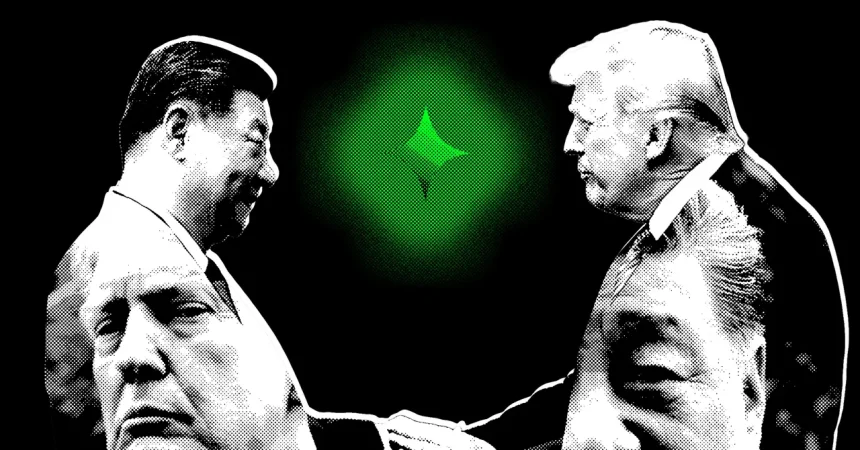
When Donald Trump and Xi Jinping sit down for a state dinner at the White House on Thursday, the menu will be carefully prepared and the place settings perfectly arranged, but the real substance of the evening will have nothing to do with food. The conversation that matters is about artificial intelligence, and the guest list makes that unmistakable. Executives from OpenAI and Nvidia, two companies at the very center of the global AI boom, have confirmed they will be at the table. That is a striking signal, because a state dinner is normally a piece of grand diplomatic ritual, full of toasts and toasts meant to smooth over tensions rather than solve actual problems. This time, the presence of major tech leaders suggests that AI is no longer just a trade issue or a national security issue or a strategic competition issue. It is all of those things at once, and it has now reached the very highest level of diplomacy. At the top of the US agenda is a proposal to establish an AI notification system with China, modeled in part on the Cold War hotline that once connected Washington and Moscow. The idea is simple to describe but enormously complicated to build: if either country detects an AI-related incident that could threaten national security, it should be able to alert the other before the situation spirals out of control. Treasury Secretary Scott Bessent first announced the proposal on Sunday after talking with Chinese Vice Premier He Lifeng, and the fact that it is now part of a formal state dinner conversation is a reminder of how fast the world has changed. Behind the scenes, however, Trump administration officials tell Inner Loop that the hotline is not close to being done. They are optimistic it could be in place by the end of the year, but they expect several more weeks of intense negotiation before anything is finalized. Thursday is not the finish line. It is the starting gun.
One reason the process is so slow is that a hotline is not just a phone number that gets exchanged on a good day. There are technical questions, and more importantly, there are deeply political questions about what the system is supposed to do. The two governments still have to agree on what kind of incident rises to the level of a national security emergency. Is it a cyberattack on critical infrastructure? A leak of powerful AI model weights? A catastrophic failure inside a major AI lab? A military use of an autonomous system that crosses a red line? None of these are easy to define, and all of them are exactly the kinds of questions that get avoided until a crisis forces the issue. China, for its part, has been noncommittal about the whole idea, and nothing can move forward without Beijing’s explicit sign-on. Trump officials say they are essentially targeting a framework that is functional and, crucially, approved by Trump by the time Bessent next meets He Lifeng for follow-up talks in two months’ time in Shenzhen. That gives the negotiators a hard deadline, but it is a tight one, and there is plenty of room for last-minute disagreements to slip in. The pressure to get this done comes from genuine fear. Frontier AI models are developing so rapidly, and their capabilities are growing so quickly, that the gap between realizing a new risk and seeing it explode into something dangerous is shrinking. The United States and China are locked in an intense competition to be the dominant power in AI, but they are also, in the strange logic of the nuclear age, dependent on each other’s restraint. A notification system, in that sense, is not about friendship. It is about creating a practical channel for survival, an emergency brake that both sides can reach for if the machine starts to veer off the road.
Even inside the Trump administration, the shape of the system is far from settled. Officials have internally discussed putting together a framework that lays out clear criteria for when each country is obligated to alert the other, along with enforcement measures so that the arrangement does not become one-sided. The biggest worry is that the US will end up as the only side making calls, while China simply listens, acknowledges the message and then does whatever it wants. If the notification system is going to mean anything, there have to be consequences for ignoring it. But enforcement is much easier said than done, especially when the administration is simultaneously trying to keep the trade truce with China alive. Trump is reluctant to stop exporting cutting-edge Nvidia chips to China, and the government has already granted a limited number of licenses this year for Nvidia to sell its H200 chip to Chinese companies. That chip is a critical component for AI labs that need enormous computing power to train their models. Any attempt to attach tough conditions to the hotline could collide with commercial interests, and Nvidia’s supporters have long argued that restricting sales would only push Chinese companies like Huawei to build their own versions. According to recent reports, that fear may already be happening: Huawei has achieved significant advances with commercially available AI chips, meaning the era of uncontested American supremacy in that field may be ending. All of this makes it harder for US officials to design a framework with real teeth. If they push too hard, they could undermine the trade relationship and alienate partners in the private sector. If they don’t push hard enough, the hotline becomes just diplomatic theater. In the end, the hardest part of the negotiation is not the technology itself. It is the question of what each side is willing to do when the other side doesn’t follow the rules. That is a human problem, not a technical one, and it cannot be solved with a signed agreement alone.
Meanwhile, the US side has another complication: who is going to run the whole thing. Some Trump officials suggest the notification system could be delayed further while Trump decides who to appoint as his next AI czar, a role that is being envisioned as the head of a so-called AI Force, in charge of interagency coordination on artificial intelligence. That choice matters enormously because a hotline does not operate by itself. It needs a senior official who can push the Pentagon, the State Department, the Commerce Department, the intelligence community, and the White House to work together, and who can speak with authority to Beijing in a crisis. The list of candidates is a reminder of how many competing power centers exist inside the Trump administration. Bessent, who has already emerged as a leading figure in China policy, is one option, although it is not clear he is the standout. Commerce Secretary Howard Lutnick is also in the running, as are White House AI officials Michael Kratsios and Sean Cairncross, according to two sources who spoke to Inner Loop. It remains unclear whether the person chosen will keep their existing job while serving as AI czar or will leave their current role to take the new position. David Sacks, the previous AI czar who served as a special government employee, is not considered a candidate to return. The delay over this appointment might seem like a small, behind-the-scenes personnel matter, but in a system where personal relationships and loyalty matter as much as policy paper, the AI czar will determine how quickly the hotline becomes real. It will also determine how effectively the United States can respond to the next big AI crisis, and that is a decision that cannot be rushed without consequences.
Part of the reason Bessent keeps being mentioned as a potential AI czar is that there is a historical precedent that gives the idea of an AI hotline real emotional weight. The model for this entire exercise is the US-China dialogue that operated during the 2008 financial crisis between former Treasury Secretary Hank Paulson and former Chinese Vice Premier Wang Qishan. At that time, the global economy was on the edge of collapse, and Washington was terrified that China might sell off a large portion of the US government-sponsored debt issued by Freddie Mac and Fannie Mae. Such a move would have punished American markets at the worst possible moment, making the financial crisis even deeper and even harder to escape. Paulson has credited the direct line of communication he maintained with Wang with helping to stave off that catastrophe. That is a powerful memory for a new generation of US officials. It suggests that a simple arrangement between two people who do not necessarily like each other can matter more than any number of carefully worded public statements. It shows that in a crisis, what matters is not the speech you give at the podium but the person you can call at two in the morning. Now the AI system under discussion is an attempt to apply that lesson to a completely different frontier. The dangers are not financial this time, but the stakes are arguably larger. The possibility of an AI-related disaster—a catastrophic failure in a major data center, a cyber incident that gets out of control, the loss of control over a frontier model—is real enough that officials on both sides want to know they can reach someone reliable in an emergency. The 2008 experience is not a perfect analogy because AI cuts across so many domains and raises so many uncertainties, but it helps explain why Bessent has been such a forceful advocate for this hotline. He knows from lived memory how much difference half an hour of communication can make when governments are staring into the abyss. That kind of experience gives his argument unusual power inside the White House.
The politics around the decision are not without friction, and not everyone is comfortable with the direction things are heading. Some Trump officials have chafed at the idea of giving Lutnick more authority over AI policy, even though Lutnick remains a serious contender. Part of the reason is that Lutnick already oversees the Center for AI Standards and Innovation, an office that successfully navigated a difficult stretch with frontier AI model companies over the summer. That experience has given him a sense of the technical realities that any AI czar will need, and it is hard for his rivals to argue convincingly that he would be starting from zero. Yet the internal resistance says a lot about how politically sensitive the role has become. AI policy is no longer a niche technology issue. It touches trade, national security, defense, diplomacy, the economy, and even questions of military strategy. Those are exactly the areas where the Trump administration’s various factions care most intensely, and whoever is chosen as AI czar will have to balance all of those competing pressures without being blown over by them. Whatever decision Trump makes, someone will feel left out. In the end, the state dinner, the hotline, and all the maneuvering around it are a deeply human story. It is about fear of the unknown, the difficulty of trusting a rival superpower, and the quiet hope that even in a world shaped by competition, there are still ways to keep a conversation alive. The AI notification system is still a work in progress, and it might be in place by the end of the year, as optimists hope, or it might slip further into 2026, or be derailed entirely if the trade truce collapses and the relationship between Washington and Beijing hardens again. But the fact that the two most powerful countries in the world are sitting down to discuss an AI hotline, with some of the most important tech companies in the world watching from the guest list, is itself a moment worth pausing over. The details are still fuzzy, the enforcement tools are unclear, and the politics are messy. That may not sound reassuring. But in a world where superpowers face dangers they do not fully understand, just having a number to call is an act of imperfect, fragile, very human sanity.