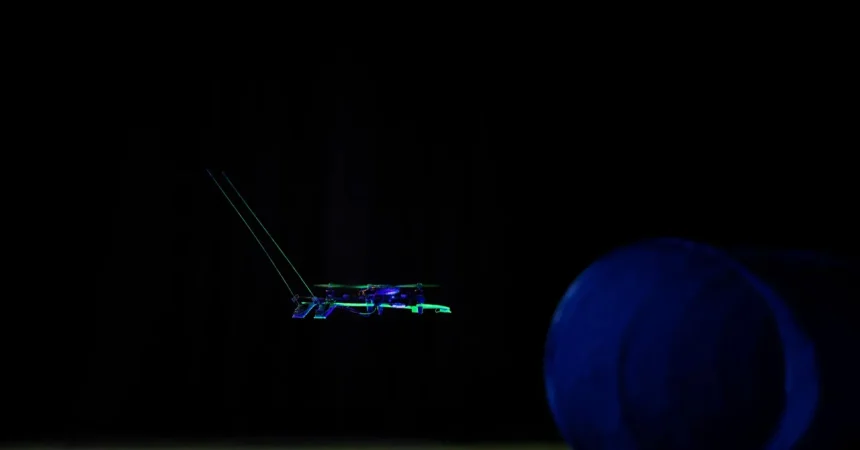
Imagine a drone small enough to settle in an open palm, flying through a dark, dusty building where a camera is useless. It has no headlights, no spinning lidar, no complicated vision system. Instead, it feels its way forward with two long whiskers, like a cat’s but far more delicate. Those whiskers are made of nickel-titanium, an alloy prized for its superelasticity and ability to remember its original shape: it can bend again and again and still spring back perfectly. Each wire is just 0.4 millimeters in diameter, about the combined thickness of four sheets of paper. Despite being so fine, each whisker is nearly eight inches long, which means each one is longer than the palm-sized drone itself. At the base of each whisker sit three tiny pressure sensors. When a whisker brushes against a barrier, those sensors measure the precise bending of the wire and the force involved. From those measurements, the drone calculates its distance from the barrier and its orientation relative to it. All of that processing happens on a microcontroller onboard the drone, without any help from an external computer. This is a very different idea of autonomous flight: instead of a machine that sees and maps its environment, it is one that touches, feels, and interprets contact. In the animal kingdom, whiskers are not just decoration. A rat sweeps its whiskers back and forth constantly, building a tactile map of its world. A seal can use its whiskers to detect ripples left by a fish. A cat uses its whiskers to decide whether it can fit through a gap. By putting whiskers on a drone, the researchers took an ancient biological idea and adapted it to a machine that moves through three dimensions.
The concept may sound simple, but the execution was anything but. In nature, the animals that rely most heavily on whiskers are usually ground dwellers. They do not have to worry about balance, aerodynamics, or the constant vibration of spinning rotors. Flight changes everything. A long protrusion, even if it is extremely light and delicate, can make a drone unstable. It can catch the air, shift the drone’s center of gravity, or send unwanted forces back into the frame. During early experiments, the researchers watched their drone struggle while flying along a wall. When the whisker touched the wall, it did not simply bend and slide. The contact created a physical force that pushed against the drone’s body. That force could rotate the drone, knock it off course, and sometimes send it crashing to the ground. The team quickly realized that they had to do more than just attach whiskers to a drone. They had to decide exactly how to mount them. But even determining the proper angle was a puzzle. There were no natural examples to follow, because animals that navigate by whiskers generally do not fly. The researchers ran a systematic series of tests: 72 flights in total, using six different mounting angles at three different flight speeds. They found that the drone could fly without major problems when the whiskers were attached at 30 degrees, 45 degrees, or 60 degrees. The 60-degree angle, however, reduced the drone’s ability to sense what was in front of it. The 30-degree angle allowed forward sensing but made the drone’s orientation less steady. The 45-degree angle turned out to be the sweet spot. It produced the least deviation in the drone’s orientation during flight, and it still left enough forward range for the whiskers to detect obstacles before the drone reached them.
With the angles solved, the researchers faced an even more stubborn challenge: understanding the information coming from the whiskers. In an ideal world, a bent whisker would mean that the drone had touched something real. But the real world is messy. The drone’s own propellers vibrate constantly. Those vibrations travel through the frame, into the whiskers, and down to the pressure sensors. The sensors cannot easily tell the difference between a genuine collision and the drone’s own trembling. The team tried filtering out some of this noise, using electronic techniques to smooth the signal. The filter helped, but it was not enough. Even after filtering, about 38 percent of the drone’s detections were false positives. In other words, more than one in every three times the drone thought it had touched something, it had actually touched nothing at all. For an autonomous robot, this is not a minor annoyance. A false positive can make a drone suddenly stop, turn away, or misjudge its distance from a wall. If the drone is meant to navigate through a collapsed building or a smoke-filled room, those false readings could make it hesitant and unreliable. It might spend all its time reacting to ghosts, weaving nervously through a space where nothing is actually in its way. The researchers knew that a simple mechanical solution would not be enough. They needed to look deeper at the sensors themselves.
The real culprit, they discovered, was drift. Drift is a slow, gradual shift in a sensor’s output even when nothing in the environment changes. It is like a thermometer that starts reading a little warmer every hour, even if the room stays exactly the same temperature. The pressure sensors at the base of the whiskers were drifting as the drone flew. Over time, their baseline readings slid away from their original starting points. That meant the drone’s idea of “not touching anything” was changing without it knowing. Every contact measurement is really a comparison: the current reading versus the baseline. If the baseline has drifted, then ordinary vibrations and tiny fluctuations start to look like actual contacts. That was why the earlier filter could not get rid of all the false positives. Filtering the noise only addressed the symptoms; the real problem was the shifting zero point. The research team therefore built a correction algorithm that runs continuously while the drone is in flight. The algorithm estimates the trend of the sensor drift over time by looking at moments when the whiskers are definitely not touching anything. If the whiskers are in open air, the reading should be the baseline. By watching how that baseline changes, the algorithm can adjust the sensor data in real time. When this drift correction was combined with the original filter, the improvement was dramatic: the false-positive rate dropped to zero. Suddenly every detection meant a real contact. The drone had stopped bumping into ghosts.
This kind of progress does not happen with a single flash of inspiration. It is the product of patient, sometimes tedious engineering. The choice of nickel-titanium, for example, was not accidental. That alloy is known for its superelasticity: it can handle enormous bending strain without permanent deformation. It can be crushed, twisted, and pressed against walls, and it will still spring back to its original shape. That makes it ideal for a whisker, because a drone flying in tight spaces is going to hit things. The whiskers are longer than the drone itself, which seems almost absurd at first. But the length gives the drone advance warning. It can sense an obstacle before the bulk of its body is anywhere near it. And because the whiskers are so thin, they do not weigh the drone down or force it to carry a heavy sensor array. The three pressure sensors at the base are small and efficient. They measure only what is needed: the bending of the wire. The drone does not need to build a three-dimensional map or recognize objects. It simply needs to know that there is something nearby, and how far away it is. All of this happens on a microcontroller small enough to fit inside a palm-sized aircraft. There is no external computer running calculations and no wireless link sending data back and forth. The drone is entirely self-contained. It carries its own sense of touch, its own processing power, and its own ability to make split-second decisions. That is a remarkable thing to fit into such a small machine.
Why does this matter? Beyond the charm of a flying robot with whiskers, the technology points to a future where drones can work in places where vision fails. Cameras are useless in thick smoke, in swirling dust, underwater, or in pitch-black tunnels. A drone with whiskers does not care about light. It can feel its way through a collapsed building, a flooded pipe, or a room filled with toxic gases. It can move slowly and carefully, always keeping close enough to a wall to orient itself but never crashing into it. This makes it a natural tool for search-and-rescue operations, where human eyes cannot see and where every second counts. But the deeper lesson is about perception itself. The challenge of separating real signals from noise and drift is not unique to whiskers. It is the fundamental problem of all robotics: how do you know that what your sensors tell you is actually true? The correction algorithm developed for this drone is a tiny example of the kind of intelligence machines will need as they enter the messy, unpredictable world of physical objects. Perhaps most importantly, the whiskered drone reminds us that innovation does not always mean inventing a brand-new sense. Sometimes the best solution is to look at the world around us and notice what animals have been doing all along. A cat in a dark room does not need to see. It trusts its whiskers. A drone can learn the same trick, not by replacing human sight, but by adding a quiet, humble kind of touch. In the end, that may be the real promise of this work: a future where robots do not just see the world clearly, but feel their way through it honestly.