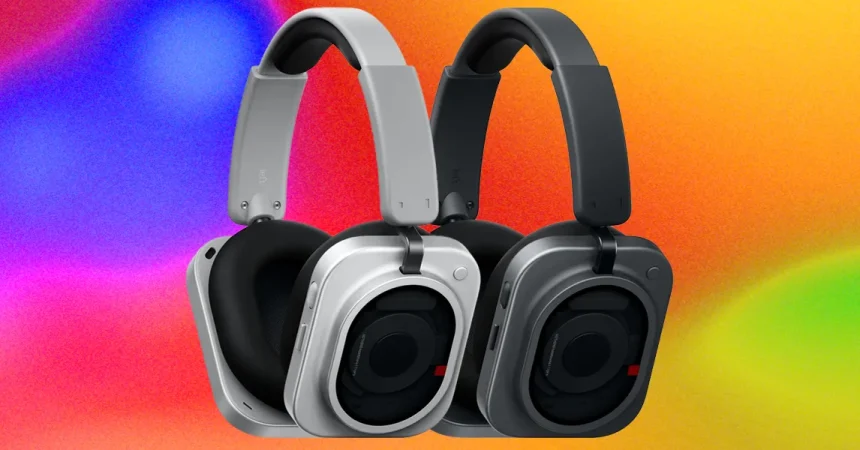
Unboxing the Headphone (1) Pro feels like a little event, because the design itself makes you slow down. The transparent panels, the visible inner workings, the clean lines—it all suggests that the engineering isn’t just hidden inside a boring plastic shell. And once you put them over your ears, the interior turns out to be the most interesting part. Nothing has gone with a triple-driver system rather than the usual single dynamic driver. There’s one dynamic driver dedicated to bass, another precision dynamic driver for the mids, and an xMEMS driver for treble. Most major ANC headphone brands use a single dynamic driver meant to cover the entire frequency range. That’s what you get from Sony, Bose, Apple, and almost everyone else. It’s a proven, cheap, compact solution that can be tuned to sound decent for most people. But it’s also a compromise. Asking one tiny speaker to produce room-shaking lows, clean vocals, and sparkly cymbals is a lot. When you split that workload between three specialised drivers, each one can be optimised for its own job. The bass driver can be tuned for low extension and enough air movement; the mid driver can focus on vocal presence and detail; the xMEMS driver can be lightning-fast and precise at the top end. The potential upside is obvious: a more detailed, less distorted, more coherent sound. But the risk is just as real. Multi-driver headphones can sound disjointed if the drivers don’t integrate seamlessly. They can have weird phase cancellations, tonal imbalances, or an artificial sense of separation. That’s why big companies avoid it, especially in wireless ANC headphones. So when Nothing decided to build a triple-driver headphone, it wasn’t just a marketing gimmick. It was a genuine engineering gamble. And after spending time with them, I can tell you that the gamble paid off. These headphones don’t sound experimental or broken. They sound clear, balanced, and impressively cohesive. You don’t need to know what an xMEMS driver is to feel the difference, and that’s exactly the point.
Before I go further, I should be clear: I’m not going to pretend I’m an audio engineer. I don’t know how to read a frequency response graph, and I don’t have a golden ear that hears the subtle difference between two op-amps. I’m just a normal person who loves music and has been using headphones daily for years. And the first thing I noticed is that songs I’ve played dozens, sometimes hundreds of times suddenly sounded more alive. The most obvious difference is in the midrange and treble. Vocals sit a bit more forward, with more texture and warmth. Guitars have a sharper attack. Snare drums crack instead of just thudding. That extra energy made my music collection feel new again. I’m not talking about some imaginary audiophile improvement that you only notice if you sit in a silent room and concentrate. I’m talking about tracks like “Staring at the Sun” by TV on the Radio, which I’ve heard through dozens of devices, suddenly making me pull the stank face—the facial expression normally reserved for when someone drops the perfect beat or a chef hands you something absurdly delicious. It happened almost every time certain choruses kicked in. I just couldn’t keep my face neutral. There’s a vividness to the high end that I didn’t expect, a kind of snap that makes cymbals and background guitar lines feel present without being harsh. I also noticed small details that usually pass me by: a breath before a line, a subtle shift in the mix, the way a backing vocal harmonises with the lead. Maybe the xMEMS driver is doing a lot of that heavy lifting, because the top end has a speed and precision that dynamic drivers often struggle to match. But it’s not cold or clinical. There’s still warmth and body. The result is a sound that commands attention. It doesn’t let you casually listen; it reminds you every few seconds that you’re hearing a recording properly. That can be a little distracting at work, but as a music lover, I couldn’t help being thrilled.
To get a real sense of what the Headphone (1) Pro was doing, I did what any obsessive would do: I compared it directly with the Sony WH-1000XM6 and Bose QuietComfort Ultra Headphones (2nd Gen). Those are probably the two most popular premium ANC headphones on the market, and they both sound very good. But on a dense song like Stevie Wonder’s “Another Star,” the Nothing headphones pulled off a trick that genuinely surprised me. That track has a lot going on: layered vocals, hi-hats, trumpet, guitar, backing voices, a busy rhythm section. On the Sony and Bose, it can sound a little crowded, like everything is compressed into a single forward wall of sound. The Nothing headphones made it feel spacious. The trumpet sat in its own pocket of air, the hi-hats were cleaner and more defined, and Wonder’s voice was front and centre without burying the rest of the mix. There was a sense of separation and depth that made the song easier to follow and even more exciting. I actually found myself choosing that song just to admire how the three-driver design can disentangle instruments. But there is a downside. The bass, while clear and tight, doesn’t have the same slam or weight as the big consumer rivals. The Sony XM6, for example, has a much more prominent low end that makes hip-hop and electronic music feel more visceral. On the Nothing headphones, Bad Bunny’s reggaeton still sounded great, but it didn’t hit my chest the same way. Kendrick Lamar’s basslines were intelligible, but not as round and fun as they were on the Sony. With EDM, I found myself wanting more physical bounce. This is not a fatal flaw; it’s a tuning choice. And thanks to the built-in EQ, it’s not even a permanent one. I’ll get into that in a second, because it’s the reason these headphones can work for a wider range of ears than you might expect.
All of this had a strange side effect on my productivity. When I’m working, I usually put on noise-cancelling headphones and stream music in the background. Most good headphones—especially the bass-forward consumer flagships—are perfect for that. The music becomes a warm, unobtrusive wash, and my brain can drift into a comfortable, focused state. With the Nothing Headphone (1) Pro, I found that much harder to do. The music kept pulling me out of my concentration. I’d be writing an email, and suddenly the high strings in some old track would grab my attention. I’d stop, rewind, and listen to the same four bars again. That’s a wonderful feeling when you want to appreciate a record, but it’s not ideal when your deadline is approaching. The tuning of the mids and highs makes the music too interesting to become background noise. For the first few days, I considered this a problem. How can headphones be “worse” for focusing if they sound more detailed? The answer is that deep focus often requires the brain to stop noticing the music. A mix with heavy, slow bass and rolled-off highs is easier to ignore. The Nothing headphones, with their lively, open midrange, are almost the opposite. They demand to be noticed. That might make them a bad choice if you want a generic office headphone. But it also tells you exactly where these sit: they are made for listening, not just for blocking out noise. Once I adjusted my expectations and used them for intentional listening sessions instead of passive background listening, I loved them even more. I don’t think I’ve ever had a pair of headphones that made me reconsider the way I think about background music. They made me realise how much detail I had been missing in songs I thought I knew by heart.
All this sound talk can quickly get pretentious, and I want to step back. Everyone hears the world differently. Your ears are not my ears. You might be more sensitive to treble, or you may love big, boomy bass. There is no single headphone tuning that is objectively right for all music and all listeners. You can find people who swear by bright, detailed sound and people who prefer a warm, dark signature; both are valid. That’s why it’s so important that the Headphone (1) Pro doesn’t force you to live with its default sound. The EQ controls are simple enough for a casual user and powerful enough to make a real difference. If the stock tuning feels too lean for your taste, you can add a bass shelf and bring back some of that low-end warmth. I tried it with a bunch of reggaeton and trap playlists, and it completely changed my appreciation of those genres on this headphone. The bottom end got closer to the big, exciting sound of the Sony XM6 without sacrificing the clarity and separation that makes the triple-driver design special. Some audiophiles frown at EQ, but I think it’s one of the best features any headphone can have. It lets the product adapt to your playlist, your mood, and your ears. And it means you don’t have to agree with the designers’ tuning choices to enjoy the hardware. You can buy these headphones with confidence, even if the first listen isn’t exactly what you expected, because you have the tools to make them yours. That’s not true of every flagship. It’s a reminder that a great headphone isn’t a one-size-fits-all object; it’s a starting point for your own listening habits.
At the end of the day, the Headphone (1) Pro is a reminder of why headphone competition is a good thing. Sony and Bose have perfected their own formulas over the years. They make excellent, reliable products with outstanding noise cancelling and safe tuning. They rarely surprise you. Nothing came along and decided to do something different. They used three drivers when everyone else said one was enough. They tuned the sound for clarity and energy instead of simply chasing bass and smoothness. They took a risk, knowing that not everyone would love the result out of the box. That’s exactly what the industry needs every once in a while. Not every experiment needs to be a mass-market hit. But this one deserves a lot of respect, because it actually works. The Headphone (1) Pro might not be for everyone. If your highest priority is maximum bass, or if you need your headphones to disappear into the background while you work, the Sony and Bose models are probably safer choices. But if you want to rediscover your music, if you want to hear details you’ve been missing, and if you’re willing to spend a couple of minutes adjusting the EQ to get the exact balance you like, these headphones are exceptional. They made me stank-face to a song I’d listened to for years, and they made me start digging through my library just to hear what other familiar tracks sounded like through those three drivers. That’s not something a lot of flagship headphones can do. It’s the difference between a device that merely reproduces sound and one that makes you love the sound all over again. Maybe that’s why the transparent shell is so fitting. You can literally see the technology inside, and the result is a headphone that’s open, ambitious, and surprisingly human. Photograph: Harry Rabinowitz