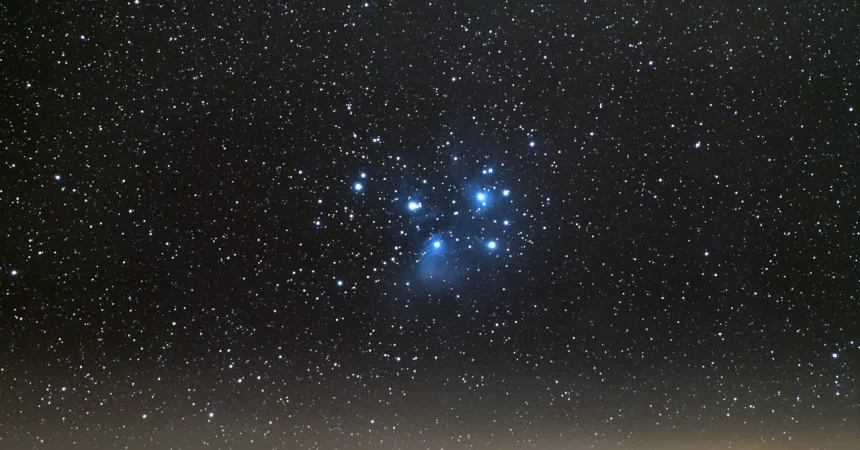
September 2026 is quietly full of reasons to look up. One of the most beautiful comes early in the month, when a waning moon drifts close to the Pleiades star cluster, the famous group of stars known as the Seven Sisters. For many sky-watchers, the Pleiades are a familiar sight, a tiny, misty patch of light that suddenly sharpens into a glittering bouquet of blue-white diamonds when viewed through binoculars. But this month, the moon makes the cluster easier than ever to find. Just find the moon, look a short distance away, and there they are: a small gathering of bright points that seem almost too perfect to be real. The proximity of the moon serves as a cosmic arrow, pointing your gaze to one of the nearest and most lovely open star clusters in our galaxy. To the naked eye, the cluster can look like a tiny version of the Big Dipper, but with a handful of bright stars wrapped in a soft haze. With binoculars, the view blossoms. Dozens of additional stars appear, and the cluster takes on a three-dimensional depth that photographs rarely capture. The moon will be waning, so it will not wash out the sky as much as a full moon would, and the cluster should still stand out clearly. If you have never taken the time to study the Pleiades, this is the month to begin. And if you miss the first close encounter, don’t worry: on September 30, the moon and the cluster will once again meet, separated by only one degree of sky. That is roughly the width of two full moons, a tiny gap that will make the pair look inseparable. It is a gentle, elegant sight, and it sets the tone for a month of celestial moments that ask nothing more than a clear evening and a willingness to wonder.
Later in the first full week of September, the sky offers something more fleeting but no less magical: the Epsilon Perseids. This modest meteor shower peaks on the nights of September 9 and 10, and while it cannot compete with the famous Perseids of August—which can send dozens of shooting stars streaking across the sky every hour—the Epsilon Perseids have their own quiet charm. Under ideal conditions, you might see up to eight meteors per hour. That does not sound like a lot, but remember that these are eight little streaks of light, each one the burning trail of a tiny piece of cosmic dust entering our atmosphere at enormous speed. And this shower has one big advantage: it peaks just two days before the new moon. That means the moon will be almost completely absent from the night sky, leaving the heavens dark and empty, exactly what you need for meteor-watching. Even the faintest meteors will have a chance to show themselves. The best views are expected from the northern hemisphere, though observers in other regions may still catch some activity. As with any meteor shower, the key is to escape the glow of city lights. Light pollution is the enemy of the sky-watcher; it washes out the faint streaks and turns a promising night into a disappointment. So plan ahead. Find a dark park, a rural road, or even just a backyard with a clear horizon. Give your eyes at least twenty minutes to adjust to the darkness. Do not look at your phone. Lie back in a comfortable chair or on a blanket, gaze up at a broad stretch of sky, and let the shower come to you. Meteors can appear anywhere, not just in the direction of the radiant. The Epsilon Perseids may be modest, but they are also patient. If you watch for an hour or two, you will likely be rewarded with at least a few beautiful, unexpected flashes. There is something intimate about a meteor shower that does not overwhelm you with spectacle. It feels less like a fireworks display and more like a quiet conversation with the universe.
Just when the meteors fade, another bright light takes center stage. On September 22, Venus reaches what astronomers call its greatest brilliancy, or simply its brightest moment of the year. Venus is already a familiar evening companion, often called the evening star, but in late September it will shine with an intensity that is hard to ignore. Its apparent magnitude will reach about -4.8. For anyone unfamiliar with this scale, it helps to know that the full moon is about -12.7 and Sirius, the brightest star in our night sky, is only -1.46. In other words, Venus will be dramatically brighter than any star, a blazing beacon low in the west after sunset. It will hang near the western horizon, glowing with a steady, silvery-white light that can survive even in moderate twilight. Some people mistake it for an airplane, or even a UFO, because it is so bright and so low. If you see a brilliant “star” that does not blink, that is probably Venus. The viewing conditions for this particular apparition are best from the southern hemisphere, where the planet will climb a little higher into a darker sky. But from many parts of the world, simply looking west after sunset should reveal it. You do not need any optical aid. In fact, binoculars might make the view worse, because Venus is so bright and appears as a tiny, featureless disk. What makes this event special is not detail but brilliance. It is a chance to look at a world that is often mistaken for a star, a planet wrapped in thick clouds, with a surface hot enough to melt lead. And yet, from more than a hundred million miles away, it appears as the most beautiful light in the evening sky. Try to catch it on the twenty-second, and remember that you are seeing sunlight reflected off another world.
September also contains a quieter kind of milestone, one that does not require staying up late or looking through a telescope. On September 23, the September equinox occurs. This is not a visible event. There is no flash in the sky, no star that suddenly appears. Instead, it is a precise moment in Earth’s orbit around the Sun, a cosmic marker that signals a change of season. On this day, the Sun crosses the celestial equator, moving from the northern hemisphere of the sky to the southern. For people north of the equator, this marks the astronomical beginning of autumn. The days have been growing shorter since June, and after the equinox, the balance tips: nights become longer than days, and the slow slide toward winter begins. South of the equator, the exact opposite happens. There, the equinox marks the first day of spring, a time of renewal, longer days, and the promise of summer. The word equinox comes from Latin, meaning “equal night,” and around this date, day and night are nearly equal everywhere on Earth. It is a fleeting balance, a moment of harmony before the tilt of our planet carries us into the next phase of the year. Many people feel the equinox emotionally, even if they do not consciously observe it. There is a shift in the light, a change in the angle of the sun, a crispness in the air. It is a good time to think about the Earth’s journey, and about how our planet is always moving, tilting, and turning. The equinox is not something you can see with your eyes, but you can feel it. You can mark it by watching the sunset, by noticing how the shadows fall, or simply by taking a moment to acknowledge that we are all riding on a spinning ball of rock and water through an unimaginably vast universe.
Finally, for anyone who enjoys a challenge, September 26 brings Neptune to opposition. Neptune is the most distant planet in our solar system—sorry, Pluto—and it is never easy to spot. It is not one of those bright wanderers like Venus or Mars. It sits far away, dim and blue, requiring patience, a good pair of binoculars or a small telescope, and a reasonably dark sky. But on September 26, Neptune will be at opposition, which means Earth will be positioned almost directly between Neptune and the Sun. From our point of view, Neptune will be opposite the Sun in the sky. That gives it two important advantages. First, it will rise around sunset and remain visible for much of the night. Second, it will be at one of its closest approaches to Earth for the entire year. The planet’s distance will still be enormous—billions of miles—but from our perspective, it will be at its best. To find Neptune, you will need more than just your eyes. It is far too faint for naked-eye viewing. You will need binoculars or a telescope, and you will need to know exactly where to look. An astronomy app or a star chart will be your best friend. Under a dark sky, Neptune appears as a tiny, pale blue dot, not quite star-like, with a slightly soft, steady glow. It is not a dramatic sight. There is no ring system to gasp at, no swirling storm bands like Jupiter. But there is something profound about seeing the most distant planet in our solar system with your own eyes. The light that enters your eye has traveled billions of miles across empty space. It is a quiet, meditative observation, one that rewards persistence more than equipment. So if you are up for the challenge, set aside some time on the night of September 26, find a dark spot, and try to track down this icy world. It may be the most difficult object on this month’s list, but it may also be the most unforgettable.
Taken together, the events of September 2026 are a reminder that the sky is always changing. Some months are loud, filled with total eclipses and brilliant comets. Others, like this one, are softer and more intimate. A close conjunction between the moon and the Pleiades. A modest meteor shower that asks for patience. A blazing evening star. An equinox that shifts the seasons. A distant planet waiting to be found. None of these events require a large telescope or a degree in astronomy. They simply require you to step outside, look up, and give the sky a chance. In a world that moves quickly, there is something grounding about standing in the dark and watching a meteor streak across the sky, or finding the Pleiades next to the moon, or catching the bright spark of Venus over the western horizon. These moments connect us to something larger than our daily routines. They remind us that Earth is in motion, that our planet is part of a family of worlds, and that the universe is full of quiet, beautiful phenomena that happen whether or not we are watching. The good news is that we can watch. We can mark the dates on our calendars, set alarms for clear nights, and drag our friends and families outside to share the view. We can learn the names of star clusters and planets, not to master the sky, but to feel more at home in it. So this September, give yourself the gift of a few minutes under the stars. Let your eyes adjust. Let your mind wander. Follow the moon to the Pleiades, wait for a meteor near the peak, say goodbye to the long days at the equinox, and try to find Neptune if you are brave enough. The universe is vast and mostly silent, but it is full of light, if only we remember to look.