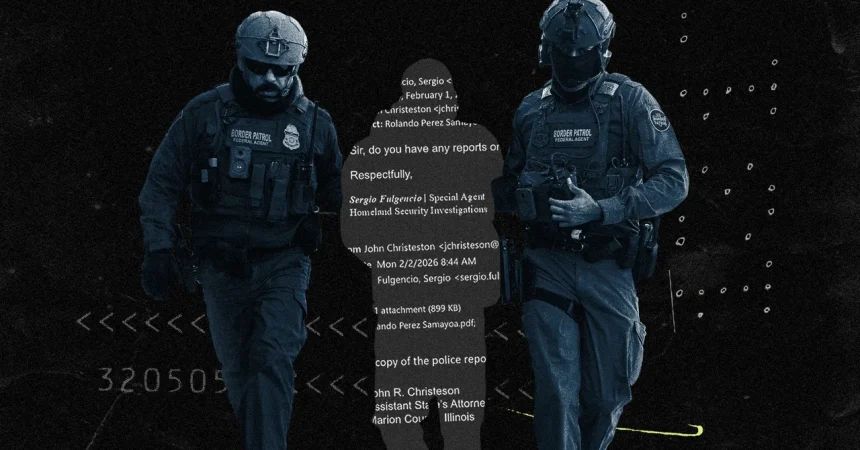
1. Rolando Perez Samayoa did not come to the United States looking for trouble. He came looking for safety, fleeing the kind of violence that has hollowed out so many Mexican communities and left people with impossible choices. It was 2023, and although he had initially planned to settle in Alabama, someone told him about Illinois, about a law designed to protect immigrants from being swept into the machinery of federal deportation. “There’s some kind of law there,” he said, remembering the advice. “It’s supposed to be a sanctuary.” And for a while, that promise seemed real. He made his way to southern Illinois, found work cleaning a factory in Centralia, and tried to build a quiet life. Then, in October, he was arrested in Marion County on a DUI charge. It was a mistake, a misstep, not a crime born of malice. He showed up to his court hearings, as the records confirm. He did what the system asked of him. But the system had other plans. In late January, an assistant state’s attorney named John Christeson sent an email to an agent with Homeland Security Investigations, a division of ICE. The message included Samayoa’s date of birth, his upcoming court date, and the town where he lived. The federal agent, Sergio Fulgencio, replied within minutes: “Ok, we’ll take care of it, thank you.” Soon after, he asked for more. Christeson sent the police report and related tickets. Three weeks after that email chain, federal agents seized Samayoa outside his own home. They also took his seventeen-year-old son. In one afternoon, a man who had trusted Illinois to shield him from harm learned that the sanctuary he had been promised was thinner than he had been led to believe.
2. That single email exchange is not an isolated story. It is part of a much larger pattern uncovered by Injustice Watch, a nonprofit newsroom in Chicago, which spent months digging through emails, court files, and public records from across Illinois. What they found is unsettling. In one out of every six counties in the state, prosecutors’ offices were effectively acting as quiet assets of federal immigration enforcement. They were sharing sensitive personal information about the people they were prosecuting—not with warrants, not in public, not with any meaningful oversight, and with no real accounting of how often it happened or who got swept up in it. The emails contained names and photographs, home addresses, dates and times of upcoming court hearings, and even the moments when a defendant was about to be released from jail. This was not a fringe phenomenon. It crossed party lines, from small rural counties to more populated ones, and involved everyone from paralegals to elected state’s attorneys. Sometimes prosecutors volunteered the information on their own, eager to help federal agents. Other times, they simply answered when Department of Homeland Security agents came asking. What’s more, the collaboration almost always happened without the knowledge of the defendants themselves or their attorneys. People caught up in the criminal legal system had no idea that the very officials charging them were also handing them over to immigration authorities behind their backs.
3. To understand why this is so troubling, you have to know something about the TRUST Act. Passed in 2017, Illinois’ landmark sanctuary law was supposed to keep local law enforcement out of federal deportation efforts. It bars police and other agencies from cooperating with ICE in civil immigration arrests unless there is a federal criminal warrant. For many immigrants, this law was the whole point of moving to Illinois, the reason they felt safe raising children there. But the law contains a significant gap. It does not clearly say whether prosecutors and their staff are bound by the same restrictions as police officers. That ambiguity has allowed county state’s attorneys’ offices to become a backdoor for ICE, a way for federal agents to access information without having to do the hard work of obtaining a warrant. And since President Donald Trump began his second term, the pressure has intensified. His administration has ramped up immigration enforcement, detention, and deportation in ways that feel both performative and terrifying. ICE agents have been seen at worksites, in suburban front yards, and even outside courthouses. In response, states like New York and more than a dozen others have passed or strengthened laws barring local police and sheriffs from cooperating with federal immigration authorities. But Illinois, despite being one of the largest sanctuary states in the country and often cited as a national model, has been undermined from within. The sanctuary protections that exist on paper are incomplete, and immigrants are paying the price.
4. The records obtained by Injustice Watch reveal just how casual and, in some cases, how eager the collaboration was. In response to public records requests filed with all 102 Illinois state’s attorney’s offices, and with the help of federal and circuit court records, the newsroom assembled more than five thousand pages of internal emails and case files. Some of the most chilling messages are brief, almost bureaucratic. “Ok, we’ll take care of it, thank you.” In others, prosecutors go out of their way to offer information, not waiting to be asked. There are emails with photographs of defendants attached, messages that disclose where a person lives, and notes about the exact date and time a person is due in court—the precise window for ICE to make an arrest. In one case, after a phone call between a prosecutor’s office and a federal agent, the follow-up email reads simply, “Thank you for taking my call.” These written records are likely only part of the story. For every email that mentions a phone call, there are surely calls that left no trace. Eleven of the state’s attorney’s offices did not respond to the public records requests at all. Several others produced records only after Injustice Watch sued them under the Freedom of Information Act. And some cases are still tied up in litigation. The fact that so many offices resisted transparency suggests they know how damning their cooperation might look. But even with the gaps, the evidence is clear: prosecutors have been functioning as an intelligence network for ICE, sharing exactly the kind of information that allows federal agents to target people with efficiency and devastating precision.
5. What makes the whole situation even more striking is that not all county prosecutors acted this way. Dozens of them, faced with the same federal pressure, told Injustice Watch they had no record of contact with ICE. At least one office made a point of shutting out federal agents entirely. That means every email, every phone call, every forwarded report was a choice. No one was forcing these prosecutors to cooperate. They were not under legal obligation. They could have respected the spirit of the TRUST Act, even if the letter of the law did not explicitly bind them. Instead, they chose to help. They chose to share information that had real, life-altering consequences. People who were flagged to ICE have been detained and deported. Families have been torn apart. Children have been left without parents. Parents have lost children. In some cases, the person being deported was a fully documented immigrant who had only been accused of a crime, not convicted, and not even accused of a violent one. There is no evidence that these prosecutors weighed the stakes or considered the human cost. There is no evidence that they paused to wonder whether the person they were handing over had children, might be a victim of crime themselves, or could be killed if returned to their home country. They just sent the information and moved on to the next case. The choices were individual, but the consequences are collective: a system that claims to offer sanctuary is quietly sending people out the back door.
6. In the end, the story of Rolando Perez Samayoa and the emails that doomed him is not just about one man or one prosecutor. It is about the limits of sanctuary laws and the fragility of promises made to vulnerable people. When a state passes a law like the TRUST Act, it sends a signal that immigrants can let their guard down, that they can trust local institutions, that they can cooperate with the courts without fear. But that signal becomes a trap when the very people prosecuting criminal cases are simultaneously working with ICE. The result is a system where immigrants are punished for doing something the state supposedly encourages: showing up, participating, and being honest. For Samayoa, appearing in court as required was not enough to protect him. The prosecutor who was supposed to be seeking justice in his DUI case was also quietly handing him over to a federal deportation machine. There is a reason these exchanges were hidden, a reason they happened without warrants and without oversight. The people involved knew they were doing something that would not survive public scrutiny. The investigation by Injustice Watch pulls back the curtain, showing how sanctuary can be hollowed out from the inside. It raises hard questions for every state that calls itself a sanctuary: Who is actually protected? Who is being left out? And what does a law mean if the people responsible for enforcing it can simply choose to ignore its purpose? Until those questions are answered, every immigrant in Illinois will have to wonder whether the safe haven they were promised is real—or just a quieter kind of danger.