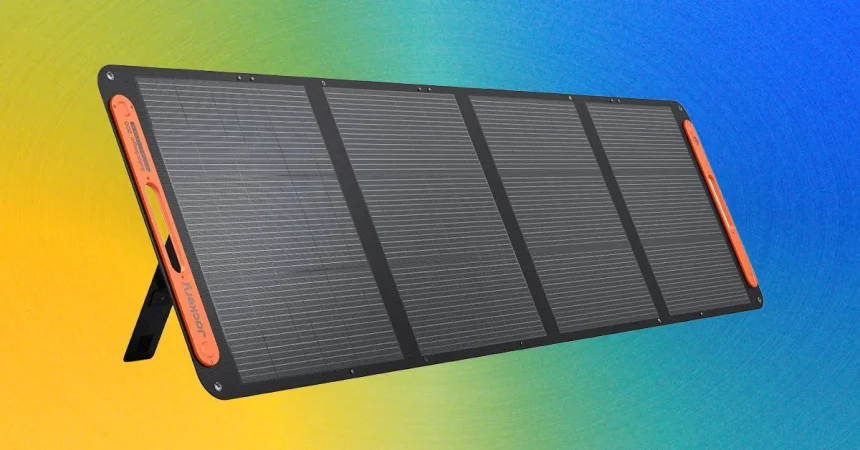
When it comes to portable solar power, the experience is rarely as simple as just “unfold and charge.” In my extensive testing, I’ve found that even the most well-regarded panels have distinct personalities that can make or break your setup experience. Take the 350-watt panels, for instance; they are generally user-friendly, though the metal fasteners on their kickstands can feel a bit fussy during assembly. On the other end of the spectrum, the 500-watt panels are significantly more finicky. Because they fold into twelve separate sections to maintain a compact footprint, wrestling them into a stable position feels like a workout. You also have to be vigilant about wind, as those larger surface areas act like sails; a sudden gust can easily tip them over if you aren’t careful. However, once you manage the setup, the trade-off is undeniable: they fold down into an incredibly slim, portable package that is truly unrivaled for the amount of power they provide.
For those looking to transition from portable kits to a permanent setup, flexible panels like the BougeRV Arch series are a game changer. These are specifically designed for the rooftops of RVs, vans, or even hardy tent setups. They are incredibly thin, weigh less than nine pounds, and offer an impressive 270-degree bend radius, making them ideal for curved surfaces. While they don’t fold up or come with a carrying handle, they are built to stay put, utilizing either adhesive, tape, or bolts. In my field tests, they boasted a 25 percent conversion efficiency, pulling in a solid 165 watts under peak sun. It’s a specialized tool, certainly, but if you’re looking to turn your vehicle into an off-grid hub, the IP68-rated durability of a mounted flexible panel is hard to beat.
I have also spent considerable time putting other popular brands through their paces, including the Anker Solix PS200. While these panels offer a familiar, rugged design with molded plastic handles and solid folding feet, they sometimes struggle to hit the performance highs of competitors like the Solar Saga 200, despite carrying a higher price tag and weight. That said, the inclusion of versatile MC4 and XT60 cables makes them very adaptable for mixed-brand ecosystems. I’ve also tested the DJI IBC Power 200W, which performs well but comes with a caveat: it requires a specific proprietary adapter module to play nicely with certain power stations. It’s a good reminder that in the world of solar, compatibility isn’t always plug-and-play, so always verify your hardware connections before heading out into the wild.
Looking ahead, the market is moving quickly, and I’m eager to get my hands on the latest offerings from companies like EcoFlow, whose updated 220-watt panels are showing great promise at a reasonable price point. I also have my sights set on brands like Renogy, Goal Zero, and Biolite, all of which maintain strong reputations among veteran outdoor enthusiasts. The landscape of solar tech is evolving—moving toward more efficient bifacial designs and lighter materials—so there is likely to be a surge of even more compact, high-output gear arriving on the scene soon. Keeping an eye on these developments is essential for anyone trying to build a sustainable, future-proof power setup for their travels.
When you’re shopping for your own setup, remember that the “rated wattage” on a box is a theoretical maximum, not a guarantee. Real-world conditions—angle of the sun, ambient temperature, and even light dust—will almost always pull that number down. A good rule of thumb is to expect 70 to 80 percent of the stated output. Portability is also a primary factor; decide early on if you want the “briefcase” style folding panels for easy storage or if you need the permanent, low-profile nature of flexible rooftop panels. If you do go with the portable route, prioritize panels with robust kickstands that can handle uneven ground, and always check the weight, as lugging around heavy panels can quickly become the most exhausting part of your trip.
Finally, never overlook the importance of technical compatibility and weatherproofing. When you are mixing and matching panels with different power stations, ensure your “Open Circuit Voltage” (OCV) remains within the generator’s safe range to avoid equipment failure or safety risks. Whenever possible, look for generators equipped with Maximum Power Point Tracking (MPPT), which is essentially a smart-chip that works to squeeze every drop of efficiency out of your panels as the weather shifts. Regarding the elements, aim for an IP67 or IP68 rating if you plan on leaving your gear out in the unpredictable wilderness. Solar power is meant to grant you freedom and peace of mind, and by understanding these basics, you can ensure that your setup remains a reliable companion rather than a constant source of frustration.