The Quest for the Perfect Car Charger
The modern automobile has evolved into a mobile command center, a place where we work, play, and connect. For families, it’s often a rolling media hub, where front-seat occupants are navigating and taking calls while the back seat resembles a miniature cinema, with tablets and phones streaming everything from movies to educational games. But this sanctuary of connectivity has a fatal flaw: battery life. Mired in the middle of nowhere, a dying device can turn a peaceful journey into a frantic scramble for a valid charger. As a guardian of my family’s digital sanity, I’ve spent a good amount of my review process testing the best ways to refuel our devices in the car. I’ve tested a register of chargers to find the best options for different needs, and I’ve discovered a few truths about what makes a good in-vehicle charging ecosystem. My journey has brought me to some interesting conclusions, a few compromises, and finally, to a champion that I confidently recommend above all others for most people.
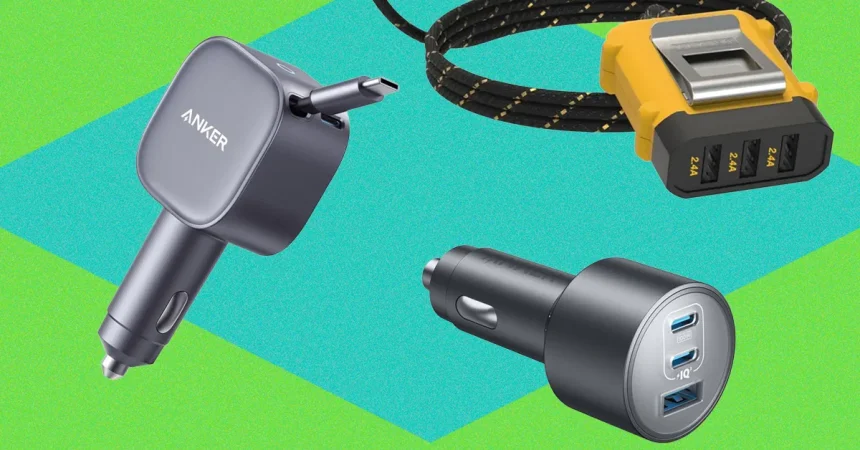
My journey into car charging begins with the Anker, a brand I’ve long trusted for its reliability and sensible design. The appeal of a retractable cable is tangible for anyone who’s fought with a spaghetti of cabling on their front seat. Yet, I often ponder the longevity of such a design. While the drawer is a engineering marvel, it inevitably introduces two failure points: the cable itself and the spring mechanism that governs its retraction. You can’t swap out a worn cable, and the mechanism could one day lose its tension, turning a tidy solution into a frustrating tangle. It’s a subtle trade-off for tidiness, and one that I accepted, knowing the price point for the charger usually hovers around a very reasonable $20, making it a low-stakes investment.
The Family-Focused Contender
For the modern family that’s on the road, there’s always a fleet of devices in the back seat, often at varying levels of charge. This is the exact scenario that led me to test the DeWalt charger, a 72-watt behemoth with ports designed for the front and the back seat. Let me be clear: I am a fan of this charger’s design. It’s not just a charger; it’ a power supply for the entire car. Up front, you get a port for your phone, but the real hero is the USB-C port that delivers a decent 30 watts of power — enough to quickly top up the latest smartphones. In the back, it has two 2.1-amp auxiliary ports, designed to keep tablets or other devices topped up. I know what you’re thinking — it’s a power tool brand, right? Well, yes, and its rugged aesthetic reflects that lineage, but it’s that very
durability that makes it a great choice for a busy car. The 30-watt USB-C front port is for the parents, and the auxiliary USB-A ports are perfect for the backseat tablets. This is the best compromise I’ve found between power, speed, and considering every device that might need a top-up.
The Nitty-Gritty of Testing
For this article, I wanted to understand not just what chargers look good on paper, but how they perform in the real world. I targeted the usual suspects: trusted charging brands like Anker, Belkin, and Scosche, and sought out models that other reviewers had crowned as their favorites. I also only considered UL-certified chargers. A random, non-certified car charger is a gamble not worth the risk; a short circuit through a wrong voltage can fry a phone’s battery, and in a worst-case scenario, might heat up enough to be a fire hazard. I’m not comfortable recommending that kind of chaos to you or your family.
My testing involved rigorous ammeter use to measure the actual current draw for every port, and I used it while at max load. I devised a test for charger heat, using an infrared thermometer to see if the charger would overheat under strain. I also conducted real-world road tests, taking long trips with my own devices plugged in, and even charging a jump starter and a laptop in heavy usage. I was testing not just speed but whether the charger could maintain a stable connection and a reliable current, even when jostled around in a cup holder. I also made it a point to read customer reviews specifically for failure patterns, trying to replicate any heat or failure complaints to see if they were common or just one-off anomalies.
The Anker Top Pick and the Scosche Runner-Up
After all the testing, I’ve landed on an Anker charger as my—editor’s choice. The 40W two-port model offers a strong balance between speed and convenience. Its dual USB-C ports are more than enough for fast charging of a phone and, at $20, it’s an accessible upgrade. Like the Anker, the Scosche PowerVolt 60W dual-port charger is also a top contender. It’s also no-nonsense, offering a pair of 30-watt USB-C ports, which is just about the universal target for the latest phones, including fast charging a laptop, and it retails for the same price. The two different chargers are both excellent for front-seat phone use, and I’ve picked the Anker as my number one because of its slightly improved layout in the car.
The Other Options and Trials
I also spent time with the other reliable options that might be better suited to certain specific needs. The Belkin BoostCharge 42W is a compact, budget-friendly device that works well, though if you’re plugging it in to a car that has deep socket flanges, it may not fit flush, and it has a bright little LED that’s not the best for night-time peace. The Nekteck 45W two-port is one of the best values around if you need to pair a USB-C fast charge with a high-speed QC 3.0 USB-A charger, a useful combo for older phones or in-car gadgets that rely on the older but still viable port.
But the DeWalt remains a specialist. While the idea of front-and-back charging is genius, and it fulfills that role perfectly, it’s not the top-speed coverage for in-car chargers. It’s a charging battery, offering that slower 2.4-amp to pages of your kids’ tablets, and being the workhorse we’re describing. The 30-watt USB-C port upfront is a good compromise, but the backseat ports are, in my opinion, the real sweet spot. They solved the exact problem that plagues the family car—the need to get power to the backseat without it being a tripwire or a cumbersome awkwardness. The DeWalt is the absolute best way I’ve found to address this need, and I recommend it wholeheartedly for the parent who’s just trying to get their kids to stop fighting over the last 15% of their tablet battery.
The Final Word
Ultimately, the best USB car charger for you will be a calculation of your specific needs—front-seat only, or a family solution. My advice, based on my tester-like approach, is to always prioritize UL-certified brands, and then to consider the power output and the port mix. The Anker 40W two-port is my go-to for simplicity, speed, and reliability, making it the standout for most drivers. For those with a backseat full of kids, the DeWalt in the back with two dedicated USB-A ports is exactly the weapon you need to keep the peace. It’s a bit of a compromise on get-up-and-go, but it’s the best idea I have for keeping the drive quiet. Most people, though, will find that the Anker charger, with its 40W output and tidy retractable cable, is the right balance of features to keep the batteries humming without a tangle. For every time, I’ve reassured myself: Going for a little extra power is the way to go to future-proof your vehicles. BATTERIES ARE THE LIFE OF A GOOD ROAD TRIP, and you want to make sure you’re not a dead in the water with a dead phone.