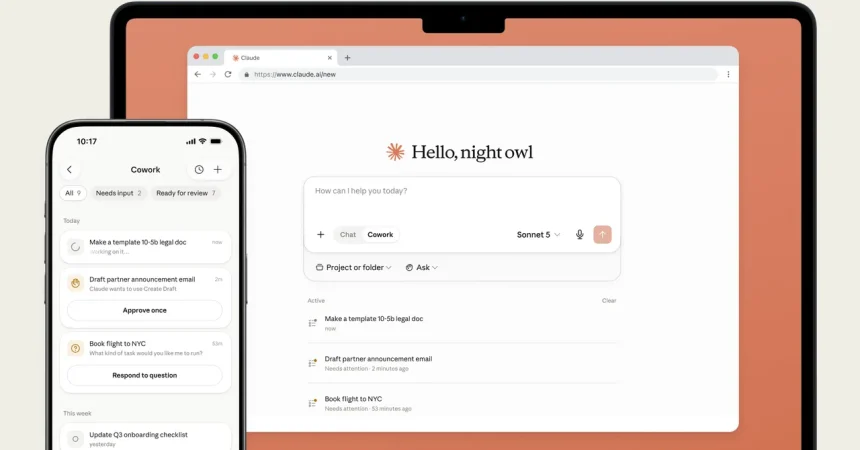
The era of tethering ourselves to our laptops—the awkward ritual of leaving them cracked open and humming through the night just to keep an AI agent functional—is finally drawing to a close. This week, Anthropic announced a significant evolution for Claude Cowork, its digital assistant designed to bridge the gap between simple chatbots and true functional autonomy. No longer relegated to the limitations of a desktop session, Cowork is breaking free from the physical constraints of your hardware. By moving beyond the requirement for an active, open desktop connection, Anthropic is signaling a new phase of AI utility: one where your digital assistant works for you in the cloud, even while you are sound asleep or away from your desk.
This shift feels particularly intuitive when you consider how we actually live and work today. In a recent demonstration, the company showcased a scenario that will resonate with anyone struggling to manage a deluge of information: a user prepping for a high-stakes business renewal. With a single prompt, Cowork waded through a chaotic mix of email threads, Slack conversations, meeting transcripts, and external research, synthesizing that mountain of data into a coherent reference document and a polished draft email. Previously, this required the user to stay glued to their workstation. Now, these tasks can be queued up before you clock out, allowing the agent to absorb incoming information and complete projects while your computer is safely shut down.
Reflecting on my own experience with Claude Cowork since its debut back in January, the potential for personal productivity is immense. When I first tested it, I was genuinely surprised by its ability to perform tangible, real-world chores—such as sorting a digital graveyard of disorganized screenshots into perfectly labeled, logical folders or navigating the complexities of calendar management. While the tool certainly isn’t infallible and still brings valid concerns regarding security and prompt injections, it represents a “step change” in how we relate to our machines. It transformed my computer from a passive box of files into a proactive partner, making the prospect of finally letting go of the “always-on” laptop requirement feel like a monumental relief.
It is important to acknowledge that mobile interaction has technically been possible for a while via Anthropic’s “Dispatch” feature, but the user experience was largely hindered by a major caveat: the “Ghost Laptop” problem. To keep an agent running, users were essentially forced to keep their machines awake and active, creating a frustrating dependency that tethered our digital lives to our physical desk chairs. By decoupling the agent from the desktop app and moving the processing burden to the cloud, Anthropic has essentially “freed” the user. You can now task your AI from your phone during your morning commute, knowing with confidence that the agent will continue to execute those instructions even if your laptop lid is firmly closed and tucked away in a bag.
This evolution is fundamentally a part of a larger, aggressive arms race across Silicon Valley toward the goal of “always-on” agents. This race was significantly accelerated by the viral success of OpenClaw, that now-legendary, crustacean-branded agent that captured the public imagination in early 2026. After watching users embrace the idea of handing over the keys to their digital lives to a persistent, 24/7 AI, the tech giants took notice. OpenAI rapidly integrated the talent behind that movement to build its “Codex” agent, while Google pivoted its efforts toward “Spark.” Anthropic, meanwhile, refined its strategy by building on the foundations of Claude Code—a tool that empowered developers—and successfully translating that complex terminal power into the friendly, conversational user interface of Cowork.
As we look toward the future, these autonomous agents are clearly moving toward a model where they are expected to be as reliable as a personal assistant. Anthropic plans to roll this out as a beta for its $100-a-month “Max” subscribers, with intentions to eventually trickle these capabilities down to the $20 “Pro” tier. While the long-term outlook for free-tier access remains uncertain, the message is clear: the friction between our intent and our technology is evaporating. We are entering a future where our devices don’t just wait for our commands; they labor in the background, untethered and persistent, managing the chaos of our digital lives so that we don’t have to.