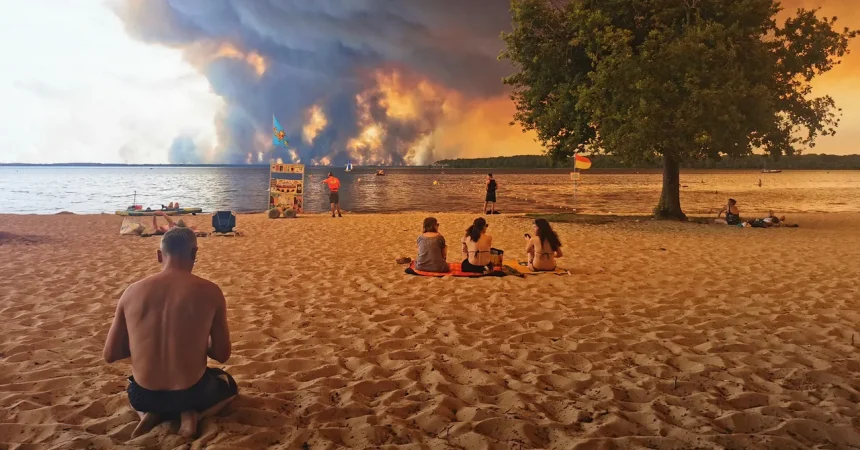
The recent wildfire crisis sweeping across France and Spain represents a terrifying evolution in our climate reality. Firefighters, usually the vanguard against encroaching flames, are now facing phenomena that defy traditional tactics—what experts describe as an “operational impossibility.” These are no longer just forest fires that can be contained by trenches or water drops; they have transformed into raw, atmospheric forces that operate beyond human control. For the first time in history, French authorities have documented the appearance of “fire clouds,” or pyrocumulonimbus formations, signaling that the intensity of these blazes has reached a threshold where the fire itself is actively dictating the local weather.
To understand the severity of this shift, one must look toward the skies. These fire-generated clouds are born from a violent synergy between rising heat and atmospheric instability. When the immense energy of a massive wildfire meets cooler, moist air layers high above the ground, the heated smoke serves as a foundation for water vapor to condense into droplets and, eventually, ice crystals. This process creates a towering, self-sustaining column of convective energy. It is a haunting sight—a man-made storm system where the “fuel” happens to be the remains of the very ecosystem it is currently consuming.
The danger presented by these clouds is profoundly paradoxical. While they mimic the appearance and structure of the rain-bearing clouds we rely on to nourish the earth, these fire clouds offer no relief. Instead, they act as active adversaries to the crews on the ground. They are capable of generating their own lightning, which sparks new, distant ignitions, essentially jumping the fire over containment lines. Even more terrifying, these clouds can produce powerful downdrafts that act like giant bellows, fanning the flames with intense, erratic winds, or, in extreme cases, spawning fire-tornadoes that turn manageable blazes into unstoppable infernos.
For France, this nightmare is uncharted territory. While the nation has battled wildfires for generations, the ferocity of this current season stands in stark defiance of historical norms. Data from the European Forest Fire Information System reveals a grim reality: the past week was the most destructive in two decades, with the scale of the damage more than doubling previous records. With over 220,000 acres reduced to ash—six times the annual average—it is clear that the climate’s “new normal” has far outpaced our infrastructure and our defensive capabilities. This is not merely a seasonal anomaly; it is a systemic shift in the character of our natural world.
We are watching the global footprint of climate change manifest in real-time, underscored by the relentless burning of fossil fuels that continues to push global temperatures into dangerous, unprecedented territory. Research consistently shows that the frequency of extreme wildfire events has doubled over the last twenty years, with the majority of the most catastrophic seasons occurring within the last decade. Australia, Canada, and the United States have long wrestled with this “fire weather,” but its arrival in the heart of Western Europe is a stark warning that no region is shielded from the consequences of a rapidly warming planet.
As we look toward the immediate future, the situation remains precarious. With temperatures poised to climb back above 104 degrees Fahrenheit, the exhausted crews on the ground face a grueling reality. They are not just fighting the heat; they are fighting an atmosphere that has become hostile. Every gust of wind carries the risk of a new fire cloud, and every degree of temperature rise brings us closer to a tipping point where the land becomes too volatile to defend. The fire clouds are not just a meteorological curiosity; they are a clear, urgent message from the environment that the era of manageable fire is ending, and the era of unpredictable, climate-driven chaos has begun.