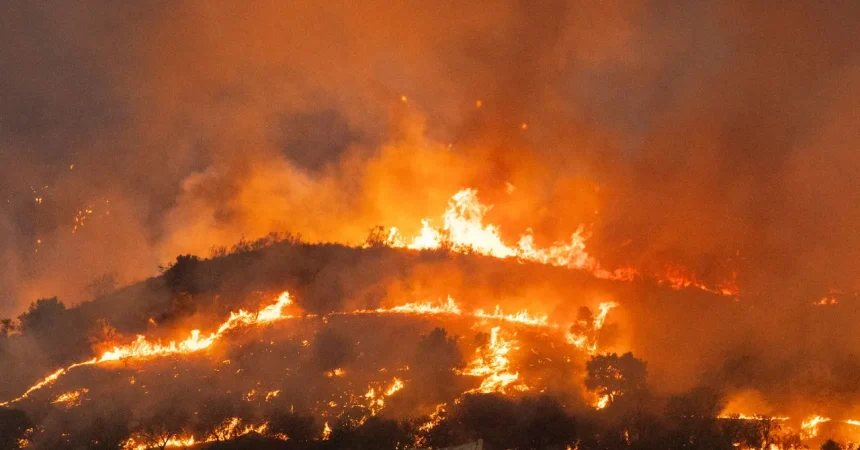
The landscape of the Iberian Peninsula is currently undergoing a harrowing transformation, as Spain finds itself grappling with a national state of emergency centered in Madrid and the province of Ávila. What we are witnessing is not merely a seasonal challenge, but one of the most destructive wildfire chapters in modern history. Prime Minister Pedro Sánchez has described the situation as “dramatic,” noting that the reach of these infernos extends far beyond Spanish borders, impacting neighboring nations and forcing hundreds of thousands of terrified residents to flee their homes. With Spain’s burn area already doubling its annual average and France experiencing a season six times more intense than historical norms, the sheer scale of the devastation—covering over 741,000 acres—serves as a grim reminder of a world shifting beneath our feet.
This catastrophe is undeniably linked to the broader, global climate crisis. We are living through an era of extreme heat and prolonged droughts, which have turned forests and brushlands into tinderboxes, perfectly primed for combustion. When the weather becomes this volatile, even the smallest spark can evolve into a “megafire”—a massive, uncontrollable beast that defies traditional containment efforts and can even generate its own localized weather systems. As these fires become faster, hotter, and more frequent, the traditional manual approach to firefighting is being pushed to its breaking point. It is a sobering reality that pushes us to look beyond conventional hoses and axes, urging a move toward a new generation of technological defense.
In response to this existential threat, Spain has become a global laboratory for wildfire innovation. The most immediate solution to the physical heat is a product called Ecofire, a biodegradable, organic liquid that fundamentally alters how we fight flames. Unlike plain water, which often evaporates before it can starve a fire of its oxygen, Ecofire is up to 40 times more effective and works nearly ten times faster. Perhaps most impressively, it serves as a protective shield; when sprayed on vegetation preventively, it creates an insulating layer that keeps the plant life from reaching the ignition point even in extreme conditions. It turns the landscape itself into a resistant barrier, buying precious time for the crews on the ground.
However, the real key to survival in this new climate is speed—catching a fire before it has the room to breathe. This is where advanced monitoring systems like Predifire come into play. A collaborative effort between academia and private industry, this early-warning system uses a web of sensors and autonomous drones integrated with artificial intelligence to pinpoint fire outbreaks while they are still in their infancy. By identifying a fire when it is only a few acres wide, responders can deploy resources with surgical precision, preventing the fire from blooming into a runaway disaster. This is supplemented by the SenForFire project, which uses dense, low-cost wireless sensor networks to monitor combustion gases and microscopic changes in air quality, acting as an “early-warning radar” for the forest floor.
Beyond detection, the logistical challenge of managing a raging fire is a game of probability and resource management. Spanish researchers, supported by the Ministry of Science and Innovation, have developed a Wildfire Assessment Model that utilizes neural networks to predict the “path of least resistance” for a blaze. By analyzing satellite imagery and atmospheric data, this AI doesn’t just see the fire; it calculates its future, estimating its spread speed and the exact amount of personnel and aircraft needed to stifle it. This move toward data-driven emergency management ensures that limited firefighting resources are never spread too thin, allowing for a strategic response that prioritizes the most vulnerable communities at the exact right moment.
Ultimately, while the technology is groundbreaking, the most important component remains the safety and awareness of the people on the front lines. The Spanish government and various tech platforms have worked to bridge the gap between complex data and public safety. From the government’s Civil Protection app, which provides real-time emergency maps, to the integration of wildfire perimeters into Google Maps and independent platforms like Incendios España, citizens are being equipped with the information they need to make life-saving decisions. As we navigate this new, hotter reality, it is the combination of human resolve, protective chemistry, intelligent detection, and accessible data that offers our best hope for preserving our forests and protecting our homes from the encroaching flames.