The final frontier of human achievement has long been synonymous with distant stars and cold exploration, but today, it is becoming something much closer to home: the key to our biological longevity. A British startup, Mass Balance, has just launched a daring mission that represents a paradigm shift in how we approach disease. By sending an autonomous, grapefruit-sized laboratory into orbit, the company isn’t just looking for extraterrestrial life—it is searching for insights into our own. The objective is to study “disordered proteins,” the enigmatic, elusive culprits behind devastating age-related conditions like Alzheimer’s, Parkinson’s, and various cancers. These proteins are notoriously flighty and difficult to study here on Earth, but in the silence and stillness of space, scientists hope they might finally hold still long enough for us to learn how to stop them.
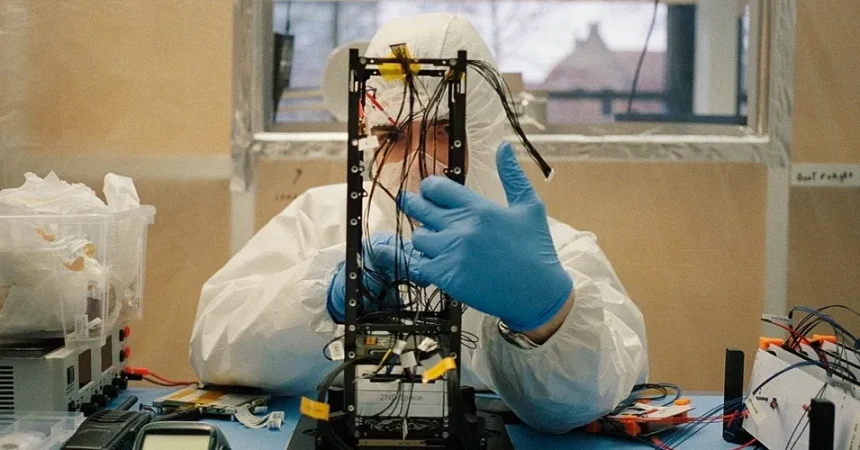
The technology behind this mission feels like something plucked from the pages of science fiction, yet it is grounded in the grit of modern engineering. Housed within a compact 10-centimeter pod crafted by the Austrian company Tumbleweed, the apparatus is a marvel of miniaturization. It contains a complex orchestration of chemicals, sensors, and control elements, all designed to function perfectly without a single human hand to guide it. Launched aboard a SpaceX transporter, the pod is currently orbiting the Earth, acting as a remote research facility. For the next few months, it will dutifully beam back data on how live cells behave in a microgravity environment. It marks the first baby step in a larger vision: making orbital research as mundane, reliable, and accessible as a standard laboratory experiment on the ground.
Why go to such lengths? The answer lies in the messy reality of Earth’s gravity. Even the most controlled laboratory experiments on the surface are subject to the constant, invisible interference of gravitational forces. Things like convection—where heat causes currents to flow—and sedimentation—where heavier substances naturally sink—create “noise” that can muddy the precision required to study complex proteins. By removing gravity from the equation, Mass Balance is looking to strip away these distractions. When the environment is stabilized, the “weird and wonderful” behaviors of biological systems emerge, offering a pristine glimpse into processes that have remained hidden from us simply because we were looking through the foggy lens of gravity.
The ultimate application for this research is as ambitious as it is human-centric. Modern life science artificial intelligence models, such as Google’s AlphaFold, are revolutionary, yet they currently struggle with disordered proteins because these molecules change shape so rapidly that they create “blind spots” in our data. These missing pieces make it nearly impossible to predict how these proteins will react to potential medicines. Mass Balance aims to use its microgravity data to bridge this gap, training AI models to finally “see” the proteins in their various states. The goal is to turn space into a routine resource, eventually building a business model around data licensing and precision diagnostics that could unlock the next generation of life-saving therapeutics.
What sets Mass Balance apart from its contemporaries in the budding “space biotech” industry is its structural modesty. While competitors like BioOrbit and Varda Space Industries are focusing on growing crystals for medicine or manufacturing pharmaceuticals that must be safely returned to Earth—a massive engineering undertaking involving heat shields and atmospheric reentry—Mass Balance is taking a different route. By opting not to recover the hardware, they are bypassing the most expensive and risky hurdles of space flight. The company is currently focused solely on demonstrating that their operating system can collect high-quality, actionable data autonomously while in orbit. It is a leaner, more agile approach that views space as a laboratory environment rather than a manufacturing plant.
Ultimately, this mission represents a shift in how we define human ingenuity. Toby Call, the CEO of Mass Balance, believes that microgravity is an under-exploited tool waiting to be harnessed for the benefit of human health. As we face an aging global population, the pressure to solve the mysteries of neurodegenerative diseases has never been higher. By leveraging the vacuum of space, we are effectively using the universe as a diagnostic tool. While the idea of a tiny, autonomous lab circling the planet to study proteins might sound wild today, the ambition is to make it boring, routine, and, above all, effective. In the intersection of space exploration and medical science, we are finding that the cure for our collective decline might just be found by looking up.